

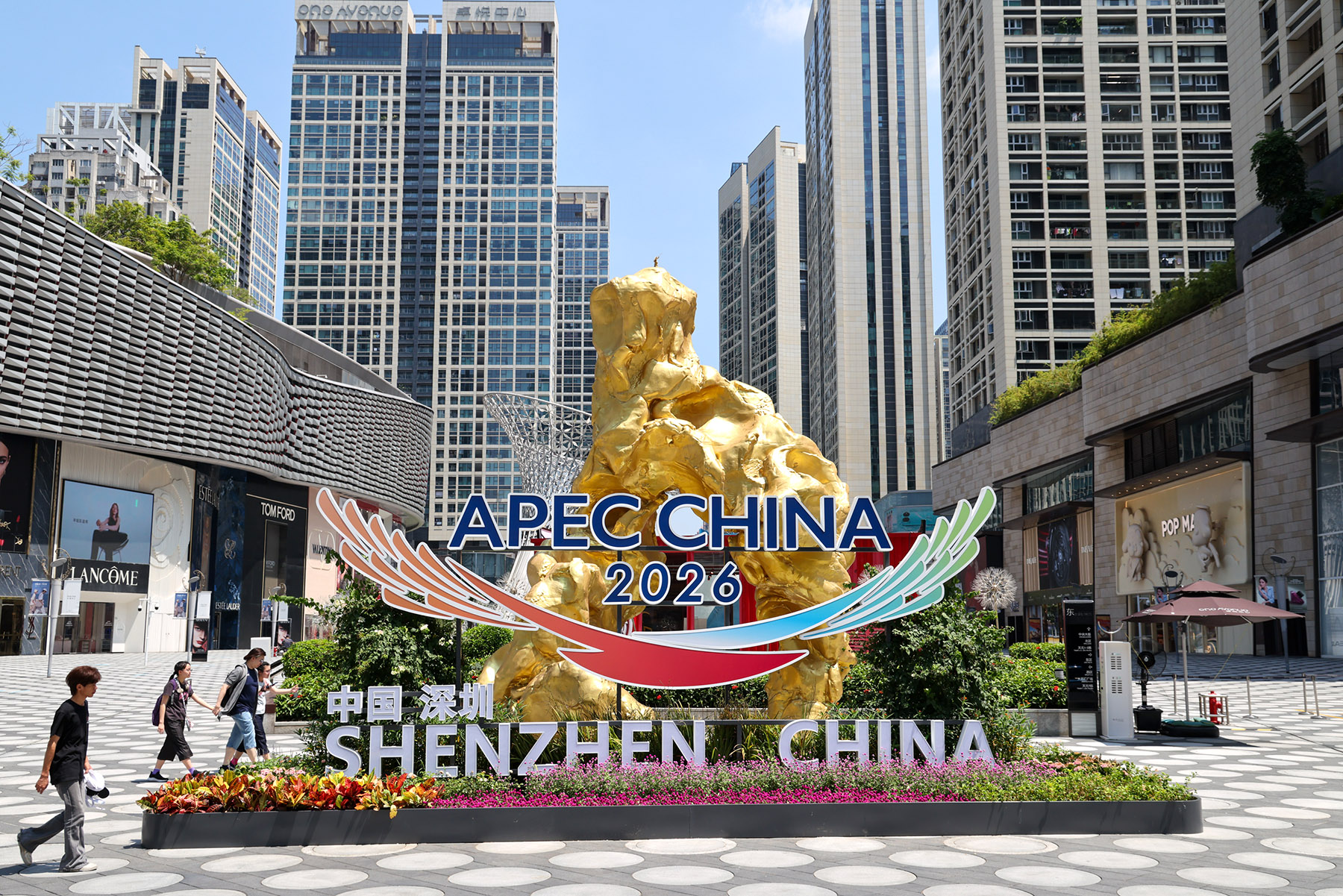
The upcoming 33rd APEC Economic Leaders' Meeting in Shenzhen, South China's Guangdong province, in November will be an opportunity to promote free trade amid rising protectionism and fragmentation, experts say.
"Despite global headwinds, the Asia-Pacific remains the world's most dynamic economic engine. With its overlapping patchwork of mega-regional trade agreements, the region is posturing a very productive and functional posture," said Mohamed Iqbal, deputy chairman of Malaysian think tank KSI Strategic Institute for Asia Pacific and former chairman of the UNESCAP Business Advisory Council.
While the world is in disorder due to natural disasters, geopolitical tensions and structural fragmentation, Iqbal said the upcoming meeting brings a ray of hope for resetting global geo-economic affairs, with China stretching out its arms for economic cooperation and integration for the betterment of the region and beyond.
READ MORE: Guangdong streamlines exit-entry procedures for visitors
The Nov 18-19 annual meeting of the Asia-Pacific Economic Cooperation will mark China's third time as host following Shanghai in 2001 and Beijing in 2014. This year's theme is "Building an Asia-Pacific Community to Prosper Together".
As major economies increasingly deploy protectionist measures, Iqbal said trade policy is no longer just about market access but has become an instrument of national security.
"As the host of APEC 2026, China is in a rare advantageous position as the champion of open multilateralism and the regional economic core," he said, adding that the meeting faces great expectations.
Iqbal added that a daunting task remains, as APEC's long-term vision hinges on binding existing free trade frameworks into the overarching Free Trade Area of the Asia-Pacific (FTAAP), which has been under discussion since 2006.
Siah Hwee Ang, professor in strategy and international business and professorial chair in business in Asia at Victoria University of Wellington in New Zealand, said major free trade agreements such as the Regional Comprehensive Economic Partnership (RCEP) and the Comprehensive and Progressive Agreement for Trans-Pacific Partnership (CPTPP) are key.
"To enhance cooperation across the Asia-Pacific region, the promotion of both RCEP and CPTPP will help to kickstart a wider conversation," Ang said.
Noting that most members of the RCEP and CPTPP are APEC economies, Ang said the unique benefits of these blocs could attract APEC economies that are not in both.
This could potentially pave the way toward the FTAAP, said Ang, who is also a visiting NTUC professor of international economic relations at the S. Rajaratnam School of International Studies at Nanyang Technological University in Singapore.
The APEC region is also seeing a trade expansion fueled by the surge in digital trade, artificial intelligence-driven demand for hardware and software, precautionary stockpiling against supply chain disruptions, and deeper business integration, said Ang.
Merchandise exports and imports of the APEC region rose 18.8 percent and 10.2 percent by value in the first quarter from a year earlier, respectively, compared with growth of 5.1 percent and 7.9 percent in the same period of 2025, according to data released by the APEC Policy Support Unit on Aug 27.
Export and import volumes also increased 10.8 percent and 11.1 percent, respectively, as demand for technology products drove trade across the region.
"Most economies are just not ready to go alone without the support of a wider economic community," said Ang, adding that there are activities providing resilience to economic cooperation among APEC members.
He also said a recent cooperation formed by Shenzhen's Yantian Port and other Asia-Pacific ports will enhance trade efficiency.
In July, Shenzhen's Yantian Port, one of the world's largest container terminals, signed a memorandum of understanding on sister port cooperation with 16 ports from 10 APEC member economies.
The 10 member economies are Australia, Hong Kong, Indonesia, Malaysia, Mexico, Peru, South Korea, Thailand, the United States and Vietnam.
Noting that Peru's Chancay Port — a deep-water mega-port inaugurated in November 2024 as a flagship of the Belt and Road Initiative — serves as a trade hub between Latin America and China, Oscar Vidarte Arevalo, director and professor of international relations at the Department of Social Sciences, Pontifical Catholic University of Peru, said the new cooperation can create more business opportunities and build a more direct connection with southern China.
"Despite the ideological differences between countries … there is a certain consensus in Latin America on the importance of continuing to build an order that promotes trade," said Vidarte, noting that such connectivity will also be important for developing Chancay Port, which is expected to begin phase-two construction next year.
With APEC trade accounting for about half of global trade, Vidarte said the upcoming APEC meeting in Shenzhen is important for the future of regional and global trade.
"APEC must work to ensure that the foundation of the liberal order, which took us many decades to build, survives," said Vidarte.
ALSO READ: Shenzhen deepens links with APEC economies
Chamaiporn Chuecharoen, president of the Asian-International Trade and Investment Association, said the gathering in Shenzhen must move beyond political discussion and create "a marketplace for growth" with tangible outcomes.
"Members must take a proactive role to deliver tangible growth for entrepreneurs and make 'shared prosperity' a reality through concrete actions," she said.
Chamaiporn noted that these actions include building seamless supply chains, ensuring small and medium-sized enterprises benefit from free trade, and promoting the green and creative economy.
She said she believes APEC's free trade efforts demonstrate to the world that openness is better than closure and that trade barriers can be reduced.
"When all countries benefit, trade becomes sustainable," she added. "APEC is like a group of friends working together to make doing business easier, faster, and fairer."
Contact the writers at kelly@chinadailyapac.com
