

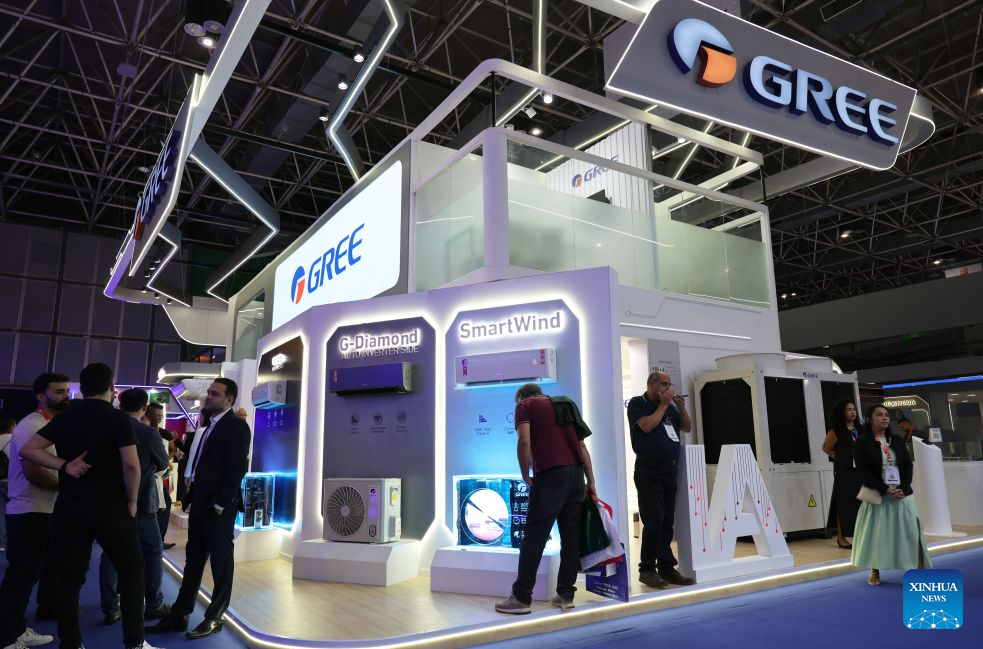
As manufacturing bellwether Gree opens its own technical school to cultivate skilled talent, industry insiders say the new model moves beyond traditional school-enterprise partnerships, but wide-range implementation faces challenges in sustainability and vocational-education governance.
In early October, Zhuhai Gree Technical School — founded by Gree Electric Appliances, a major Chinese home appliance manufacturer in Zhuhai, Guangdong province, and led by renowned businesswoman Dong Mingzhu — welcomed its first group of students — over 300 junior high school graduates.
This rare move in industry attracted more than 8,000 applicants, including some top-scoring students. With annual tuition between 9,000 yuan ($1,345) to 15,000 yuan, this three-year program offers nine majors such as electromechanical engineering, smart manufacturing, and the internet of things. Graduates can enjoy priority for employment at Gree and companies in its industrial chain.
As a manufacturing powerhouse, Guangdong province has 141 technical and vocational schools with nearly 690,000 students enrolled. Its total skilled workforce stands at 22.01 million, including 8.27 million highly skilled workers, both figures ranked first in the country.
However, there are still relatively few private enterprises that operate their own schools. Most of them team up with universities or vocational schools to jointly establish industry-academic colleges or training centers, or they set up specialized classes to train talent based on enterprises’ needs.
Gong Xiaofeng, director of Shenzhen University’s Institute of Emerging Industry Development in the Greater Bay Area, said that Gree’s initiative encourages companies to move beyond talent recruitment and on-the-job training to become more actively involved in the entire talent development process.
According to reports, hands-on training accounts for more than 70 percent of the school's curriculum. It aims to tackle pain points of traditional collaboration between schools and enterprises, such as the mismatch of educational content with industry needs; insufficient depth in professional skill development; and a lack of training in real-world environments, Gong said.
With strong industrial platforms, practical training conditions, and employment resources, the school is expected to boost parents’ confidence in their children’s employment prospects, help students clarify their career paths earlier, and thereby attract more young people to the advanced manufacturing sector, he added.
Meanwhile, he also cautioned that in the long run, corporate-run schools require sustained investment over many years, and should maintain educational quality even when facing industry fluctuations.
It’s also essential for them to respect students’ pursuits of seeking further education, changing careers, or choosing other employers. Since some students are younger than 16 when they enroll, their training must strictly adhere to established guidelines for safety protection, the expert said.
Xu Pingli, a researcher of Shenzhen Technology University’s Research Center for Vocational Education in New-era China, believes the high level of public attention this new school has received stems primarily from its contrast with the stereotypes of traditional vocational education, and resonance with current society’s employment anxiety.
He said that some leading companies with a steady demand for talent are also capable of establishing schools, but they may lack strong motivation to do so, given such schools’ responsibility in public education, significant demand for investment, and the high mobility of young talent.
Xu added that the mainstream approach to skilled workforce cultivation still centers on schools. To optimize the existing school-enterprise collaboration model, he called on vocational schools to adhere to people-centered educational principle, rather than simply producing workers tailored to corporate needs.
He also expressed hope that schools strengthen their cooperation with small, medium, and micro enterprises, as these businesses have broader and more diverse talent needs.
Chen Chongjia, a senior at Shenzhen Technology University, expressed confidence in the competitiveness of Gree technical school’s graduates, given the household brand’s reputation and influence.
He said he hopes that in addition to vocational training, schools like this will also offer general-education courses such as physics and advanced mathematics, which helps him a lot in skills competitions. He added that this theoretical knowledge will enhance students’ overall capability and may help them break through the limits of career development.
Chen said that many teenagers have not yet fully developed a sound set of values and worldviews, expressing concern that students of such schools may be exposed to unhealthy corporate cultures. He hopes that more attention will be paid to students’ physical and mental well-being and to their holistic education.
