

Drones, humanoid robots, brain-computer interfaces being added to expanded tours
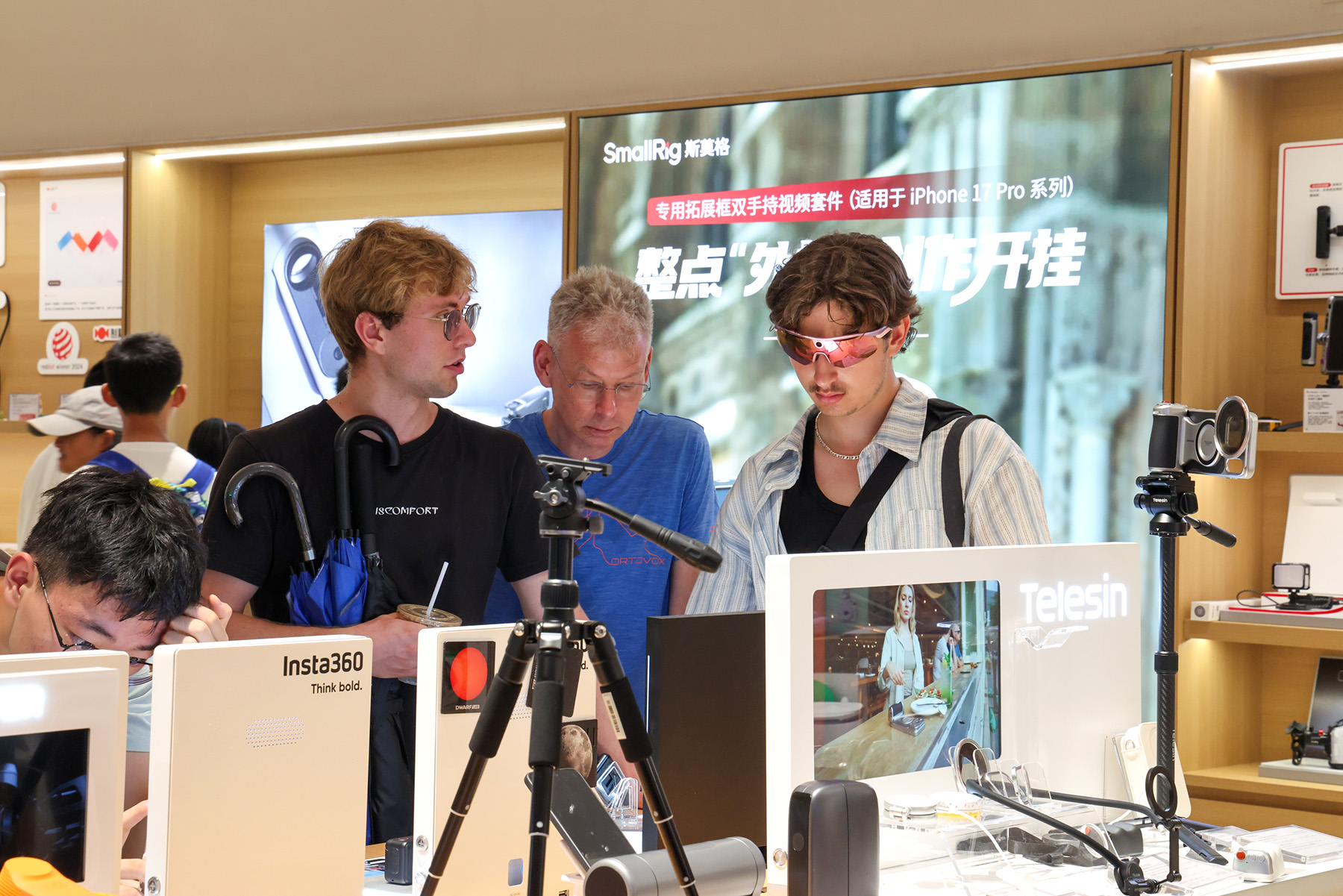
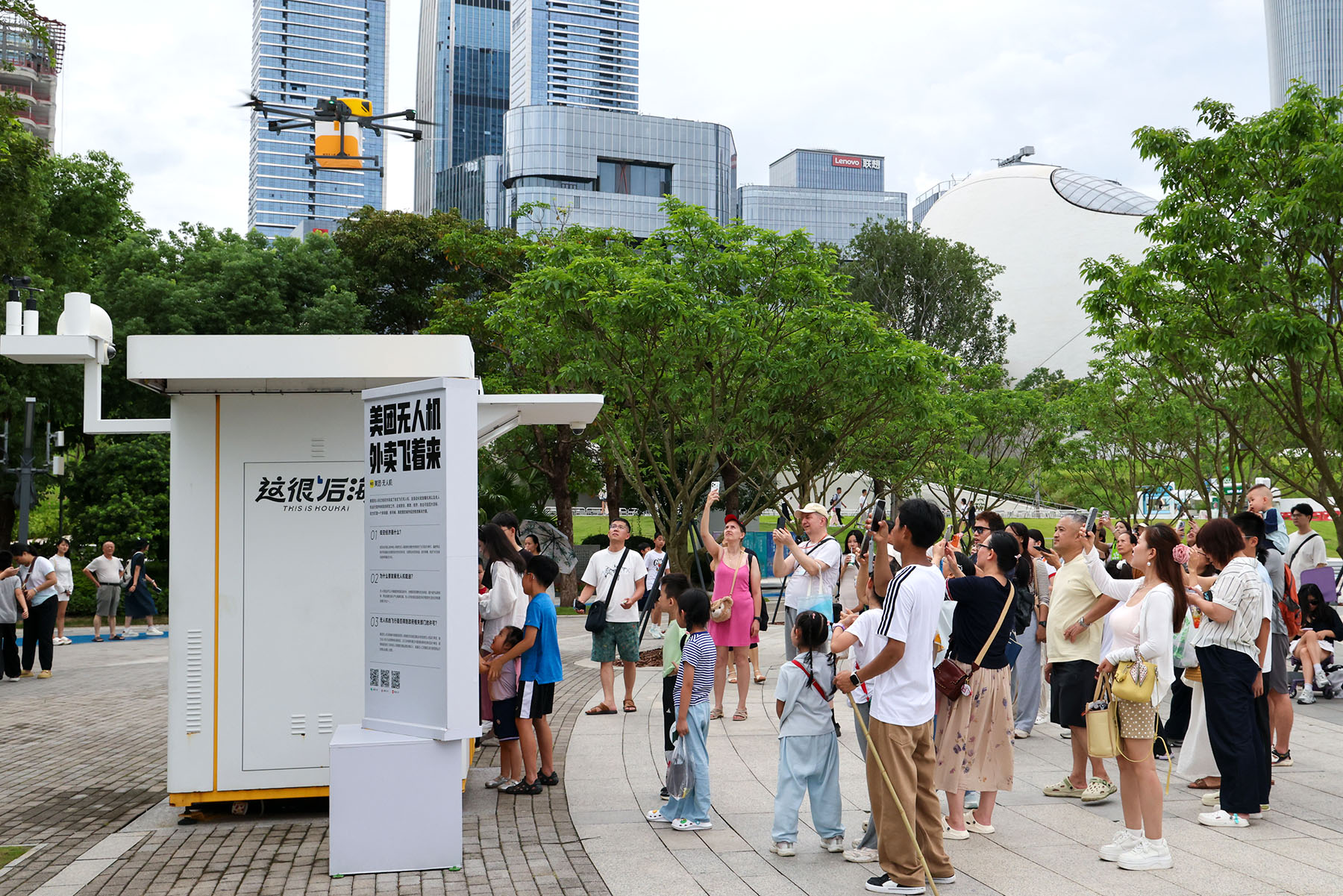
A meal order delivered by drone, dinner at a robot-themed restaurant and a ride in a driverless car formed part of the itinerary for US travel influencers Kara and Nate during a journey from Shanghai to Beijing.
Their 33-minute YouTube video titled "China is Living in 2050" also featured robotic dogs and a shopping center filled with high-tech consumer products. It had racked up about 1.3 million views as of Aug 5, bringing experiences once associated with science fiction to the couple's 4.5 million subscribers.
The video is part of a growing trend on social media, turning China's everyday technology into a major tourist attraction. Robotaxis, drone deliveries, humanoid robots and smart retail are now appearing alongside historical landmarks and natural scenic spots on foreign visitors' itineraries.
READ MORE: 'Shopping in China' creating opportunities for multinational firms
Travel operators say technology-focused trips, once aimed largely at overseas professionals and corporate delegations, are increasingly attracting more independent travelers, families and students. The shift is helping technology emerge as a calling card for Chinese tourism, built less around a single museum or theme park and more around experiencing how digital services and automation integrated into daily life.
In Hangzhou's Yuhang district, Zhejiang province, itineraries for overseas visitors link the Liangzhu archaeological site, where digital tools help interpret ancient Chinese civilization, with an artificial intelligence town, robotics facilities and Alibaba's digital industrial park.
Visitors can interact with humanoid robots, test brain-computer interfaces, experiment with AI-generated content and see how digital platforms are used in transport, shopping and urban management.
One of the companies included in Hangzhou's newly launched technology study-tour routes is BrainCo, a developer of non-invasive brain-computer interface technology. Its demonstrations include an intelligent bionic hand that uses neural and muscle signals to interpret intended movements, along with wearable products designed for attention training, relaxation and sleep support, giving visitors a tangible look at how the technology is being developed for rehabilitation and consumer use.
"Overseas interest has risen markedly since June last year," said Gu Weiping, director of the Study Tour Department of Hangzhou Shunjing Technology Cultural Tourism Development Co Ltd. "More independent travelers, families and overseas students began making reservations specifically for AI, robotics and smart-city experiences."
The number of overseas customers joining the company's technology-themed program increased by more than 120 percent year-on-year, Gu said.
The expansion of the visa-free policy has made it easier for overseas visitors to turn online curiosity into real-world trips. China has expanded unilateral visa-free access to citizens of 50 countries, while nationals of 55 countries are eligible for its visa-free transit policy at 65 ports.
Foreign nationals made a record 22.9 million entries into China in the first half, up 20.4 percent year-on-year, said the National Immigration Administration. Visa-free entries rose 30.6 percent to 17.8 million, accounting for 77.7 percent of the total.
Wu Liyun, a professor at the China Academy of Culture and Tourism at Beijing International Studies University, said technology tourism is a global trend rather than a uniquely Chinese phenomenon.
China's advantage, she said, lies in the scale at which technology has moved beyond laboratories and exhibition halls to become seamlessly integrated into daily life.
Foreign visitors can ride robotaxis, order goods delivered by drones, encounter service robots and use mobile phones for payments, transport and admission to attractions. The appeal comes less from any single invention than from seeing multiple technologies operating across the same city.
"China has a large number of technology companies, but the more distinctive feature is how AI and smart technologies have been applied to daily life and tourism," Wu said. "That allows visitors to experience directly how technology changes ordinary life."
Technology is also effectively removing some of the practical barriers that have long affected inbound travel, Wu added.
"Real-time translation, smart translation glasses, interactive screens, digital admission and mobile guides make it easier for foreign visitors to navigate attractions independently."
For Daniel Chan, a Chinese-American technology enthusiast living in Los Angeles, China's wide deployment of technology has made Shenzhen in Guangdong province the city he most wants to explore.
Chan said he was particularly interested in its automation and civilian-drone ecosystem, including companies that have developed around drone maker DJI. Hangzhou offers a different combination, pairing technology companies such as Alibaba with historic sites, scenery and food.
"Hangzhou has technological vitality, but it also retains deep cultural roots," Chan said. "You can experience both innovation and everyday life."
Wu said the trend was broadening the geography of China's inbound tourism. International itineraries were once concentrated in traditional destinations such as Beijing, Shanghai, Guilin in the Guangxi Zhuang autonomous region and Xi'an in Shaanxi province, but more foreign visitors are extending their journeys to other emerging tech hubs.
"Technology could bring more second and third-tier cities into the itineraries of overseas visitors," she added.
The rise of technology tourism is also creating an emerging commercial loop. More than 60 percent of the overseas groups handled by Gu's company ask to add technology-product demonstrations or shopping to their itineraries, he said.
Popular items include AI translation devices, small robots, drone equipment and consumer brain-computer products such as sleep-assistance devices.
Young visitors typically spend 200 yuan ($29.64) to 500 yuan a day on technology experiences and products, while family study tours spend about 500 yuan to 1,000 yuan per person, Gu said.
Hangzhou is now seeking to build shopping directly into its technology-tourism offering. On July 30, the city's culture and tourism authorities unveiled 10 locally developed "new technology specialties", 20 technology-tourism attractions and 20 themed study-tour routes. They also launched a platform for inbound technology study tours and a dedicated section on Alibaba's Taobao marketplace.
The products include an AI-powered walking exoskeleton, Rokid smart glasses, augmented-reality swimming goggles, an AI recording card and a DNA data-storage "time capsule". Visitors can try and buy them in Hangzhou's Wensan Digital Life Block or order them online.
The initiative seeks to give technology the role once occupied mainly by conventional souvenirs: visitors see how a product works, try it and take home a piece of the city's innovation ecosystem.
The connection between product discovery and spending is even more established in Huaqiangbei, a renowned electronics hub in Shenzhen.
The district receives more than 8,000 foreign visitors and business travelers daily and boasted 197 registered departure tax-refund stores by mid-year, said the Futian district government.
Local merchants said smartphones, drones, smart glasses and AI wearables accounted for nearly 80 percent of purchases for which overseas customers sought tax refunds, though the estimate does not cover all foreign-visitor spending in the district.
A service center opened in June combining departure tax refunds, foreign-currency exchange and payment support. It also distributes local restaurant and service vouchers, encouraging customers to spend their refunds within the district and extending the commercial loop beyond the initial purchase.
ALSO READ: Hainan Free Trade Port a global launchpad
China reduced the minimum same-day purchase at a single store eligible for a departure tax refund to 200 yuan from 500 yuan last year and expanded its "refund-upon-purchase" service nationwide. More recently, procedures were further streamlined with paperless processing and expanded random inspection protocols.
The number of overseas travelers using the departure tax-refund system increased 366 percent year-on-year in the first half of 2026, while both sales of eligible goods and the amount refunded rose 69 percent year-on-year, the State Taxation Administration said.
Despite the rapid growth, the market remains at an early stage. Many technology venues are still difficult for independent overseas visitors to discover, while booking channels, multilingual explanations and information about payments and refunds are yet to be fully standardized.
"Inbound visitors are no longer coming only to experience traditional culture," Wu said. "They also want to experience ordinary life, the convenience brought by economic development and China's technology at close range. Technology is fast becoming a new tourism draw for China."
Contact the writers at lijing2009@chinadaily.com.cn
