

Hong Kong’s economic growth in the first half of this year was better than expected, partly driven by strong global demand for advanced electronics and artificial intelligence-related products, with local exports recording high double-digit growth for several consecutive quarters, Financial Secretary Paul Chan Mo-po said on Sunday.
Writing in his weekly blog, Chan said the nation’s rapid advances in AI have provided a significant boost to the special administrative region’s economy and financial markets. From December last year to May this year, the initial public offerings of AI-related companies in Hong Kong raised nearly HK$100 billion ($12.8 billion), accounting for about 55 percent of total IPO funds raised during the period.
To help the local workforce adapt to rapid technological change, the HKSAR government has allocated HK$50 million in the 2026-27 Budget to launch an “AI for All” training program, providing diverse AI training for working professionals, students, and members of the public through Cyberport, Hong Kong Science and Technology Parks and the Hong Kong Productivity Council.
ALSO READ: HK maps enhanced digital transformation program for AI shift
The goal is to organize more than 200 events in two years that are expected to benefit about 50,000 people, Chan said. The Employees Retraining Board will also collaborate with major technology companies in launching AI courses for employed individuals in November.
Chan cited a report by a multinational tech company showing that nearly 70 percent of surveyed Hong Kong residents are proficient in using AI, including comparing different tools, with about 20 percent identified as “super users” capable of using AI agents to automate daily tasks.
The report estimated that if AI adoption among Hong Kong’s small and medium-sized enterprises could catch up with large corporations by 2035, it could unlock up to HK$65 billion in economic benefits for the city.
Chan said the HKSAR government is streamlining AI-driven operations. The AI Efficacy Enhancement Team has facilitated an initial batch of 30 efficacy enhancement projects across 13 departments, covering areas such as license processing, facility bookings, environmental hygiene, and complaint management.
The Transport Department will launch its “e-licensing portal” by the end of the year, utilizing AI for automatic document recognition to shorten the processing time for online vehicle license renewals from up to 10 working days to just one. In the first quarter of next year, AI will also be trialed for real-time traffic signal adjustments to reduce pedestrian waiting times.
READ MORE: Chan urges HK youth to embrace AI while pursuing future paths
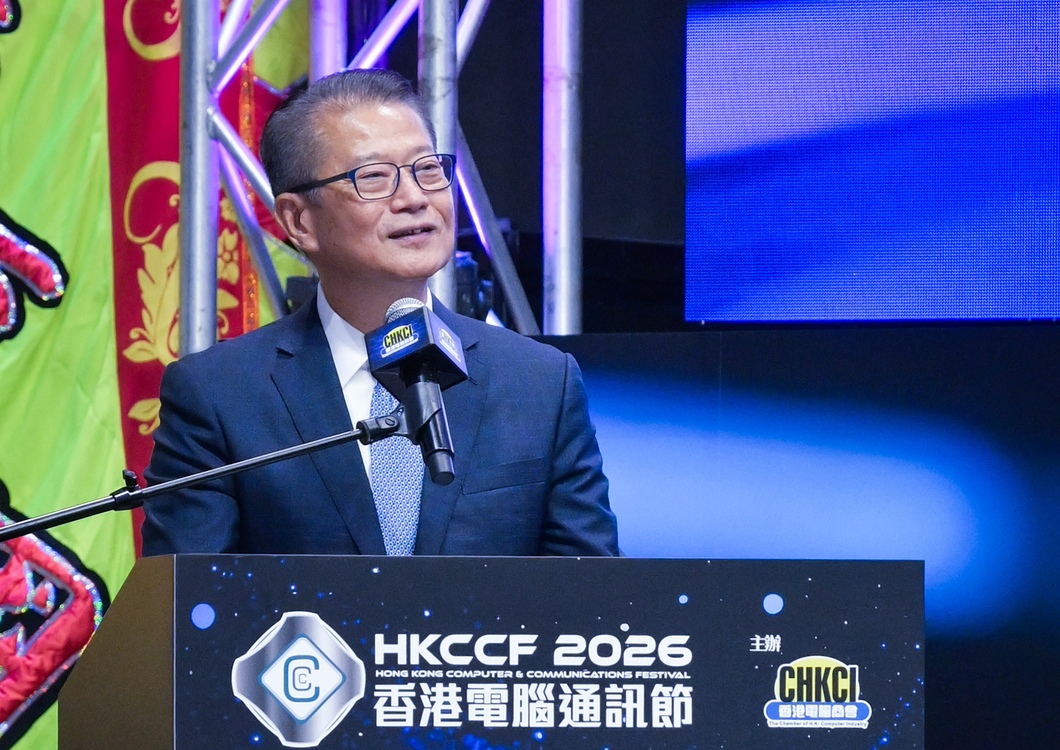
Chan attended the Hong Kong Computer & Communications Festival 2026 at the Hong Kong Convention and Exhibition Centre this week.
He said frontier technologies and applications have continued to evolve and pose challenges to the job market. Hong Kong must step up its response, such as enabling young people to acquire new skills early and providing them with opportunities to apply these skills in the workplace.
He also noted that Hong Kong has a vast number of SMEs whose agility, resilience and innovative spirit have been tested and proven through past technological shifts and economic cycles.
“During the current technology paradigm shift, we’ll fully support them in making preparations and adapting, ensuring their sustained forward development,” Chan said.
Contact the writer at akirawang@chinadailyhk.com
