

Award recognizes veteran's years of industrial firsts
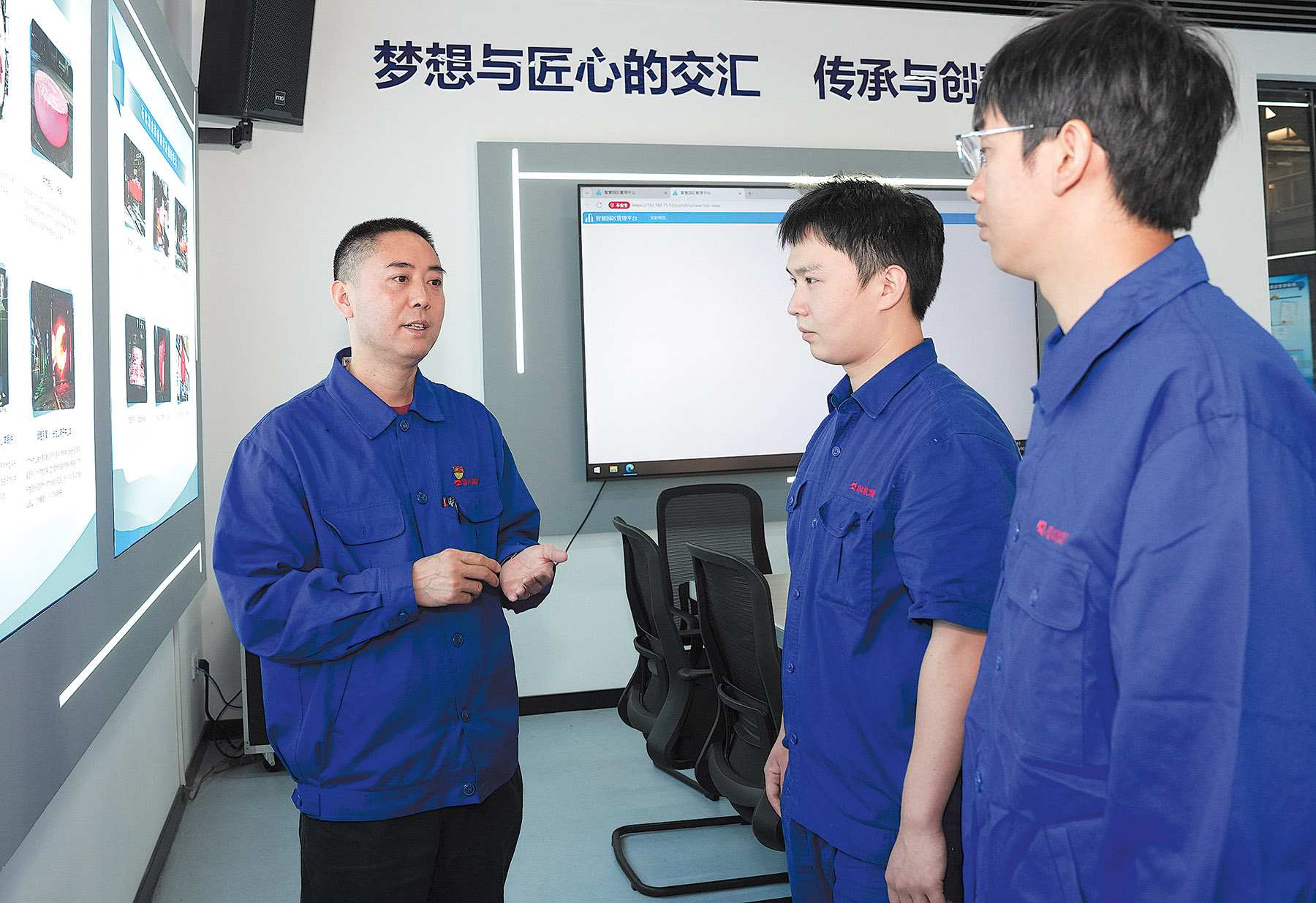
Liu Mingqiang, a veteran forging master who helped break foreign monopolies on critical nuclear and energy components, has been officially recognized for his decades of industrial contributions.
The Sichuan Provincial Committee of the Communist Party of China and the provincial government honored the 53-year-old senior technician with the prestigious Sichuan model worker award in May last year.
The accolade highlights Liu's 33-year trajectory at Erzhong (Deyang) Heavy Equipment Co, a heavy machinery manufacturing giant based in Deyang, Sichuan province. His career mirrors China's broader transformation from an industrial underdog to a self-reliant powerhouse in high-end manufacturing.
When Liu first stepped onto the factory floor as a fresh graduate in 1993, the environment felt surreal."I felt like I had stepped onto a movie set-the giant overhead cranes moving across the cavernous hall like spaceships in a sci-fi film," Liu recalled.
"Forging, in simple terms, is placing red-hot metal under a hydraulic press and squeezing it repeatedly — like kneading dough — until it achieves a denser internal structure and superior mechanical properties," Liu said.
Forgings, or forged components, are indispensable for critical applications including nuclear, hydropower and thermal power units, as well as heavy-duty gas turbines and large marine vessels.
Liu began as an assistant to forging masters — workers whose skills ranked among the most technically demanding at the time.
After watching the forging masters work for half a year, he came to think their job wasn't really that hard. One day, he walked up to a master with youthful confidence and said: "Take a break, master. Let me give it a shot."
He soon regretted his arrogance.
"When to feed the metal, when to flip it and how much pressure to apply — every single decision mattered," Liu said. He ended up creating something utterly misshapen.
The humbling experience ignited a relentless pursuit of mastery.
By age 25, Liu was already leading a forging team on a 3,150-metric-ton press. A little over a year later, he was assigned to lead a team on the 12,000-ton press. There, he faced the biggest challenge of his career.
"I thought I was ready," Liu said. "I had forged all kinds of complex shapes on the 3,150-ton press, while forgings produced on the 12,000-ton press looked relatively simple — but once I started, I realized it was far from easy."
For months, his team's output ranked at the very bottom.
"The 12,000-ton one is a completely different beast," Liu said."From the equipment and setup to the heating temperature and timing — everything is different."
Refusing to accept defeat, he sought advice from veteran masters and spent his breaks watching how other teams operated. From the sixth month on, his team's output and quality were consistently among the top.
Decades in the forging industry have given Liu a front-row seat to China's transformation in the field.
"The whole country had just three 10,000-ton-class presses when I started," he said. "Our plant's output was very small. It wasn't until 1995 that we finally broke the 10,000-ton mark, and the whole plant celebrated with drums and gongs."
The plant now has a 16,000-ton press. Annual capacity has surged to over 80,000 tons, with 80 percent being core components for high-end energy equipment.
What fills Liu with pride are the multiple firsts he and his team have achieved in advanced nuclear, thermal power and hydropower, as well as heavy-duty gas turbines — areas long dominated by foreign technology.
One of their toughest challenges was forging the main pipe for China's third-generation nuclear reactors, a component described as the aorta of a nuclear power plant. It carries superheated, high-pressure coolant from the reactor core to generate steam for electricity.
"The foreign supplier demanded 40 million euros ($46.2 million) for a single main pipe, with no room for negotiation," Liu said. "Delivery schedules were also entirely at their mercy, which seriously held up the progress of our country's new-generation nuclear projects."
The main pipe was intricately shaped and made of a material that was extremely difficult to forge. The forging process, which took hundreds of hours, was divided into over 10 heats and each heat had to meet the technical specifications exactly.
A heat refers to one cycle of heating the metal and forging it under the press.
"Once you start, you have to keep going. A pause would ruin everything," Liu said.
In March 2012, Liu's team delivered the pipe at a price of merely 30 percent of the foreign quotation.
Liu has also led his team to master critical nuclear turbine shafts weighing up to 650 tons, the centerpiece for the world's first 500-megawatt impulse turbine, and rotors for ultra-supercritical coal-fired units.
Liu has set his sights on boosting efficiency and capacity. He raised the 16,000-ton press's daily average heats from 8 to 12, a record for similar equipment.
"An extra half-heat per day means more than 40 additional products a year," he said.
"Face difficulties head-on. Otherwise, nothing gets done," Liu said.
Contact the writers at pengchao@chinadaily.com.cn
