

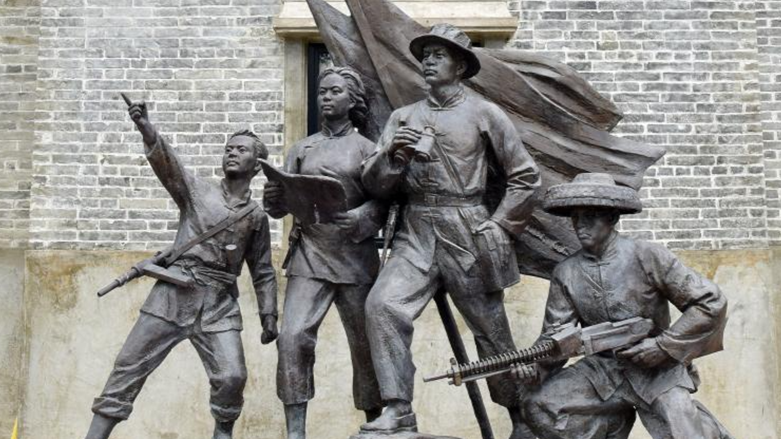
Following four years of devoted hard work, Lin Ming, son of a war veteran, has bulked up a one-hour public talk on Hong Kong’s heroic struggle during the War of Resistance Against Japanese Aggression (1931-45) to a 15-topic, 10-hour-plus series.
In the expanded history lecture series, Lin has added reams of factual information about the Hong Kong Independent Battalion of the Dongjiang Column, a guerrilla force that his father served in.
“It takes strong commitment and will to tell the brigade’s wartime history faithfully and accurately,” said Lin.
The Hong Kong Independent Battalion, a guerrilla force led by the Communist Party of China (CPC), fought alongside the wider formation to liberate Hong Kong from Japanese occupation.
Days before July 1 — the 105th anniversary of the CPC’s founding and the 29th anniversary of Hong Kong’s return to the motherland — Lin, vice president of the Society of the Veterans of the Original Hong Kong Independent Battalion of the Dongjiang Column, told China Daily that his aim is to grant more people a holistic view of the city’s wartime history and courage of soldiers.
One highlight of Lin’s talks is the “Chinese Cultural Celebrities Rescue”, an iconic wartime feat of the Dongjiang Column.
The rescue was a covert evacuation organized and carried out by CPC operatives and armed squads — the forerunners of the Hong Kong Independent Battalion — in the early days of Japan’s occupation.
The 11-month operation began in December 1941, just as Japanese forces seized control of Hong Kong. Over 800 people — cultural figures, patriot leaders, Allied service personnel, including painter He Xiangning, later a vice chairwoman of the Standing Committee of the National People’s Congress, and novelist Mao Dun — were moved from Hong Kong to guerrilla sanctuaries on the Chinese mainland.
With help from resistance fighters and ordinary people, they were spirited away from Hong Kong to guerrilla sanctuaries on the Chinese mainland.
Lin argues that this rescue proved decisive in persuading patriotic intellectuals, cultural figures and lots of ordinary families in Hong Kong of the CPC’s genuine commitment to national salvation. “Many subsequently rallied to the Party’s call for a national united front against Japanese aggression,” Lin said.
The rescue also spared the country from a potential postwar cultural development gap, Lin said.
He added that the Party’s role in Hong Kong’s wartime history was substantial — having arrived in the immediate aftermath of the city’s surrender, orchestrated the rescue, and later spearheaded a sustained local guerrilla resistance.
‘Active resistance’
A key reason for his tireless efforts to revive this history, Lin said, is to make more Hong Kong people learn about that the city’s three years and eight months of Japanese occupation was not simply “a time of suffering” — a view many still hold, he noted — but a period of “active resistance”, forged by ordinary Hong Kong people who chose to fight back.
The Hong Kong Independent Battalion was formed on Feb 3, 1942. “Its members were predominantly Hong Kong people who had been born in the city. It was our own armed resistance,” Lin said.
Lin’s father stands as a compelling illustration of how the Party’s wartime deeds won over the support of Hong Kong people.
In April 1942, the CPC set up a radio station in Hong Kong to provide a vital communication channel between its Guangdong provincial organization department and its wartime command center in Yan’an, Shaanxi province, far to the north on the mainland.
The radio station was set up in Shek Shui Kan, a secluded village deep in the Sha Tau Kok woodlands of the New Territories and home to just a single household: Lin Ming’s father, Lin Chuan, then 16; Lin Ming’s grand-uncle, Lin Wu; Lin Ming’s eldest uncle, Lin Sheng; and their families.
The radio stayed hidden at their house for 11 months. Initially, brigade fighters had to trudge over five kilometers through the hills. But Lin Sheng and Lin Wu, who had seen the CPC-led guerrillas “fight foreign invaders and treat locals with decency”, offered to ferry the messengers by boat, shortening the journey to two kilometers. They later joined the brigade and worked as messengers.
Lin said his father told him it was through this experience that he came to understand that “when the enemy from abroad attacks at the gates, the nation’s cause and interest comes first”
Lin Chuan died 10 years ago, aged 90. In his twilight years, he started working on his memoirs, which sparked conversations that drew Lin Ming deeper into the wartime narrative.
Youngsters’ attention key
It was also about 10 years ago that Lin Ming accepted an offer to work for the veterans’ association, where he has since focused on preserving wartime memories and historical education.
A decade on, Lin Ming said his work has undergone a sea change — from fragmented knowledge to systematic study, and from simple retellings of individual accounts of survivors to a deeper appreciation of the war and its broader implications that are still relevant today.
Through his efforts, Lin Ming said, he hoped to remind people of the grim realities of war — so that vigilance is not lost in times of peace — and to cultivate among the public a greater sense of national duty and a more nuanced understanding of history and a far-sighted worldview.
Now in his 70s, Lin Ming said he will keep telling the brigade’s story as long as he is able. Still, he’s also keenly aware of time passing, and increasingly looks to any of the younger generation who might be interested in continuing the work.
To keep younger audiences engaged, Lin Ming has tried various methods, packing his talks with vivid details and historical parallels. And he is now mulling over recording his talk series in both long-form and short clips, for social media.
He once encountered a cameraman in his 30s who had been sent to shoot his talk. Afterward, Lin asked: “You’re a young man, what did you make of my presentation?”
“He paused, then said, ‘It held my attention, to say the least’.”
Lin has long treasured that feedback. To him, being able to “hold their attention” could be the very first sign that the next generation is open to his message.
Roys Zhang contributed to the story.
