

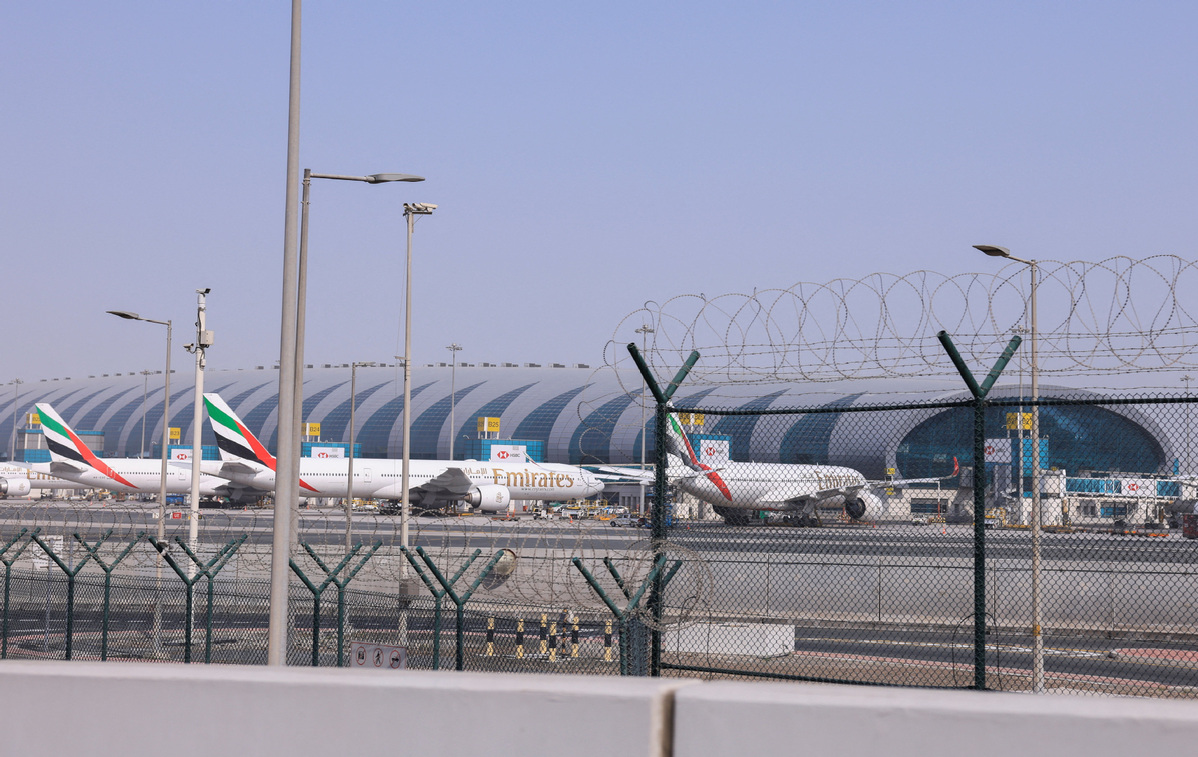
Airlines and travel agencies in China have moved swiftly to assist passengers and contain the disruption after multiple Middle Eastern countries closed their airspace amid escalating regional tensions.
The closures triggered sudden cancellations on China-bound routes and forced large-scale rerouting of international flights, leaving many travelers seeking urgent alternatives.
Aviation data provider VariFlight reported that nearly 14,000 Middle East-related flights worldwide had been canceled by the morning of Monday, representing an overall cancellation rate of 17.4 percent for the first week of the month.
READ MORE: US-Israeli strikes cause global travel disruptions
China-linked routes took a heavier hit.
Of 808 scheduled flights between the Chinese mainland and the Middle East, more than a quarter were canceled, disrupting the plans of thousands of passengers.
VariFlight noted that Dubai remained the most affected hub, with routes like Guangzhou-Dubai and Beijing-Dubai seeing the most disruption. The pattern indicates airlines are taking a cautious, wait-and-see approach to capacity deployment in the coming days.
To ease passenger anxiety, Chinese carriers rolled out flexible ticket waiver policies. Major domestic airlines including Air China, China Eastern Airlines and China Southern Airlines announced that passengers booked on flights involving major hubs like Dubai, Abu Dhabi and Riyadh could change their itineraries free of charge or receive full refunds for unused segments. Other Chinese carriers, including Hainan Airlines and Xiamen Airlines, swiftly followed suit with similar relief measures.
Foreign carriers also scrambled to assist affected travelers. Emirates halted all flights to and from Dubai due to airspace restrictions, offering rebooking or refunds, while Qatar Airways temporarily suspended all Doha flights. To support stranded travelers, Qatar deployed additional ground staff members at Hamad International Airport. Etihad Airways paused departures from Abu Dhabi until the morning of Monday.
Rerouting has also added significant strain to global operations and prolonged passenger journeys. VariFlight said that many Europe-Asia flights were forced to detour.
Data from VariFlight show average flying distances increased by about 1,200 kilometers — roughly equivalent to a trip from Beijing to Shanghai — significantly raising fuel burn, carbon emissions and travel times for those on board.
Back in China, online travel platforms and tour operators activated emergency support centers to assist outbound Chinese travelers.
Qunar launched a guarantee mechanism for hotel bookings in 14 Middle Eastern countries, pledging to share cancellation losses with merchants so customers would not bear the full financial brunt. Trip.com Group and Tongcheng Travel formed dedicated support teams to proactively process refunds and coordinate with domestic and foreign airlines.
ALSO READ: China air travel recovers with '25 seeing record flights
Utour, a major Beijing-based travel agency, also activated a 24-hour emergency response mechanism. Li Mengran, the company's marketing manager, confirmed that all its clients currently in the Middle East are safe.
"We have launched a 24/7 special task force to closely monitor local developments and prioritize the safety of our travelers," Li said. "For group tours scheduled to depart, we will do everything we can to assist with itinerary changes and absorb customer losses where possible."
Industry analysts warned that the Middle East's role as a major transit hub means the disruption extends far beyond local traffic, affecting passengers traveling between Asia, Europe and Africa. If the conflict persists, higher jet fuel costs and longer flights could add another layer of pressure on airlines already grappling with operational uncertainty.
Contact the writers at lijing2009@chinadaily.com.cn
