

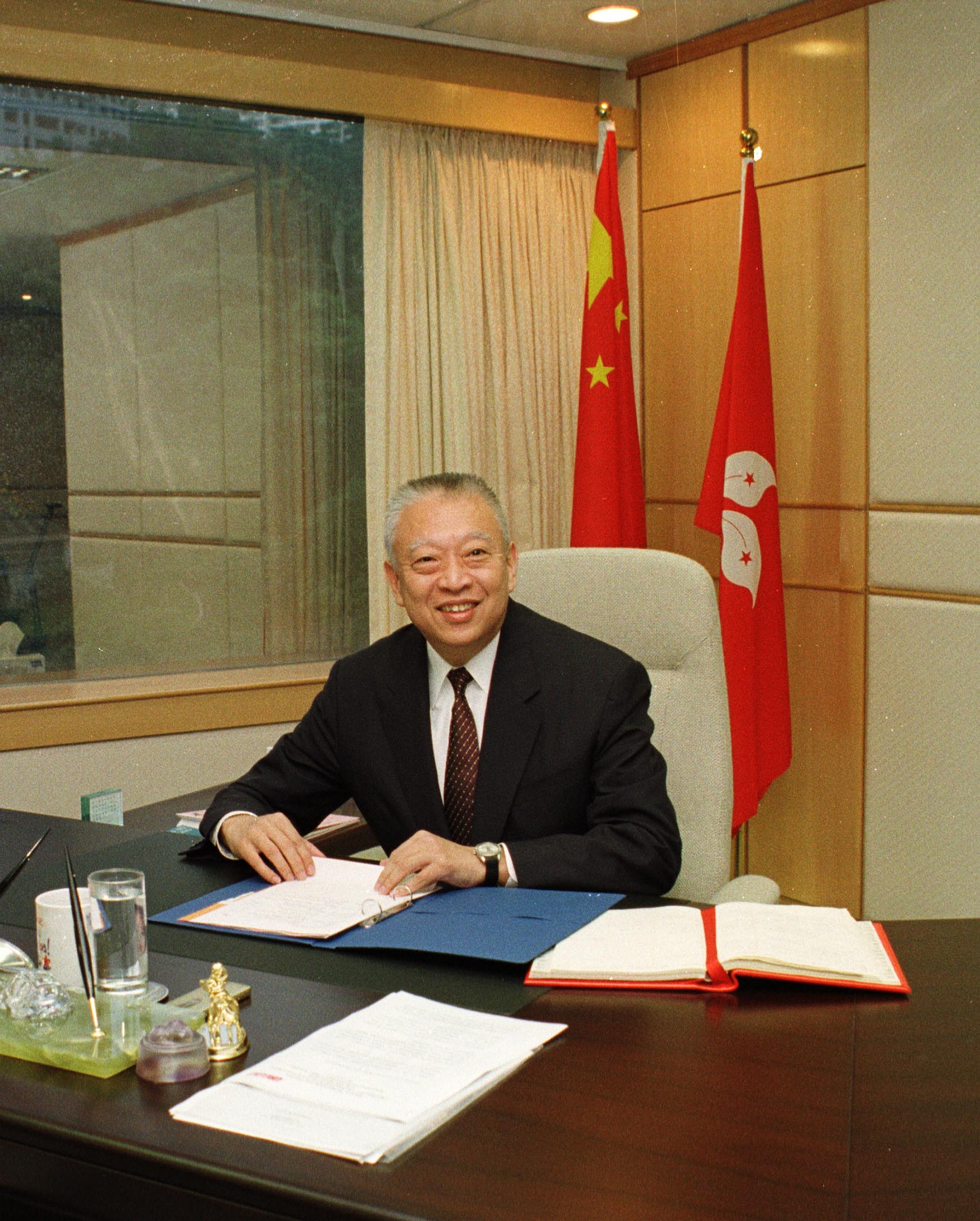
Tung Chee-hwa, the Hong Kong Special Administrative Region’s first chief executive, passed away on Tuesday at the age of 89.
In a statement in the early hours on Wednesday, his office said Tung passed away at Hong Kong Sanatorium and Hospital, in the presence of his family members.
Serving as chief executive from July 1997 to March 2005, he steered Hong Kong through its formative years that followed the city’s return to the motherland.
Tung managed a tenure that ensured the city’s smooth return to the motherland and was instrumental in ensuring a successful implementation of the “one country, two systems” principle and the Basic Law of Hong Kong SAR, which allows “Hong Kong people governing Hong Kong” with a high degree of autonomy, with the central government’s full trust and support.
RELATED ARTICLES
- Lee: Tung dedicated his life to serving the nation, HKSAR
- Tributes pour in as HK mourns passing of Tung Chee-hwa
- LegCo: Tung Chee-hwa led smooth establishment of HKSAR
- Ex-colleagues lavish praise on Tung's 'diligence, perseverance’
- Tung Chee-hwa honored for advancing US-China cultural ties
In 2019, he received a national honorary medal and title, which recognized his pivotal work on Hong Kong’s return to the motherland and contribution to the implementation of “one country, two systems.”
He also served as vice-chairman of the National Committee of the Chinese People’s Political Consultative Conference (CPPCC), the country’s top political advisory body. He was awarded the Grand Bauhinia Medal by the Hong Kong SAR government in 2006.
Born in Shanghai in 1937, Tung spent his childhood in Hong Kong before furthering his education at the University of Liverpool, the United Kingdom. He returned to Hong Kong in 1969 to take care of his family’s shipping business after years of working in the United States.
Before his 1997 swearing-in as HKSAR chief executive, Tung had already established himself in the city’s corporate scene while building a reputation by serving in various public sector and advisory roles.
His stewardship was tested during the Asian financial crisis in the late 1990s. Tung steadied the SAR through the turbulence, notably in a bold 10-trading-day market intervention that saw his administration deploying HK$118 billion ($15 billion) in foreign exchange reserves to buy into the local stock market.
Tung was also remembered for his efforts to enhance the SAR’s bonds with the Chinese mainland. In 2003, as the city was recovering from the social, economic and psychological stress brought by the SARS (severe acute respiratory syndrome) outbreak, he delivered a Policy Address that drew a clear focus on economic recovery through deeper ties with the mainland.
He also helped fast-track the Mainland and Hong Kong Closer Economic Partnership Arrangement (CEPA), a free-trade pact signed in June 2003 that has since granted Hong Kong businesses privileged access to the mainland market.
Also in 2003, to revive the SARS‑hit tourism and economy, Tung’s government secured the landmark Individual Visit Scheme from the central government. It allowed residents of selected mainland cities to travel to Hong Kong on individual leisure endorsements, whereas previously most mainland leisure visitors could only come on group tours or business permits. In normal years, the scheme has brought tens of millions of mainland visitors to Hong Kong annually.
Tung left office in 2005 citing poor health, yet remained actively engaged in public life afterwards.
He channeled his energy through two non‑profit organizations he founded – China‑United States Exchange Foundation (CUSEF) and Our Hong Kong Foundation – in 2008 and 2014, respectively. While CUSEF promotes bilateral exchanges between China and the United States, Our Hong Kong Foundation is today a prominent local think tank generating public‑policy proposals for Hong Kong.
Contact the writer at wanqing@chinadailyhk.com
