

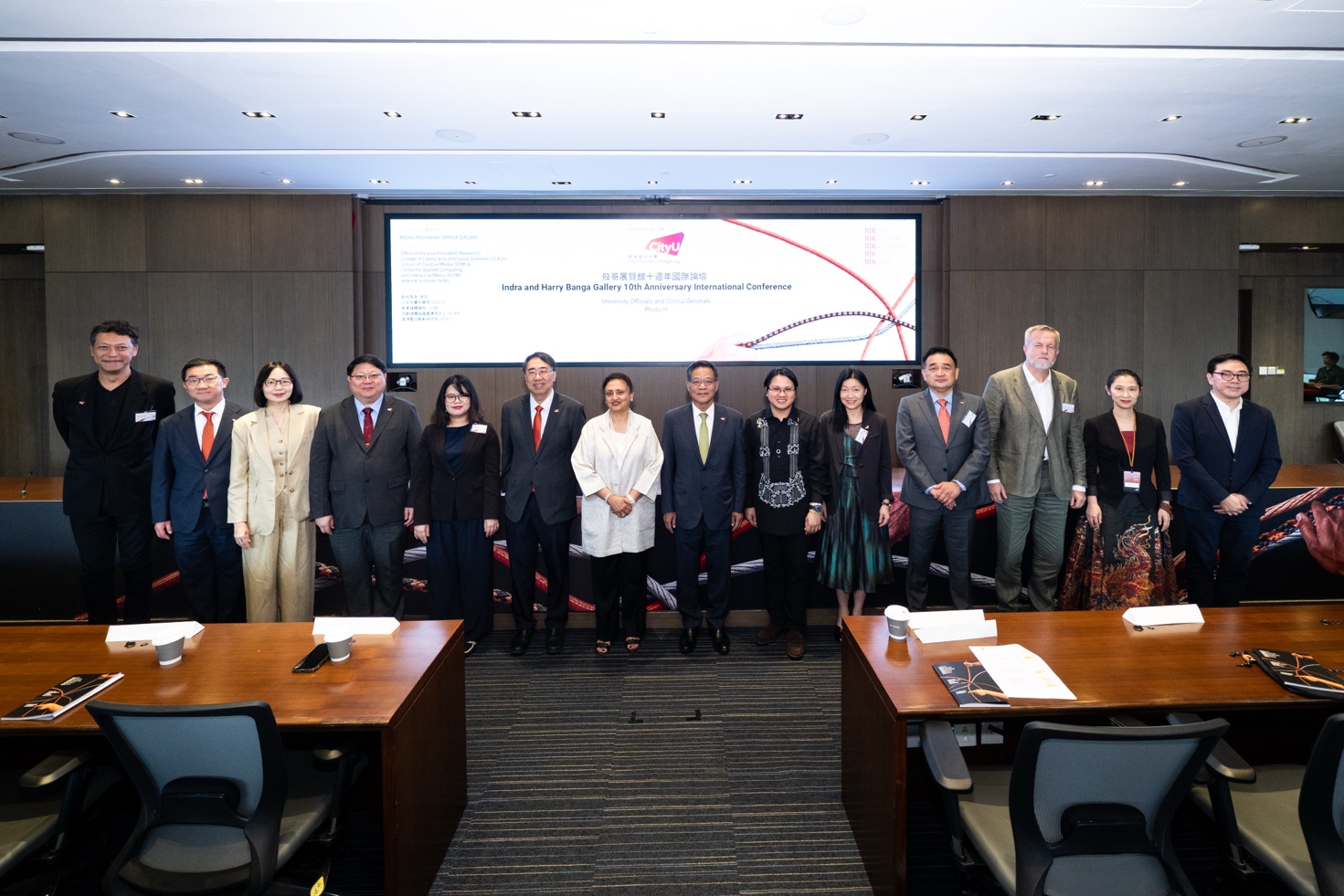
Leading researchers, artists and creative and cultural innovators from around the world gathered at City University of Hong Kong on Friday to explore technology’s reshaping of museums, heritage preservation and cultural education, confident it can help cultural institutions engage more people, represent greater diversity, and contribute more to an interconnected world.
They spoke at the opening of the inaugural 10AFEST, a three-day forum on art-technology collaboration that kicked off with networking on Thursday and ends on Saturday.
Presented by CityUHK and organized by its Indra and Harry Banga Gallery, which celebrates its 10th anniversary this year, the forum attracted over 120 thought leaders in culture and the creative fields from 23 cities in 13 countries and regions with a varied program of plenary discussions, intersectoral presentations and opportunities to connect.
Welcoming the crowd at Friday’s opening ceremony, CityUHK’s Council Treasurer Charles Chin Ying-on said outreach is “an integral part” of the university’s holistic strategy and international collaboration, and that it lies “at the heart of the school’s mission to address global challenges”.
“I’m confident that you will not only gain knowledge and experience but also forge lasting friendships and lay the groundwork for future collaboration,” Chin said.
Indra Banga, founding patron and honorary chairperson of City University of Hong Kong’s Indra and Harry Banga Gallery Advisory Committee, described in her opening remarks the launch of 10AFEST as “a natural and exciting step” in the gallery’s growth as a meeting point for ideas in art, technology, education and cultural innovation.
She recalled that she and her husband, Harry Banga, began their gallery partnership with CityUHK 10 years ago with the “aspiration of supporting a space where art, culture, technology, education and research could come together to inspire curiosity, creativity and new ways of thinking”.
Amid technological and educational progression, said Indra Banga, “it’s increasingly important to create spaces that encourage us to think beyond established boundaries”.
ALSO READ: Global youth classics recitation promotes cultural exchange in HK
University museums and experiential learning, regarded as central to the future of arts and cultural education, was the main topic of discussion at the panel on “Cultural Education of Tomorrow”, moderated by Muloy Luib, deputy multimedia director of China Daily Asia Pacific.
Jin Jun, director of the Central Academy of Fine Arts Art Museum (CAFA) and a professor at CAFA, Beijing, focused on how university museums could use new digital technologies to make traditional exhibits more widely accessible.
“Art galleries and museums offer a platform for arts education and exchange,” he said. “More people need to know about good works of art.”
Technology, from early audio guides to today’s internet and virtual tools, can expand museums’ reach, Jin said, which helps widen public access to cultural artifacts and the humanistic ideas behind them, creating grounds for greater social consensus.
Luke Syson, director and Marlay curator of the Fitzwilliam Museum at the University of Cambridge, England, advocated a shift from “temple or palace-like” university museums toward “more of a forum”, with community-building central to their role on campus and beyond.
Syson added that the university museum, with some latitude to navigate external pressures, should work to present more diverse narratives and develop new cultural approaches.
The Fitzwilliam Museum, founded in 1816, has been moving to juxtapose historic and contemporary art in exhibitions, revisit canonical works and extend the museum’s collecting scope to artists from social minorities long underrepresented in art history, Syson said.
Participants also discussed topics such as culture and creativity in a connected world, and how heritage, diversity, and technology could shape tomorrow’s cultural institutions.
On the recent expansion of international arts exchanges, Matthias Bottger — a professor and head of HyperWerk at the Basel Academy of Art and Design FHNW in Switzerland — said he welcomed the globalization of the art economy, citing the international commercial fair Art Basel — but stressed that many artists and creators worldwide remain “grounded, situated” in local realities, offering valuable critiques and fresh perspectives.
“It’s about building vessels to connect all these people, while seeing their differences and accepting them but still working together.”
As for art-tech fusion, Lu Xiaobo, director of the Tsinghua University Art Museum — who is also a distinguished professor of liberal arts at the university — said that technology can enhance and expand human perception but cautioned that it cannot replace human judgment.
Lu advised against “using new technology for its own sake”, arguing that its meaningful integration with artwork should “solve real problems, bring new insights and benefit the public”.
The program will conclude on Saturday with further discussions on digital museology and intangible collections.
