

Editor’s note: What draws the world’s leading scientific minds to Hong Kong? In this series, China Daily speaks with locally based researchers ranked among the global top 2 percent of scientists, exploring the frontiers of their current research and uncovering why they chose to make Hong Kong their home.
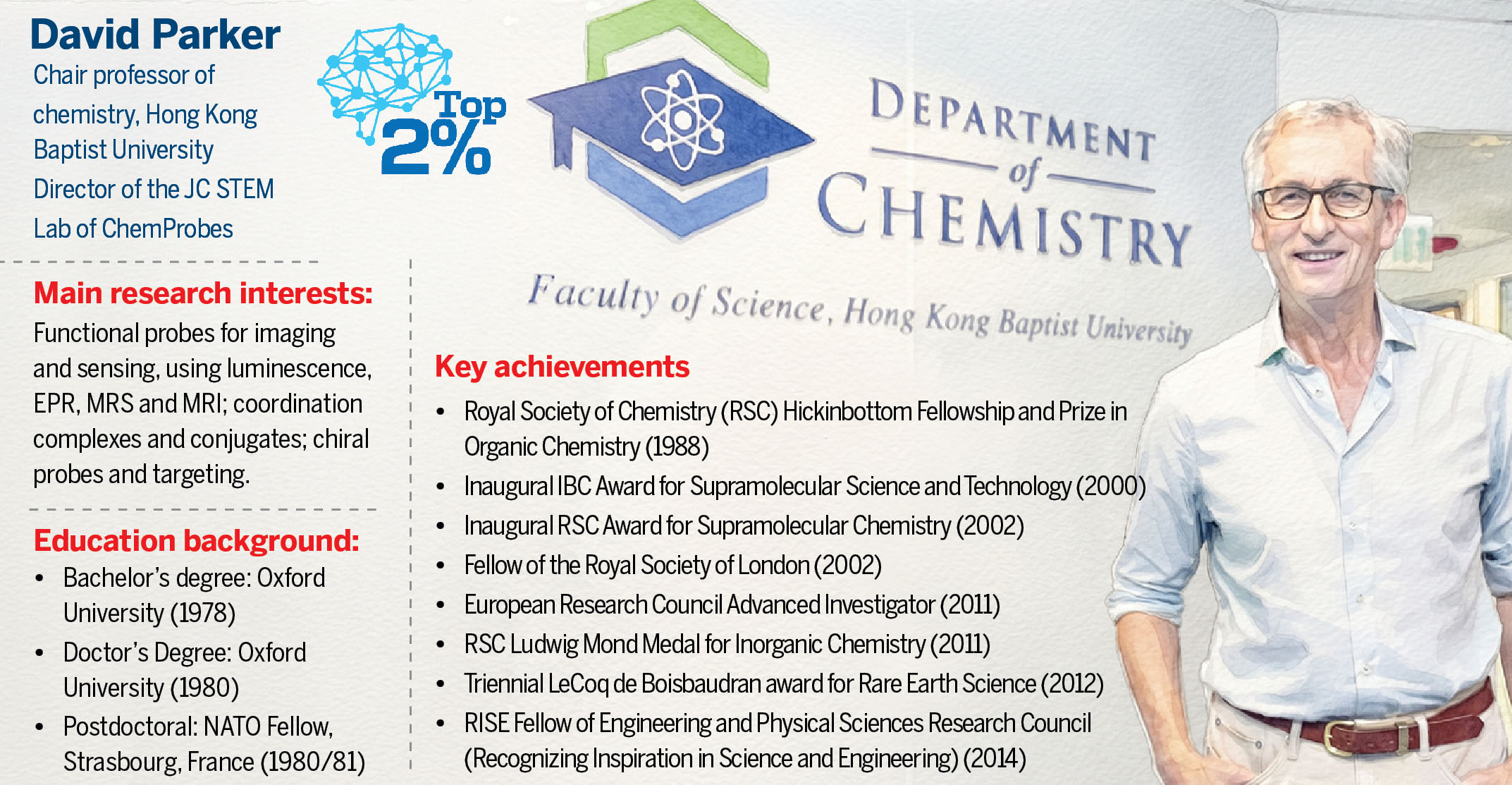
Few people could do what British chemist-poet David Parker did at the age of 66. He decided to uproot and move across the world to Hong Kong and joined Hong Kong Baptist University (HKBU) in 2022, when most other places had been hijacked by the COVID-19 pandemic.
After just four years in the city, he says what he has achieved he “would never have done in Durham”, his home city. The point, however, is not the achievements that followed — building a world-class laboratory from scratch or seeing his pH-sensitive luminescent probes launched globally. The real point is the people: excellent colleagues to do research with.
Hailing from the northeast of England, Parker — a fellow of the Royal Society of London — is now a chair professor of chemistry at Hong Kong Baptist University and director of the JC STEM Lab of ChemProbes. He calls Hong Kong a place with “good people” and “efficient interaction”.
Born in County Durham, the United Kingdom, Parker spent over 50 years living in the northeast of England. He earned his doctorate at the University of Oxford in 1980, enjoyed a 40-year distinguished academic career at Durham University, and in his seventh decade, made a “spontaneous” decision to leave the region where his family has been rooted for 300 years.
The decision to relocate to Hong Kong may have seemed spontaneous to Parker. Yet, there were signs all along.
READ MORE: HK offers a warm academic atmosphere, strong GBA research collaboration, says HKBU chemistry chair
In 2021, Parker got an invitation from Hong Kong Baptist University under the newly rolled out government-initiated Global STEM Professorship Scheme. The program offers HK$2 billion ($255 million) in funding to local universities to net a total of 100 top brains over a five-year period.
At that time, Parker had turned down many top universities’ offers. HKBU’s offer came at a time when the pandemic had made Parker rethink his life.
However, Parker had fond memories of HKBU from when he was a visiting professor back in 2019, despite his time being cut short due to the social unrest and the pandemic.
“It was somewhat rational, but mostly rather spontaneous,” Parker says, noting that he likes the atmosphere in the institution. “The ethos was not just hung up on statistics. It was more to do with education. I liked the fact that we had the communications school and a music academy — a bit more breadth.”
Start from scratch
In May 2023, after a challenging preparation process — during which equipment procurement was slow and there were difficulties in finding suitable laboratory staff due to the pandemic — JC STEM Lab of ChemProbes was finally established from scratch. The research team focuses on designing, creating, and testing new chemical probes that may provide unique information on the probe environment for analytical and diagnostic purposes.
In August 2025, global life sciences company Revvity launched pHSense, a family of diagnostic reagents built on pH-sensitive luminescent probes developed by Parker’s team. The probes are plate reader-compatible reagents with a time-resolved fluorescence readout, specifically designed to help pharmaceutical companies understand how drugs enter cells.
Using obesity drugs as an example, Parker explained that these medications bind to the glucagon‑like peptide-1 receptor — a cell‑surface receptor that links with the feeling of satiety. The mechanism also involves dopamine, which associates the feeling of eating with pleasure, sometimes leading to overeating.
During the development of such drugs, researchers needed to understand how the compounds were taken into cells, whether they were metabolized, and if they were subsequently expelled. The probes his team developed, Parker says, are now being used to help answer these questions.
In July, Parker’s former institution awarded him an Honorary Doctor of Science degree in recognition of his pioneering work in molecular probes and sensors, which has led to the development of clinically important imaging and therapeutic agents.
HK’s strength and uniqueness
On Hong Kong’s research ecosystem, Parker is candid. He sees too much top-down direction and short-term applied research. Emphasizing the role of creativity, Parker says such hands-on supervision will harm science. Instead, he says he believes discoveries come without planning, by doing the right experiments and training young people.
That aside, he applauds the strengths of the city. “Hong Kong is a village. Everyone knows everyone else. That interaction is good — efficient.” He says he believes Hong Kong’s role should be outward-facing, facilitating international collaboration.
On integrating into the nation’s development, he is pragmatic: “Hong Kong has to know its place. To me, what’s unique about it is it needs to be outward-facing. There need to be mechanisms that support collaborative research.” He also sees the Guangdong-Hong Kong-Macao Greater Bay Area as a natural partner: “The Greater Bay Area has wonderful manufacturing and capacity. If you want to set up a company, you turn to the Greater Bay Area. Those partnerships are important.”
He adds that he believes that “adaptation” is the key for Hong Kong’s future: “being resilient and flexible in its approach to evolving initiatives in science and technology that embrace the developments (of the country)”.
Legacy beyond papers
At the age of 70, the same age as HKBU, where he started a new chapter, Parker is thinking about his legacy. “What matters more to me now is what I leave behind.” Not only the equipment or those over 450 papers and patents he had published, but the people.
“Getting somebody to leave here with the concept that they are good scientists, that they can address complex problems and know how to do it. That’s what I leave behind.”
He still walks to work every day, plays badminton, and has explored many places on the Chinese mainland, including Xi’an, Jiuzhaigou, Shanghai and Beijing. “I’ve really enjoyed being in China. The history is amazing.”
Four years in, he has no regrets. “If you don’t like being where you are working, why stay? I’m very happy to come here.”
Born into a musical family and shaped by the arts, Parker has a deep love for literature and the arts. Since 2016, he has written poems weekly, drawing inspiration from nature, the beauty found in art and music, and personal feelings in different settings. To date, he has completed over 700 poems, seeing creativity as the link between science and verse.
Parker explained that just as a relaxed mind lets poetic words flow from the subconscious, he sometimes wakes up with scientific puzzles stirred in his subconscious, and it is in that moment that innovative and original ideas are envisioned.
“The rate of flow is different, but it’s the same creative spirit.”
Contact the writers at stacyshi@chinadailyhk.com
