

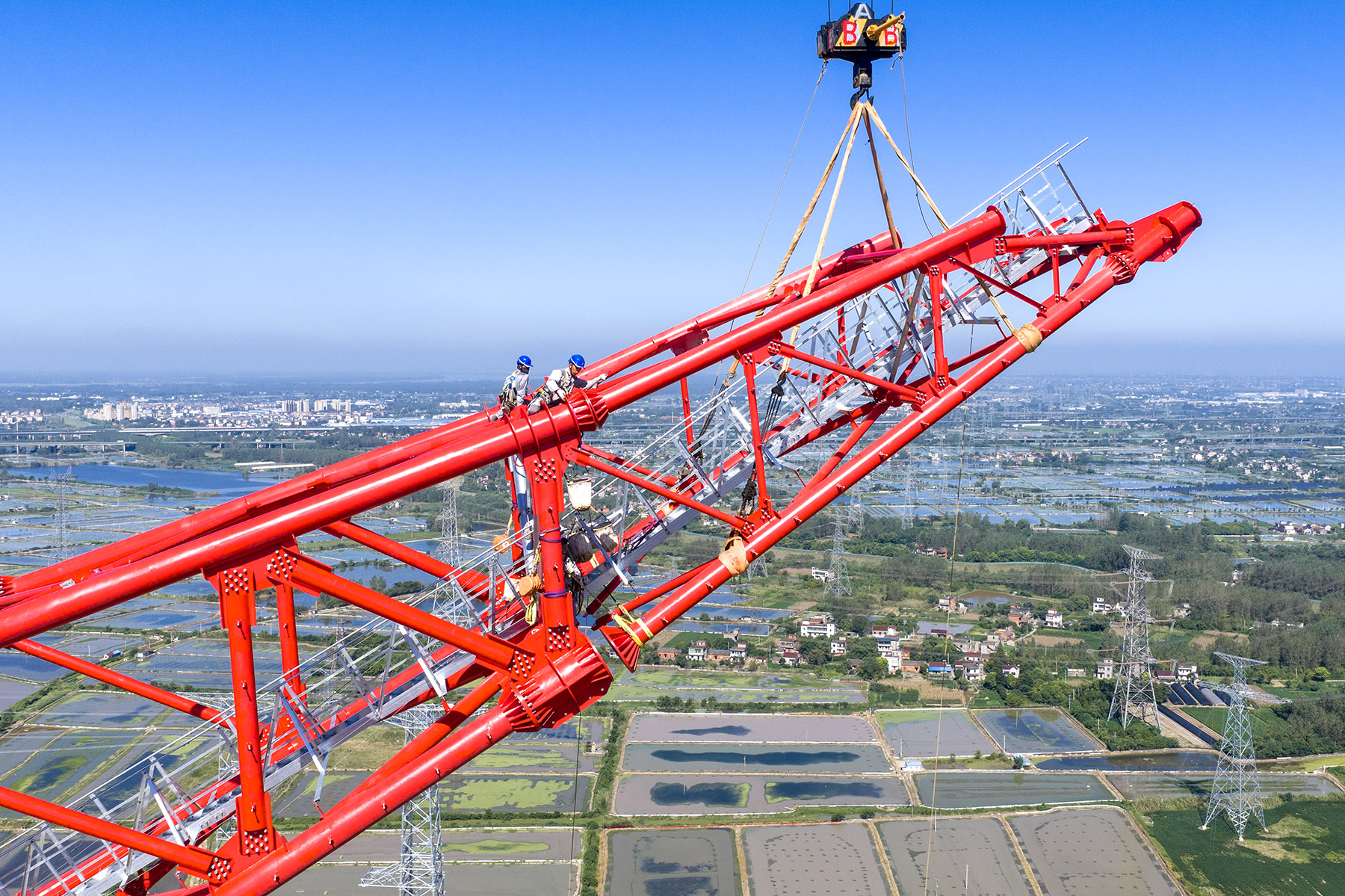
State Grid Corp of China aims to lift the share of renewable power generation across its operating footprint to over 30 percent by 2030, committing to meet all incremental electricity demand with clean energy under a comprehensive decarbonization blueprint unveiled for the 15th Five-Year Plan period (2026-30).
To deliver on its targets, the world's largest power utility plans to connect an average of 200 gigawatts of new wind and solar capacity annually through the end of the decade.
The company has pledged to guarantee the seamless grid connection of mega renewable bases in desert and Gobi regions, alongside offshore wind and distributed energy projects.
READ MORE: China to generate 50% of electricity from non-fossil sources by 2030
State Grid's ambitious targets are designed to keep pace with China's broader, world-leading renewable energy rollout.
According to the latest data from the National Energy Administration, the country's cumulative installed power generation capacity reached 4.08 billion kilowatts by end-July, representing a robust 11 percent year-on-year rise, with the rapid expansion of renewable energy to continuously headline the sector's growth.
Solar power capacity grew 16.1 percent to 1.29 billion kW, while wind power capacity surged 19.5 percent to 690 million kW, it said.
As this green footprint rapidly expands, the pressure on the grid to safely integrate and absorb intermittent power has never been higher.
To manage the inherent intermittency of these green power sources, the grid operator is significantly ramping up system flexibility. State Grid aims to have over 120 GW of pumped-hydro power storage in operation or under construction by 2030, while an additional 140 GW of new energy storage capacity will be integrated into its network during the 2026-30 period.
Concurrently, the utility will support the low-carbon and flexibility retrofitting of traditional coal-fired power plants. By lowering their average minimum output to 35 percent of rated load, the grid will free up critical peak-shaving capacity to accommodate more renewables.
Optimally allocating this surging clean energy requires massive physical investments. State Grid will accelerate the construction of ultra-high voltage transmission corridors, planning to commission 15 new cross-regional direct current lines by 2030. This build-out will elevate cross-provincial transmission capacity to an unprecedented 500 GW.
According to the NEA, grid infrastructure investments are rapidly accelerating this year.
ALSO READ: Solar sector in value rebuilding
National grid investment reached 302.7 billion yuan ($45.04 billion) in the first half of this year, up 4.0 percent year-on-year. State Grid completed over 310 billion yuan in fixed-asset investment, facilitating 3.48 trillion kilowatt-hours of marketized electricity trading and providing critical support for cross-regional power sharing and new energy consumption, it said.
At the local level, the utility is overhauling its distribution networks to absorb more than 60 GW of distributed clean power annually. By deploying agile virtual power plants and rural microgrids, State Grid aims to maximize on-site power consumption and sharpen real-time demand response.
Industry experts point out that this massive grid overhaul is necessary because greening the grid goes far beyond just building more solar panels.
"High-quality development and absorption of renewable energy is not solely an issue for power generators and grid operators; it is a systemic engineering feat that involves multiple sectors including power, heating, industry, transportation and construction," said Chen Guoping, vice-chairman of the China Energy Research Society. "Currently, the spatial and temporal mismatch between renewable energy output and load demand is the primary contradiction in its development."
Contact the writers at zhengxin@chinadaily.com.cn
