

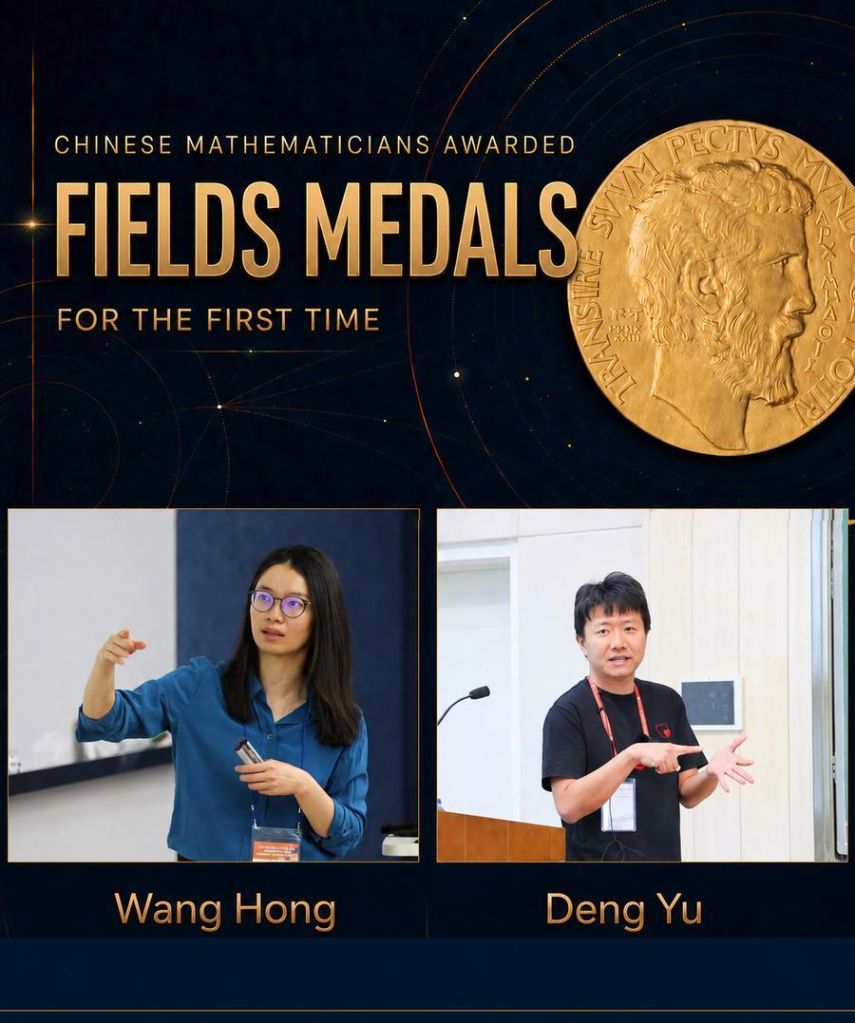
Chinese mathematicians Deng Yu and Wang Hong have won the prestigious Fields Medal on Thursday, the first time Chinese nationals have received the accolade.
Widely regarded as the “Nobel Prize of mathematics”, the Fields Medal is awarded every four years to two to four young scholars under 40 years of age, for their outstanding contributions. The award was established by the International Mathematical Union (IMU) in 1936 and named after the Canadian mathematician John Charles Fields.
The list of awardees was unveiled at the opening ceremony of the 2026 International Congress of Mathematicians held in Philadelphia, the United States.
Deng won for his progress in partial differential equations, while Wang was recognized for her work in harmonic analysis and geometric measure theory. They shared the honor with US mathematician John Pardon and Canadian scholar Jacob Tsimerman.
Deng said being awarded the Field Medal is an exciting milestone not only for him personally but also for the mathematics community in China. “I hope to see even more young Chinese mathematicians win this award in future,” said Deng.
“It is my greatest honor to become the third female recipient of the prize,” said Wang, adding that she hopes her achievements can encourage more people to pursue their true passions with courage.
Born in Shenzhen, Guangdong province in 1989, Deng was admitted to Peking University and later transferred to the Massachusetts Institute of Technology. He now works at the University of Chicago’s department of mathematics.
Wang was born in Guangxi Zhuang autonomous region in 1991 and earned an undergraduate degree at Peking University. She is a permanent professor at the Institute of Advanced Scientific Studies in France and a Silver Professor of Mathematics at New York University.
He Xuhua, a professor at the University of Hong Kong who was elected vice-president of the IMU on Wednesday, said Deng and Wang’s honor signifies Chinese mathematics transitioning from a “frontier follower” to a “key contributor” in the global mathematical research network.
“Their groundbreaking work has not only resolved long-standing problems but also demonstrates how Chinese scholars are reshaping contemporary mathematics with original methodology,” He said.
He highlighted Hong Kong’s unique role in the transition, noting that the city’s long-term research funding, talent-attraction policies, and world-class institutions offer an ideal environment for top young scholars.
Hong Kong provides an international platform for pioneers, serving as a hub that connects Chinese mathematics with the world’s leading academic forces, he added.
HKU Vice-President Wang Yang, who is also a renowned mathematician, said fundamental mathematics stands on the cusp of a profound paradigm shift, accelerating toward an era defined by deep human-AI partnership.
He said Chinese mathematicians have demonstrated sharp insight and foresight, enthusiastically placing themselves at the leading edge of the convergence between algorithms and pure mathematics.
Recognizing the immense potential of AI to advance mathematical research, HKU aims not only to remain a stronghold of traditional mathematical inquiry, but also to build a premier academic ecosystem — one that seamlessly merges top-tier human intellect with cutting-edge AI technologies, he added.
Contact the writer at williamxu@chinadailyhk.com
