

Brave Chinese environmentalist and generous US teacher rekindle friendship, reminisce on remarkable greening effort
Ronald Sakolsky, a retired teacher affectionately known as Mr S by his former students, lives a typical middle-class life in Plum, a suburb of Pittsburgh, Pennsylvania, with Barbara, his wife of 46 years.
But the 69-year-old's life has become quite extraordinary in recent months after his act of kindness in China 27 years ago brought about a touching reunion.
In 1999, he raised $5,000 from an organization in Boston, Massachusetts, to help environmental hero Yin Yuzhen combat severe desertification in the Maowusu, China's largest sandy area, in the Inner Mongolia autonomous region.
The father of four and grandfather of eight remains extremely humble about his selfless actions and insists he's not a hero.
"I'm just an actor in the play that was designed back in 1999," he said in an interview with China Daily. "Ms Yin is the hero. I was like the stick that put the hole in the ground. She put the saplings in and watered them to create the 50,000-tree forest.
"If my story gets other people involved, not just in stopping the desertification of China, but just involved to make the two cultures more similar, then it did its purpose."
Sakolsky was teaching English at Luoyang No 2 Foreign Language School in Henan province in 1999 when he sought the donation. He saw an appeal for funds on CCTV by Yin, who wanted to turn an area of the Maowusu sandy area into a lush, green forest.
At that time, $5,000 was enough to buy a small apartment. But when she received the large donation, Yin spent every penny on saplings and kept just $1 as a souvenir.

Fate intervenes
Sakolsky's journey to teach in China happened by chance.
He remembers sitting in a doctor's office back home when he opened a magazine just to "kill time". He saw a tiny advertisement asking for teachers from the United States to teach English listening and speaking in China.
"Something hit me," he said. "I can't tell you why. But I answered the advertisement."
After an interview in New York, he was selected as one of 14 Americans to teach in China for a year. Before embarking on his teaching trip, he was eager to see Beijing, the Great Wall, the Yellow River and the Terracotta Warriors. But he experienced much more during his visit. "Going to China just enhanced my Chinese education beyond expectation," he said.
He believes a "miracle" led him to Yin.
Sakolsky had planned to teach in Chengdu, Sichuan province. However, another teacher took that position so he chose Luoyang instead.
When he arrived, he felt homesick, but remembered his two daughters' support before he embarked on his China journey. He kept busy by doing tai chi with locals and watching the news. There were two English-language half-hour CCTV news programs aired at noon and 7 pm back then.
"A reporter … from CCTV was doing a five-minute TV segment called Chinese Heroes and Heroines," he said.
He was struck by the story of Yin and her husband planting trees in Inner Mongolia. "At the time, I thought the trees were only going to be 2-feet (60 centimeters), maybe 3-feet high at the most to keep the sand down," he said.
He saw that Yin's husband had lung problems. She made just $250 a year and spent all their money on trees.
"I can't tell you why something hit me in the heart," he recalled. "I'd only been in China for two months, but I said, 'I need to help this lady. I need to do something.'"
He added: "China had already changed who I was, my personality, the way I looked at things. I had learned how to appreciate simple things … I wanted to help her, and at the same time thank China for what it had already done to me."
From October to December that year, he researched organizations in the US that might donate money for Yin's tree-planting mission. Finally, he found an institution in Boston, Massachusetts, willing to give the full $5,000.
After he received the donation, he spent two months cutting through red tape to get Yin the funds.
"You have to understand in 1999, there were no roads to Ms Yin's house, which I found out later. No roads! She had no telephone. They drove out to her," he said.
"Local officials brought her a generator and a telephone so that they could communicate with her … and then I lost contact. I knew in December that the money had made it to Beijing. And that's the last I heard."
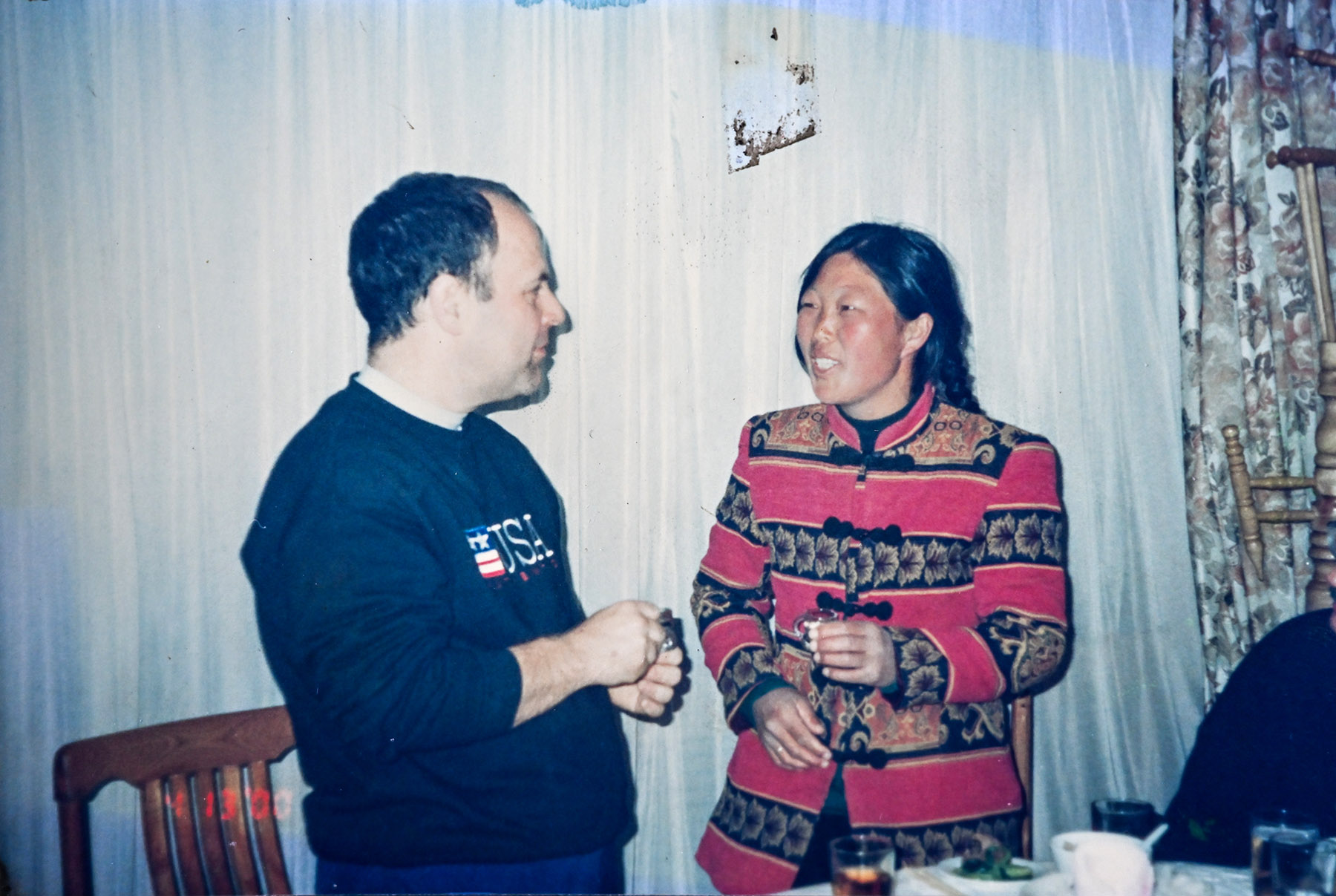
In May 2000, Bai Fan, the vice-principal at the school where Sakolsky worked, took the American on a surprise visit to meet Yin in the grasslands of Inner Mongolia.
Bai had dreamed of visiting the grasslands and Sakolsky invited him along as a translator. "He had become not my boss anymore. He was my brother," he said.
Sakolsky met Yin at a banquet and fondly remembers feasting on an entire lamb — a Mongolian delicacy.
The next day he gave a speech to a big audience, including local officials, that was translated by Bai. They then drove for hours over sand dunes, Sakolsky recalled.
"We stopped in the middle of nowhere; all sand, no roads, no houses. We had passed the village about two hours before, and seen nothing but a hole in the sand. (Then) out of the hole came Ms Yin," he said.
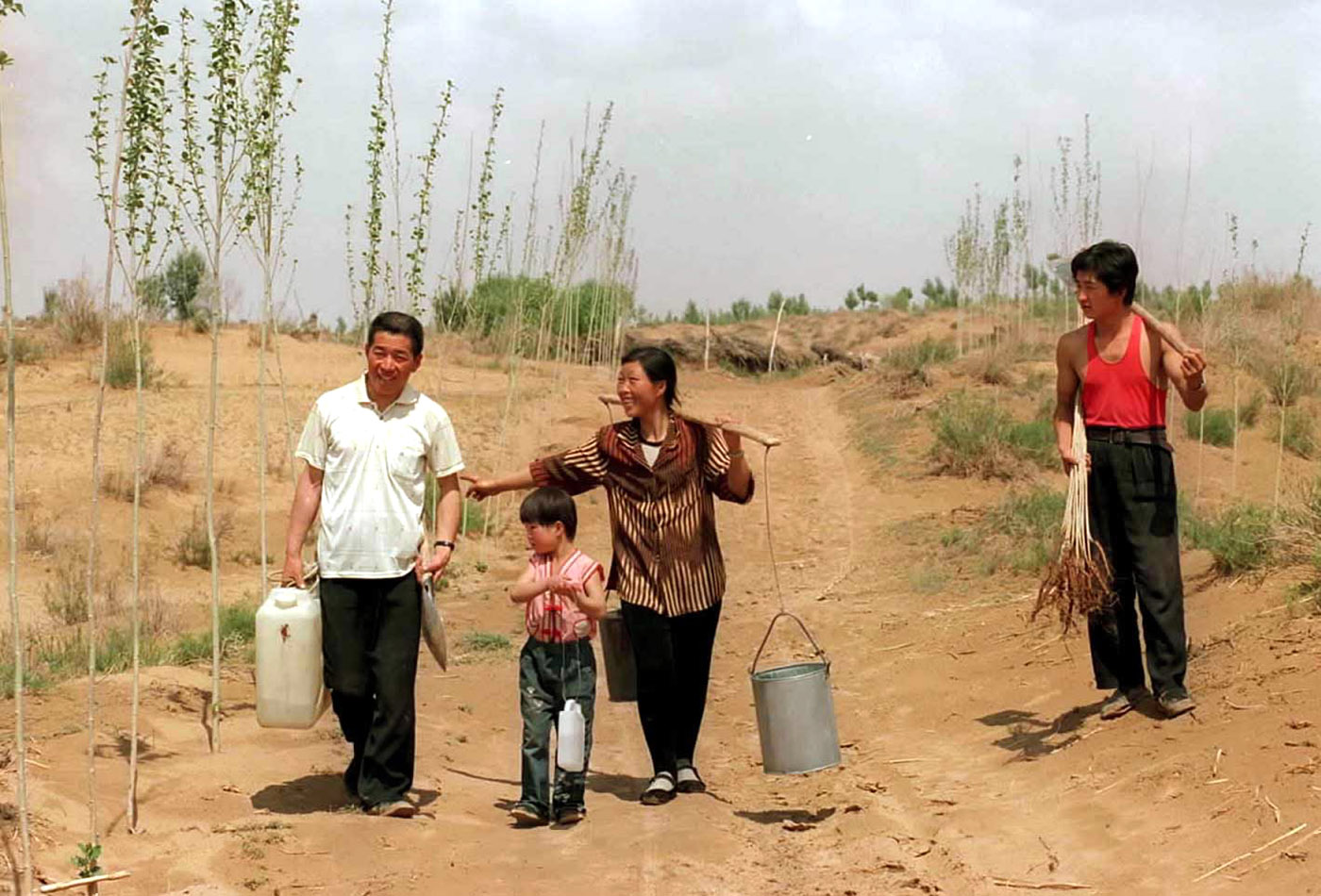
She had been digging through the sand to hit the water table 2.4 meters down to irrigate the trees. Her only tools were a shovel and a yoke. She tied the saplings with hemp rope and carried them in bundles to be planted, Sakolsky said.
"I kept telling her what you're doing is miraculous, but it's impossible," he said. "Then she starts saying, 'this is going to be your forest'".
"I said to Bai Fan, 'why does she keep calling it my forest? It's not my forest. I didn't do this for it to be my forest.'
"And he said to me, 'The Chinese government is calling it the Sakolsky Forest'. I said, 'No, I don't want this. I don't want it called the Sakolsky forest'".
The group then drove 45 minutes to Yin's house and planted more trees. She cooked him a delicious noodle dish.
Search for old friend
Yin, a pioneering environmentalist, began her quest to save the desert in the 1980s.
At 19, she married a man who lived in the Maowusu sandy area, and moved from Shaanxi province. Life was tough for the new bride. Her first Shaanxi home was a cellar half-buried in sand.
But she was determined to improve the environment, so the couple began planting saplings they'd brought with money from their own labor. Yin declared: "I'd rather die planting trees, than live buried by the desert."
It is estimated that Yin and her husband planted saplings across nearly 2,667 hectares between 1985 and 1999, according to Chinese media reports.
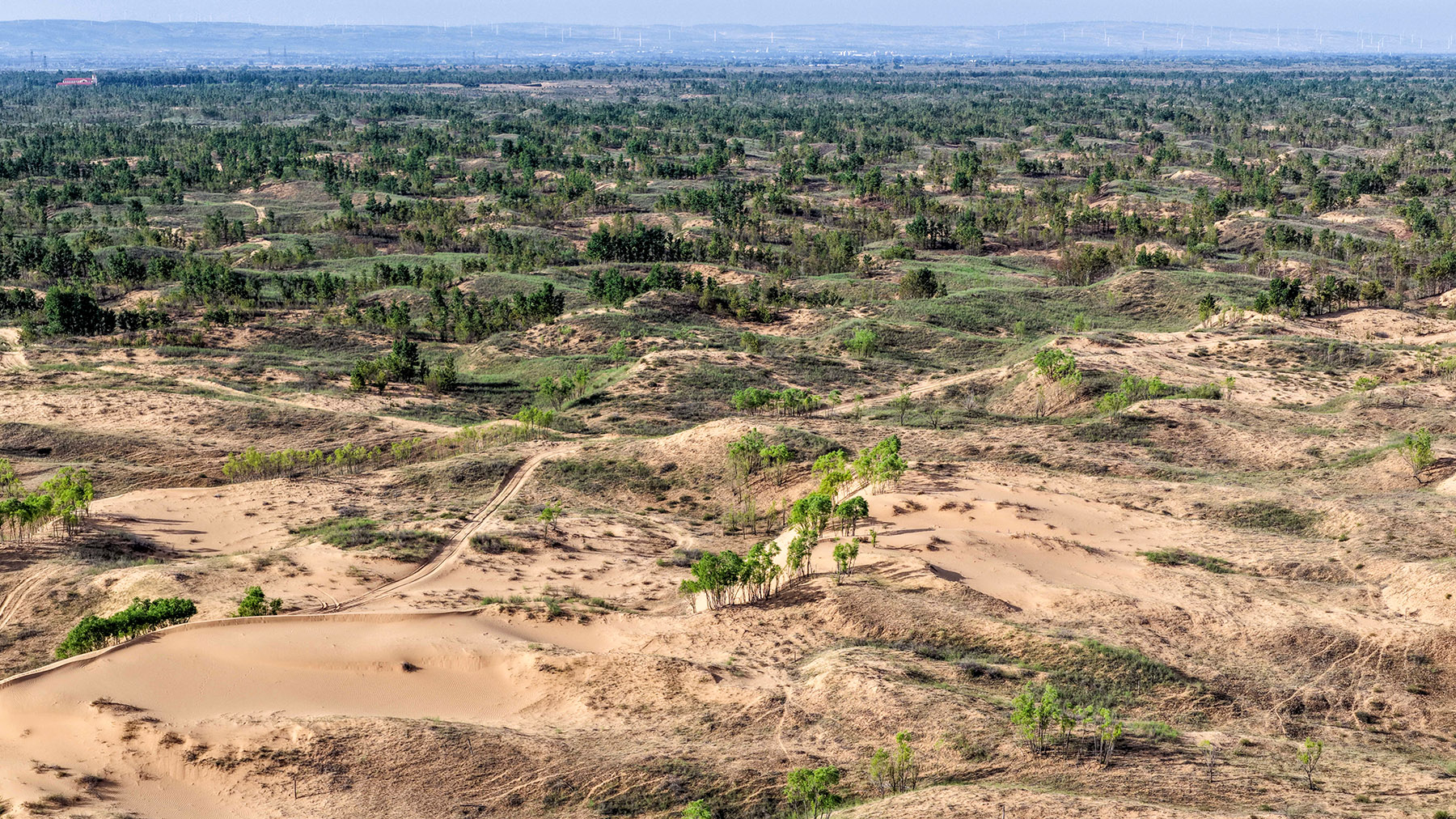
Over the next few decades, she planted more than 8 million trees and transformed over 70,000 mu (or 4,667 hectares) of barren desert into a lush landscape, according to People's Daily.
Sakolsky said he was amazed to learn Yin and other workers did all the work by hand. "They were digging the ground, digging with a stick, and planting; (there was) no machinery, none," he said.
In 2000, Yin was named a National Model Worker by China's State Council. In 2017, she gave a speech at the United Nations Convention to Combat Desertification.
But she never forgot the American teacher's kindness "at the most difficult time", she told Chinese media.
After his teaching assignment in China finished, Sakolsky returned to the US and lost touch with Yin. He briefly returned to China in 2004 to teach alongside Bai again.
On May 16 this year, Yin, now age 60, made a video and posted it online, hoping to find Sakolsky.
"Mr Sakolsky, we would like to invite you to come back to China to witness how the $5,000 you donated many years ago has become a large forest," she said.
The video went viral and Sakolsky was inundated with emails and texts. Some were from past students.
They all asked one question: "Are you the teacher?"
"I thought it was a joke!" he said. It was only when Bai called him that he knew it was real.
Two days later, Yin phoned him. Sakolsky said she had learned a little bit of English to converse with him. "She wanted to say 'hello' and 'thank you'," he said.
Sakolsky teared up recalling the conversation and the rekindling of the friendship. "I was stunned that she called," he said.
Yin told him: "You are my brother. I used the $5,000 you donated to plant a forest. When will you come and see it? I really want to see you." "I will try," Sakolsky replied.
He admitted when she called him "brother" he became very emotional. "There's not words to tell you. I lost it. I mean, I never thought I would ever hear from her (again)," he said.
Anticipated reunion
Sakolsky will travel to China in August for around 10 days to meet Yin. She plans to cook him noodles and share Inner Mongolian lamb skewers. He wants to plant a new tree.
His incredible story has touched many hearts worldwide. At least 40 to 50 of his former students from around the world intend traveling to China to reconnect with him.
On a recent family vacation in Australia, Sakolsky was sitting on a tour bus when two tourists, one from Singapore and one from Hong Kong, recognized him.
"They turned around and said to me, 'you look like the guy on a video that we just watched on the internet, about a forest,' and I said 'yes, that's me.'
"I couldn't believe I was halfway around the world and these people were recognizing me," Sakolsky said. "A simple world history teacher from Plum, a suburb of Pittsburgh."
On June 19, Chinese Ambassador to the United States Xie Feng invited Sakolsky and other Americans to the Chinese embassy in Washington, DC.
The teacher, who retired in 2021, described it as an "honor", adding he "never expected anything like these last six weeks".
Yin, now living in Wushen Banner in the city of Ordos, continues to protect Maowusu, which covers about 42,200 square kilometers.
Their story has inspired others to volunteer. Her son also cares for the land.
Sakolsky, who was given the Chinese name Long Fu, which he was told meant "happy dragon", has become a social media star.
ALSO READ: New forests halt desertification
His house, full of memories, is adorned with photos of his family, a life-size replica of a Terracotta Warrior (a gift from Bai Fan), panda toys, photos of his time in China, gifts and a large, mock, plane ticket from the Inner Mongolia People's Association for Friendship with Foreign Countries inviting him to visit.
But over the years he has also faced personal challenges.
His wife Barbara has had dementia for six years and he patiently takes care of her each day.
Five years ago, he broke four vertebrae in his neck after slipping in his driveway while shoveling snow. He has recovered and gained even more strength from the outpouring of kindness from China over his story, he said.
"If we focus on our similarities and not our differences, the world would be at peace," he said.
Sakolsky also reminisced on one of his favorite quotes from Aesop's fable The Lion and the Mouse. "No act of kindness, no matter how small, is ever wasted. If the forest doesn't tell that story, I don't know what does," he said.
Contact the writers at belindarobinson@chinadailyusa.com
