

'Everyday' stability, sense of security impress tourists, foreign residents

"What is it like night walking in China's Guangzhou, one of the most populated cities in the world? It's extremely safe. I'm wearing my very expensive watch. No one bothers you, no one is trying to pull you in their shops," British creator Ben posted on his social media account, OTWD.
His observation about the capital of South China's Guangdong province, casual as it seemed, struck a chord with a large number of foreign visitors to China.
When a man can stroll through one of the world's busiest urban centers late at night wearing an expensive timepiece — and nothing happens — his actions challenge assumptions about safety in densely populated cities.
READ MORE: China's cross-border trips hit 369m in first half of 2026, setting record high
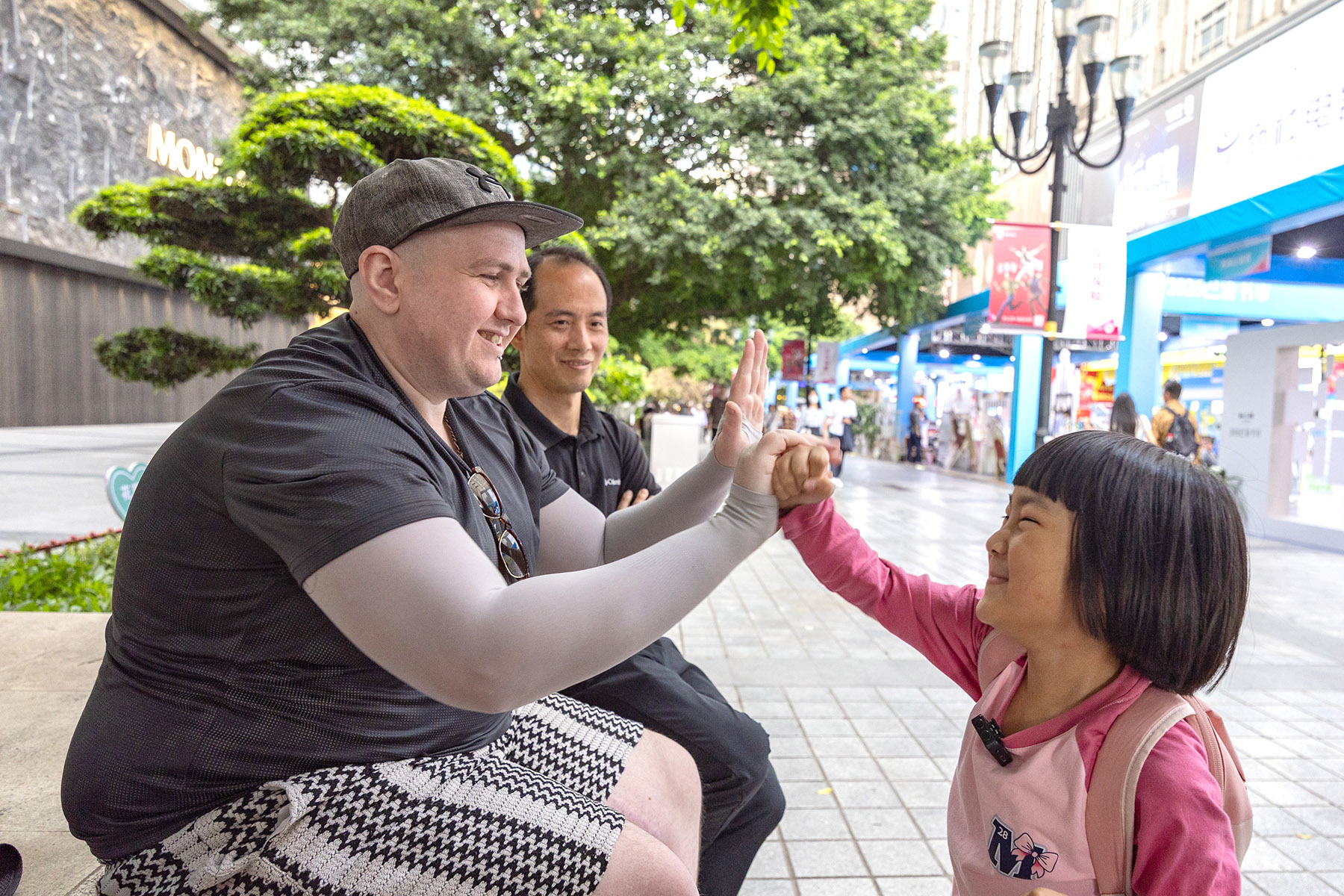
As China gains in popularity as a travel destination, a growing number of foreign tourists are capturing moments through their lenses showing how safe China is, their images resonating deeply with expats and visitors. This "Chinese sense of security" has sparked spirited discussions on social media platforms both at home and abroad.
The growing perception that China is an extremely safe destination is backed up by statistics. In 2025, the number of criminal cases in the country dropped 12.8 percent year-on-year, reaching their lowest level in decades, while public order cases also declined, according to data from China's Ministry of Public Security. In addition, public confidence of public safety remained above 98 percent for the sixth consecutive year.
Perhaps more telling for an international audience is the Global Safety Report 2025, released in January 2026 by the US-based analytics firm Gallup. Among more than 140 countries and territories surveyed, China ranked third safest overall. The report also highlighted strong public confidence in local law enforcement and low levels of personal experience with crime.

The new normal
"When I first came to Beijing two years ago, I went outside at night and found there were still a lot of people walking around, and everything felt normal, like it wasn't even that late. At that moment, I thought 'this place is actually really safe'," said Salah Eddine Ben Mhmed, a 20-year-old student from Morocco, who is now studying at Dalian Polytechnic University in Liaoning province.
"It felt strange seeing people outside late at night without a worry. But now it feels completely normal to me," he added. He attributes this feeling to a combination of public order and a general trust that daily life is calm and well-managed.
This transition from a surprise to seeing it as normal is common among many long-term foreign residents in China.
Merlin Palmer, 40, a Canadian IT engineer who works in Beijing, arrived in China in 2012 and planned to stay only briefly. "I was thinking about traveling the world as an English teacher," he said.
That was before he met his wife Bonny Liu. Fourteen years later, he lives happily in Chaoyang district with his wife, 5-year-old son Arthur, and a puppy called Chocolate.
Palmer said living in Beijing had fundamentally changed his perspective on parenting and safety.
"Parents don't have to worry about guns or drugs, or racism or bullying," he said. "Arthur is in a classroom of 99 percent ethnically Chinese children, and he has never experienced any kind of 'othering' because of that. He is very much accepted and loved within his peer group."
Palmer credits not just legal protections, but also school food standards, community safety measures, and everyday kindness from strangers. "In China, there are a lot of policies about children's safety that may feel restrictive to some people, but in the end, they make a meaningful impact on the safety of children day-to-day."
Eddy, an American host at Dunhuang Media Center in Gansu province, pointed to the absence of gun violence as a major difference to the United States.
Growing up in an environment where school shooting drills were routine, he finds a special meaning in China's sense of security. He also pointed out that China's safety goes beyond law enforcement.
From fire safety education on campus to community awareness and shared responsibility, he believes the country's strong sense of security is built not only by institutions, but also by the people and communities who look out for one another every day.
Italian artist Federico Gentile, who visited Dalian during this year's Summer Davos forum in June, was equally impressed.
"People roam free and don't worry about anything. It's amazing to see a lot of happy families, having fun with their kids," he said.
During the May Day holiday, the "unattended luggage wall" at Liyuan station of Wuhan metro in Hubei province went viral.
Tourists neatly lined up their suitcases along the station wall before heading out to explore the city. This unguarded and perfectly orderly wall of luggage went viral on Chinese social media, becoming a symbol of the country's trademark "worry-free" travel.
Foreign Ministry spokesperson Mao Ning also shared a video on social media with the caption, "In Central China's Wuhan, unattended luggage lined the walls of a metro station, left behind by tourists eager to explore the city. Safe and worry-free!"
Unattended luggage walls and designated luggage storage areas are not unique to Wuhan.
They can also be found at metro stations in Changsha, Hunan province, Foshan in Guangdong, Nanjing, Jiangsu province, and Fuzhou, Fujian province, and other cities. This sense of security goes beyond trusting that one's suitcase will remain safe; it reflects a deeper confidence in the sense of security in China that people have come to rely on.
Positive impression
A playful post by Chinese vlogger Alan Jun on Facebook gained wide recognition. It posed the question:"'Is it safe to travel in China? Please don't lie.' An American netizen asked this question. Every city in China is extremely safe. The only unsafe place is the night market, where you will spend all your money, lose sleep, overeat, and gain weight. So you must not go out at night."
Under that post, netizen Properly_Basic replied: "As someone who lived in China for a bit, it is amazing how you can go outside at like 1 am without the worry of someone kidnapping you."
Another user, Alan Camp, commented: "I had 14 days in China. Beijing, Yantai (Shandong province), Shanghai, Qingdao (Shandong), Guangzhou and many other smaller cities. It's incredible how efficient and safe everything is. I treasure my time spent making friends and experiencing so many things."
Mark Owens, a member of the Oregon House of Representatives and a farm owner, visited the Inner Mongolia autonomous region, Beijing and Shanghai in October 2025 as part of a trade delegation — his first trip to China.
"The first couple of nights, I had trouble sleeping, so I got up early and I'd go for a walk. As the sun was coming up, I felt very, very safe in Beijing. I went out after dinner by myself and felt very, very safe. I mean, very, very clean, very polite, just a very good experience," he told China Daily.
Students from the University of Waterloo in Canada who took part in a Chinese culture immersion program at Beijing Normal University in October 2025 had similar positive impressions.
"Before visiting, I had heard many conflicting descriptions of what life there might be like. However, my experience showed me a place full of warmth, innovation, history, and everyday beauty," one student, Gia-Thanh Yvonne Ly, said.
Mudupeola Aladetokunbo Caxton-Martins added: "I could go out at 3 am and I would see other locals out too; this also added a safety net as I didn't feel alone and knew that there were also others around me."
Natalie Hermila Garcia Munoz, who has traveled to 24 countries, said "none compared to Beijing" — citing the advanced subway, the safe late-night streets and the world-class hospitality.
Raine Mimoza Hutton said: "I came back home with a completely unique perspective on China … I feel that all the negativity surrounding China in the news and media creates a significant shadow over all the amazing things the country has to offer."

The roots of reassurance
When Serbian influencer Saitie, who has lived in China for over four years, was asked by friends how China maintains such a high-trust society, he offered two reasons: the prevalence of technology, and — more importantly — the dramatic improvement in average living standards over the past two decades.
"There's no point for a person to go out and steal stuff and therefore face the consequences for that," he said.
His down-to-earth observation aligns with broader analysis.
Professor Wang Jianxin, dean of the school of public security at People's Public Security University of China, said: "China's ability to maintain long-term social stability alongside rapid economic growth reflects a distinct path of social security governance."
He identified the key factors as "the leadership of the Communist Party of China, sound laws and good governance, technological empowerment, and public mobilization".
Commentator Nie Zhiwang said: "The Chinese sense of security is by no means merely about low crime rates: it is a people-centered, inclusive, comprehensive, and safety-net type of security."
ALSO READ: Beijing ranks among world's top tourist cities
For individuals, it means walking alone late at night without fear, not worrying about children at school, and confidently leaving belongings temporarily unattended. For society, it means stable public order, harmonious neighborhoods, and resolvable conflicts. For the nation, it reflects the governance effectiveness of maintaining long-term order and stability across a country with a massive population and vast territory.
This security rests on three pillars: coordinated development that keeps violent crime low, refined grassroots networks that nip risks in the bud, and continued economic improvements.
In Guangzhou, Ben walked the night streets with his expensive watch and felt totally safe. In Dalian, Italian artist Gentile heard the streets ring with the laughing of families and children at play. These scenes capture a deeper meaning of security in China: it is not merely the absence of danger, but the presence of a confident, everyday existence.
That everyday life — the "Chinese experience" — is what many foreign visitors most want to take home with them, yet cannot pack in their luggage.
Yang Gao in Toronto, Lia Zhu in San Francisco, Chen Meiling and Wang Songsong in Beijing, Hu Yumeng and Ma Jingna in Lanzhou, and Liu Mengtong in Dalian contributed to this story.
Contact the writers at zhangxiaomin@chinadaily.com.cn
