

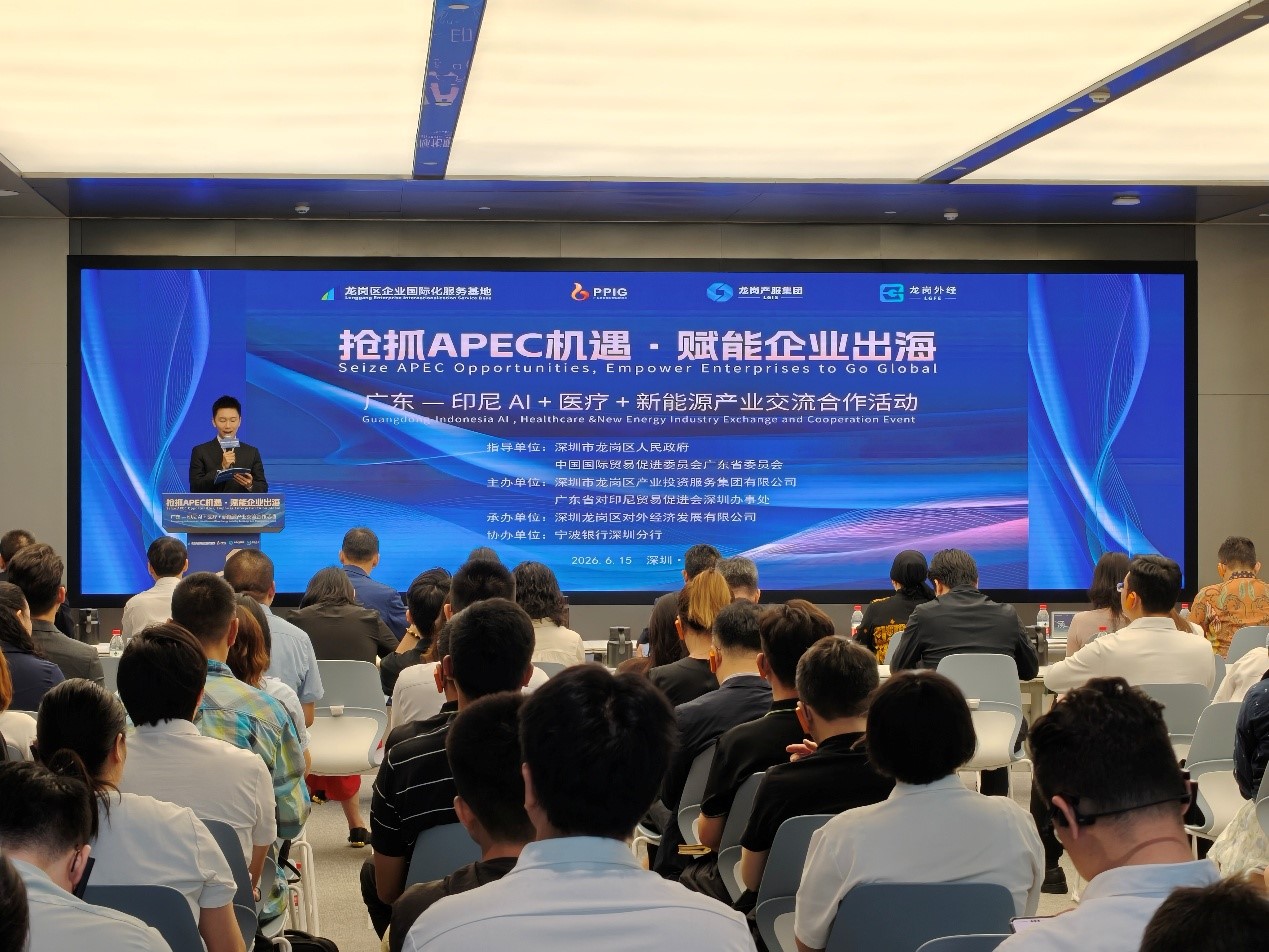
Officials and business leaders have voiced strong confidence in bilateral industrial cooperation between Guangdong province and Indonesia, citing robust trade ties and high industrial complementarity, as Guangdong companies accelerate investment and project rollouts in Asia-Pacific Economic Cooperation (APEC) member economies.
“Indonesia stands as a core Association of Southeast Asian Nations economy with a huge market and strong demand. Coupled with the policy dividends brought by the Regional Comprehensive Economic Partnership, ‘going global’ has become a key choice for Chinese enterprises to explore overseas markets, ease domestic competition and extend industrial chains,” said Wang Yuanyuan, executive director of the Association of Guangdong-Indonesia for the Promotion of Trade.
She made the remarks at a Guangdong-Indonesia exchange and cooperation event focusing on artificial intelligence, healthcare, and new energy industries in Shenzhen’s Longgang district on Monday.
Andalusia Tribuana Tungga Dewi, acting consul general of Indonesia in Guangzhou, said Guangdong’s technological strengths fit well with Indonesia’s vision to turn itself into an AI-powered nation, with a focus on such areas as economy and finance, energy, natural resources and environment, health, education, and housing.
“For Chinese investors, the opportunities are concrete and immediate,” she said.
The diplomat pointed out three key areas of cooperation: first, developing data centers, cloud computing, and AI to boost Indonesia’s industrial capacity and productivity; second, joint pharmaceutical research and development and local production to build a sustainable healthcare ecosystem in the country; third, investments from Guangdong to advance its green transformation and low-carbon energy development.
Bilateral trade between Guangdong and Indonesia hit 178.6 billion yuan ($26.4 billion) last year, growing nearly 4 percent year-on-year and accounting for one-sixth of the total amount between China and Indonesia, according to official statistics.
Shenzhen-based telecom equipment maker ZTE Corp is ramping up efforts on the construction of network infrastructure and data centers across the Asia-Pacific region, with Indonesia being one of its key markets.
“Our ‘connectivity plus computing power’ strategy aligns well with APEC’s objectives of advancing the digital economy, inclusive AI application and bridging the digital divide,” said Cui Li, ZTE’s chief development officer.
“By leveraging our three business units of connectivity, computing power, and terminals, we are actively promoting digital connectivity and inclusive growth across the Asia-Pacific region.”
The company has partnered with more than 30 telecom operators in the region, deploying 5G services in Thailand, the Philippines, Vietnam, Indonesia, and other APEC economies.
“In Indonesia, we have completed the integration and upgrade of over 20,000 4G sites and the deployment of more than 7,000 new 5G stations for XLSmart within just eight months, helping it become the country’s first operator with nationwide 5G coverage,” Cui said.
In terms of computing power, ZTE has built more than 20 data centers for telecom operators and enterprises in Southeast Asia. Over 10,000 data center racks have been deployed, with a total capacity hitting 100 megawatts.
Yang Ling, deputy general manager of Shenzhen tech firm BFTD Technology Co Ltd, said the company has encountered hurdles in expanding overseas, including challenges in securing suitable local distributors and high platform service fees.
Praising the Longgang district government’s efforts in addressing enterprises’ needs, Yang said the bridge that the authorities built helps the company relieve its financial burden and enhance its overseas competitiveness.
Chen Ziyu contributed to this story.
Contact the writers at sally@chinadailyhk.com
