

A veteran editor has spent 43 years compiling the religion's scriptures, driven by a determination to keep ancient wisdom accessible, Wang Xin reports in Shanghai.
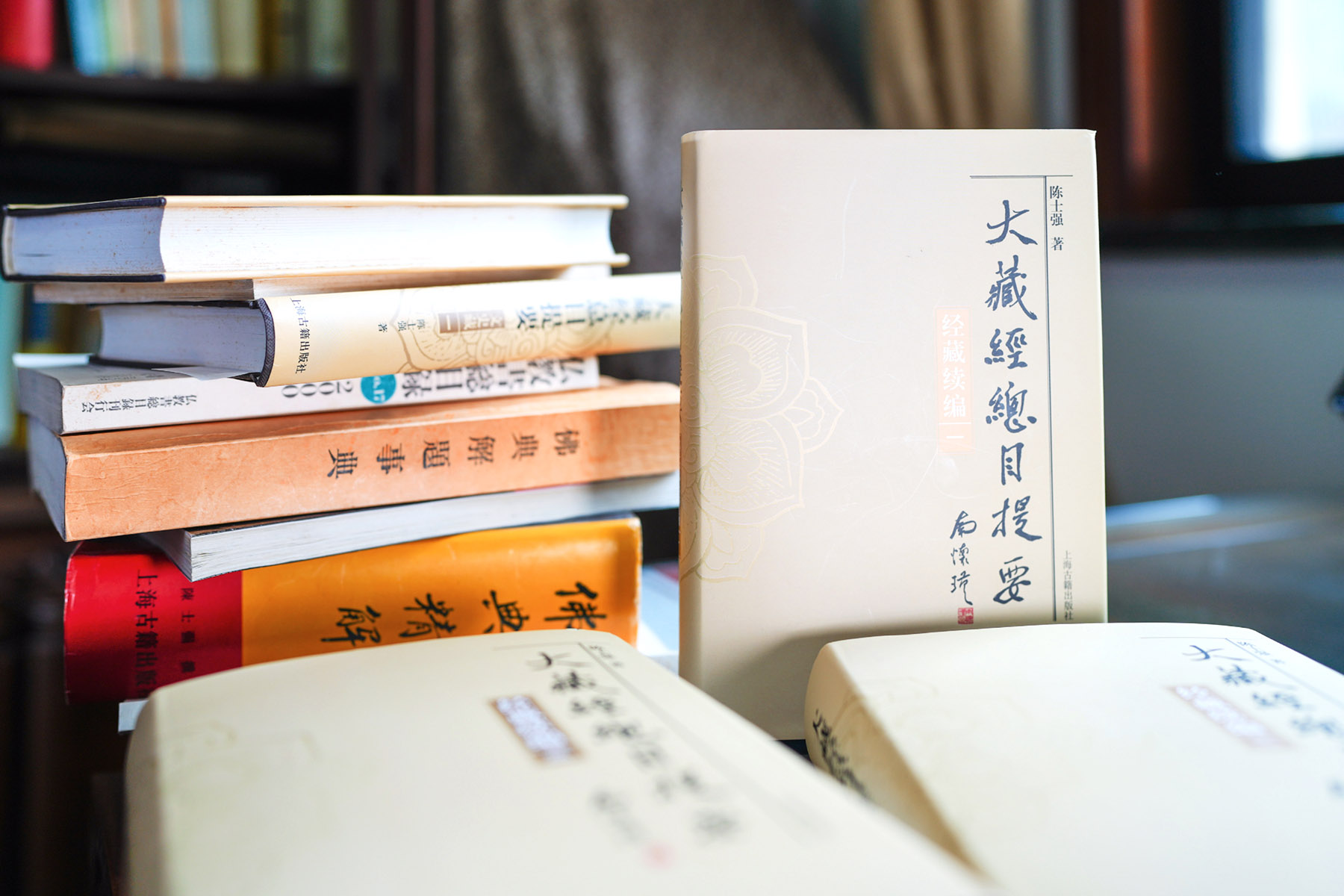
Chen Shiqiang, a 76-year-old senior editor at Fudan University Press in Shanghai, could hardly hold back his tears when he touched his newly published books, a massive Chinese Buddhist philology masterpiece that he has been working on singlehandedly for 43 years.
Three books of the General Catalogue and Synopses of the Chinese Buddhist Canon were recently published by Shanghai Ancient Books Publishing House, bringing the collection's current total to 13 volumes.
Comprising a total of 1,473 Buddhist works in 8,246 volumes, the collection, with about 6.7 million characters, provides a detailed guide through Chinese Buddhist scriptures of successive dynasties. It is also believed to be the most authoritative and comprehensive reference work in the field of Chinese Buddhist scriptural studies to date.
The work currently comprises two volumes on classic Chinese Buddhist works first published in 1992(revised and reprinted in 2008), three volumes on Hinayana Buddhist sutras published in 2007, two volumes on Vinaya texts published in 2015, three volumes on Abhidharma published in 2019, and the latest three volumes on Mahayana Buddhist sutras released in March.
Among them, the sutra is the source of basic Buddhist teachings, which is believed to be the actual words of the Buddha. Vinaya usually refers to the collection of canonical texts outlining the rules of conduct and discipline for Buddhist monks and nuns. Meanwhile, Abhidharma, or commentaries, refers to works on various Buddhist scriptures that are attributed to masters and offer commentary on the words of the Buddha.
"Originating in ancient India, Buddhist scriptures were translated and expounded in classical Chinese after their introduction to China. However, the vast majority of these texts lack punctuation and annotations. They are profound yet obscure, abstruse, diverse and complex, making them very difficult to read and understand," Chen explains.
All these factors present significant challenges to the reading and study of Buddhist scriptures, which motivated Chen to create a specialized reference book on Buddhist studies to provide basic guidance and assistance for today's researchers.
Thus, in June 1983, he embarked on this journey with no end in sight. Rather than brief annotations or dictionary-style entries on Chinese Buddhist scriptures, he expects to complete a collection that provides comprehensive information and detailed summaries of the core content of each scripture — in a modern way and using layman's terms.
Almost devoting his entire life since then to sorting out Buddhist scriptures, Chen says he simply does not wish to see these millennia-old classics become incomprehensible texts to modern readers.
Chen notes that the collection provides a detailed analysis of each scripture, covering its title, number of volumes, origins of translation and composition, version history, chapter structure and core philosophical principles, while also addressing the tracing of origins, the collation of variant texts, and the correction of historical inaccuracies.
"I am not merely compiling an index for a single edition of the Tripitaka, but rather synthesizing all editions from the Song Dynasty (960-1279) through to modern times, to create a truly comprehensive reference work on Buddhist studies," says Chen.
Fate and faith
This path has never been easy for Chen, yet he pursues it with determination, as if it were his destiny.
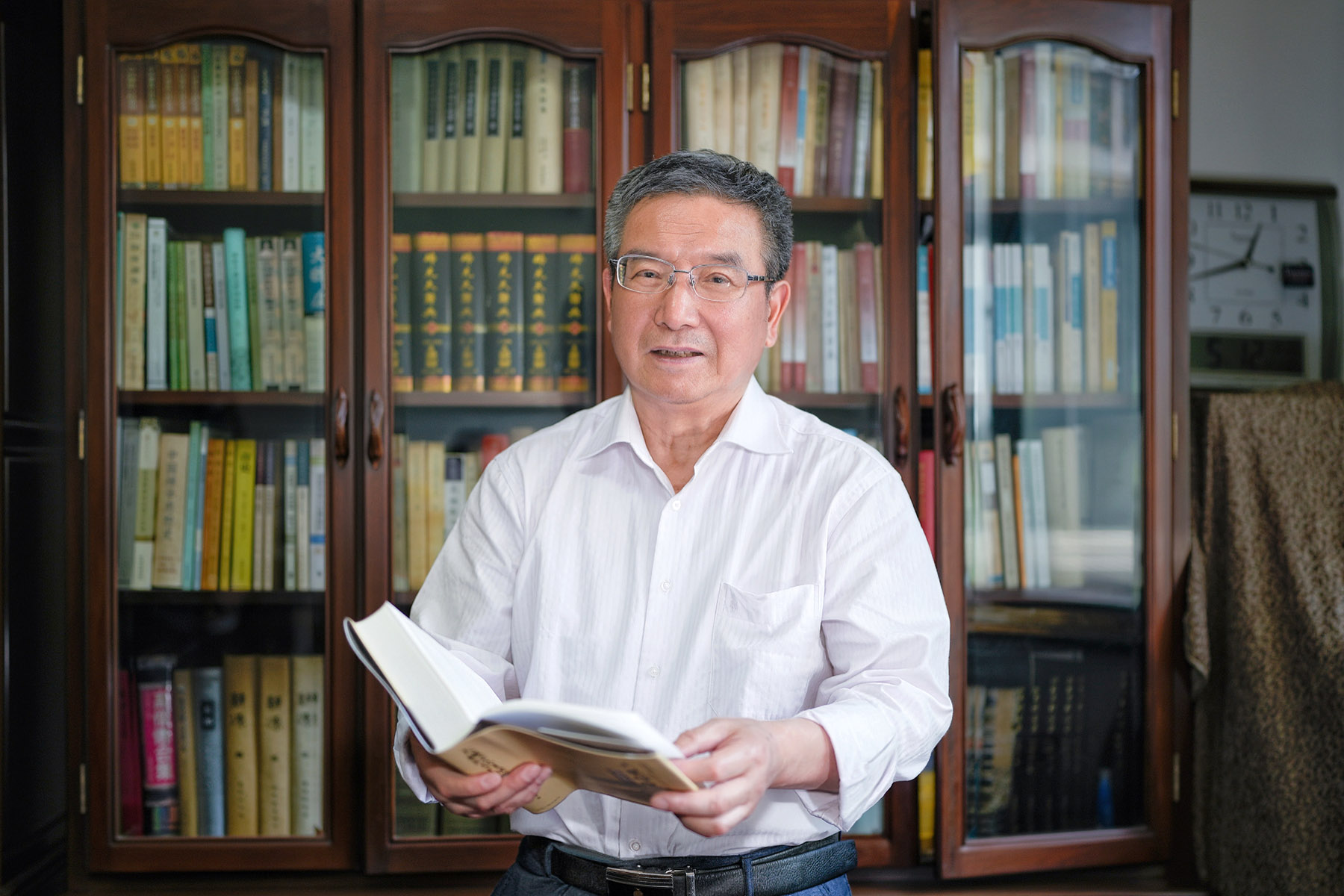
Born in 1949 in Zhuji, Zhejiang province, Chen was recommended to join the Department of Philosophy at Fudan University in 1973 and stayed at the school as an instructor after graduation.
Chen was not a Buddhist and knew barely anything about Buddhism before stepping into the university. However, Fudan, as one of the earliest universities in China to systematically conduct research and teaching in religion, boasts a long-standing tradition and deep-rooted heritage in Buddhist studies and research. In 1979, the university officially launched the research direction of Buddhist studies for the first time, and Chen — who was good at classical Chinese — became the only master's student admitted into the program.
That marked the real beginning of Chen's story with the Chinese Buddhist Canon. After earning his master's degree, Chen joined Fudan University Press in 1984 and continued his academic research on Buddhist philology.
Over the past four decades, Chen has edited and published more than 200 books on philosophy and social sciences. The editing experience has continuously expanded his knowledge in various fields and categories, laying a solid foundation for the writing of the vast Buddhist collection.
"Buddhist classics engage with ancient Chinese and Indian civilizations. They are not only religious works, but also historical records involving all kinds of knowledge such as philosophy, geography and arts. The massive books I edited before are carved in my mind, and later became the basis for me to understand those classics," says Chen.
The collection includes detailed accounts of Buddhist doctrines, figures, events, rituals, festivals, activities, temples, artifacts and terminology over the past millennia, as well as covering a wealth of knowledge across various fields such as history, philosophy, literature, ethics, education, linguistics, logic, psychology, customs, geography, astronomy, medicine, architecture, sculpture, painting and music.
It is a huge task that is not profitable, but requires superhuman determination and effort, which may also explain why no similar works have ever been completed before. To achieve his ambitious goal, Chen has given up all his spare time since the 1980s — not even spending time watching TV.
"It is hard — very, very hard," Chen said at a panel meeting held at Fudan University on May 21 to mark the release of the updated collection.
But he told China Daily that he had never thought about quitting this epic work. He would always recall the legendary trek made by Tang Dynasty (618-907) Buddhist monk Xuanzang on his westward pilgrimage more than 1,300 years ago.
"He risked his life to bring the Buddhist scriptures back. He, like other ancient sages, sought neither fame nor personal gain, but built a cultural Silk Road. If no one today interprets them, his life, efforts and sufferings would be all in vain. I am always deeply moved by their spirit of self-sacrifice," says Chen.
In the days before computers, a pen and a stack of paper were his only companions. For each scripture, Chen would read through the original text intensively at least three times, and pore over obscure passages repeatedly while making in-depth comparisons and cross-references.
He regards this work as the foundation for future Buddhist research in China, likening it to the first step laid at the foot of a mountain."Future researchers, like climbers, can now continue their ascent to the top by stepping on these steps," says Chen, smiling in relief.
Chen's efforts also align with the nation's and the university's exploration of developing a system of philosophy and social sciences with Chinese characteristics, which incorporates the country's socialist practices, and contributes more wisdom and strength to the nation's modernization drive and cultural heritage.
"The collection is a major achievement in the compilation and publication of ancient Chinese Buddhist historical and cultural texts. It is not only an indispensable authoritative reference book in the fields of Buddhist philology, religious studies and Chinese philosophy, but also serves as a solid bridge for the wider general public to engage with China's outstanding traditional culture," says Fang Ming, deputy Party secretary of Fudan University.
Chen's journey still continues. Despite his vision being severely impaired by decades of desk work, which limits him to reading for only about 15 minutes at a time, he is still relentlessly marching toward the end of the collection.
"I intend to devote the remainder of my life to compiling the 300-plus Esoteric Buddhist scriptures, so that the collection will cover Mahayana and Hinayana sutras, Vinaya and Abhidharma in full, as well as the scriptures of both the exoteric and esoteric traditions," says Chen firmly.
Contact the writer at wangxin2@chinadaily.com.cn
