

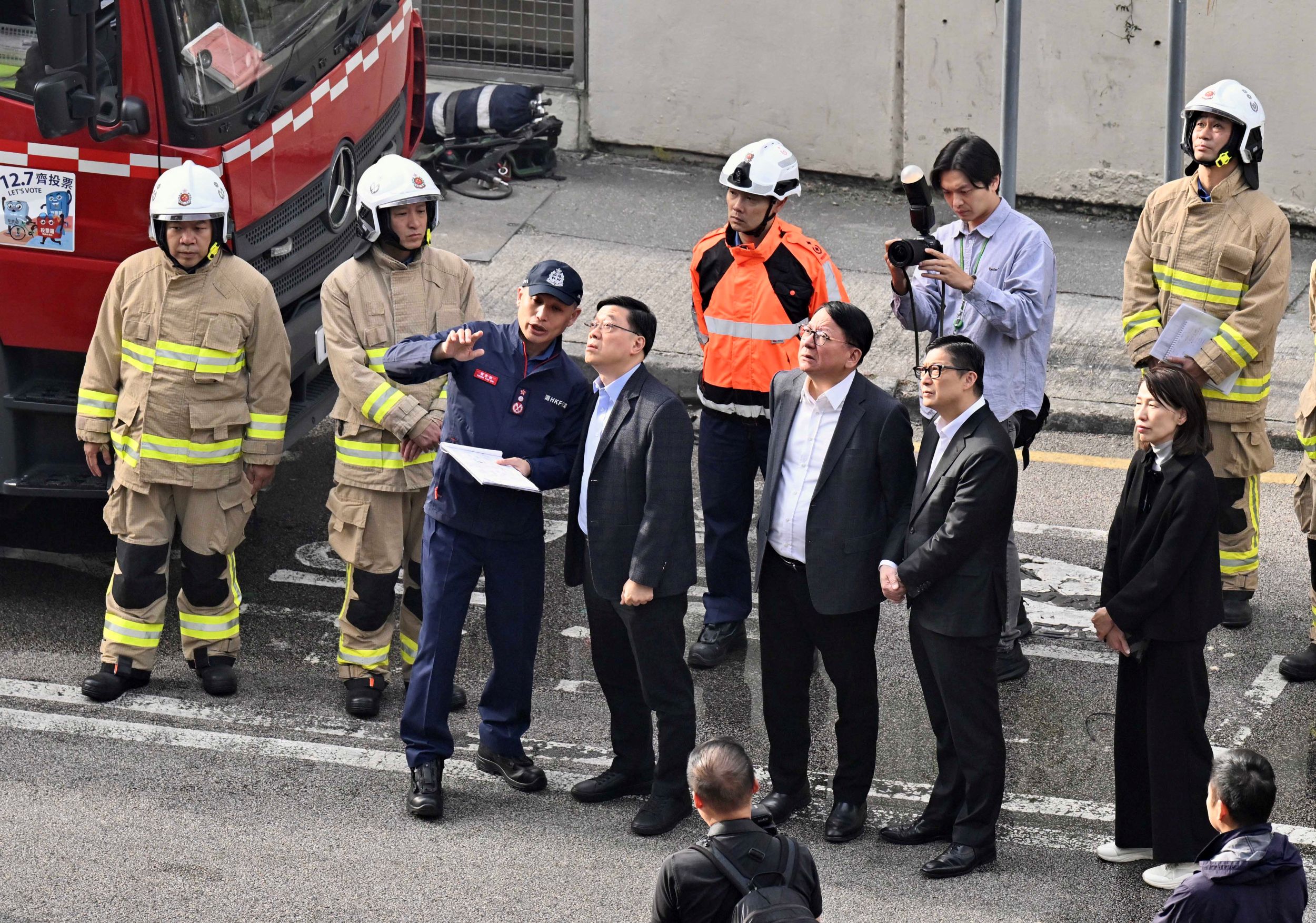
An independent committee investigating November’s deadly Tai Po fire heard on Friday that city authorities are contemplating heavier penalties for failing to report damaged fire-safety equipment and for delays in submitting annual inspection certificates.
Fire Services Director Andy Yeung Yan-kin, the first government department head to testify at the evidentiary hearings, said authorities are considering increasing the penalties by five to 10 times, including imprisonment, and designating property-management companies as liable parties.
The Fire Services Department is also studying the introduction of a license renewal system for fire-service installation contractors, requiring them to renew their licenses every three to five years. During the approval process, the department will consider a number of factors, including a contractor’s prosecution record and demerit points, to disqualify poorly performing contractors.
The department is also drafting another amendment requiring contractors to apply before shutting down any fire-safety facility. Under the proposed changes, the department would assess whether a shutdown is necessary and whether alternative equipment has been placed in the building.
The draft amendment is expected to be presented to the Legislative Council in May, with hopes of completing the legislative process this year.
But Yeung said the department will not wait for the amendment to take effect, as officers already scrutinize fire-device shutdown notices in detail to weed out unnecessary shutdowns.
Even when a shutdown is deemed necessary, the shutdown period will be limited to 60 days, after which a fire hazard removal notice will be issued. He also defended the current practice of requiring an extension application every 14 days, saying it helps ensure a contractor stays on the job.
Regarding earlier testimony from some FSD officers that fire hazards, such as plastic-foam-sealed windows and movable boards installed in the estate’s emergency staircases, should fall under the Buildings Department’s responsibility, Yeung agreed that the FSD also has the authority to regulate them, as the department has a duty to protect human life.
He said that in practice, the FSD needs to coordinate with the Buildings Department to complement each other’s expertise and achieve a clearer division of work.
Many residents thanked front-line firefighters for their rescue operation, but the committee’s lead counsel, Victor Dawes, said a significant number still believe their complaints about fire safety facilities and materials remain unaddressed. He cited an email on Thursday from resident witness Yip Ka-kui, who said he was distressed over the failures.
“The ultimate responsibility lies with the Fire Services Department,” Dawes said. “We cannot prevent all fires from happening, but how to enforce the law and how to eliminate fire risks are your duties.”
Meanwhile, a government statement issued on Friday announced that the Security Bureau, which oversees FSD, is working on amending the Fire Services Ordinance and relevant subsidiary laws, and has actively consulted relevant stakeholders.
Proposed amendments include requiring FSD approval for shutting down major fire-safety systems, making it a crime to misuse or tamper with such facilities, and establishing statutory duties for property management companies to maintain fire safety. The amendments will also make the semiannual fire alarm test a legal requirement, and introduce fixed fines for easily proven violations, such as blocking escape routes.
Penalties for registered fire service installation contractors issuing false or misleading certificates would increase, with liability extending to management and directors. FSD officers would also be granted stronger enforcement powers.
The bureau plans to consult LegCo’s security panel in May, followed by public consultation, aiming to submit the bill to LegCo for scrutiny by the end of this year.
Contact the writers at stacyshi@chinadailyhk.com
