

Lingnan University researchers have supplied key data from a carbon emissions source database to support the Multi-Spectral Imaging Carbon Observatory – a scientific payload developed by The Hong Kong University of Science and Technology that has been installed on the nation’s Tiangong space station.
Hong Kong’s first astronaut, payload specialist Lai Ka-ying, was chosen on Saturday to be among three crew members of the Shenzhou XXIII manned space mission. She’s due to board a spacecraft and be lifted into space from Jiuquan spaceport, Gansu province, at 11:08 pm on Sunday.
During Lai’s six-month stay aboard the Tiangong, she’ll use the Hong Kong-made MUSICO to carry out multiple scientific experiments to track greenhouse gases from orbit.
RELATED ARTICLES
- Tiangong to use HKSAR-made ‘eye for space’ to detect emissions
- First HK astronaut to join Shenzhou XXIII space mission
- Lee: HK’s first astronaut a historic moment in city’s aerospace dream
The database used by MUSICO was developed by Li Jia, director of Lingnan University’s Shenzhen Research Institute, and her colleagues.
Analyzing more than half of China’s carbon dioxide emission sources, the database records emission volumes down to one square kilometer with precise geographic coordinates, and functions as a “map and navigation system” for MUSICO to pinpoint emission sources from space.
“This enables the instrument to observe the large-scale distribution of greenhouse gas concentrations, and also analyze emissions from individual factories or facilities with greater precision, thereby increasing the accuracy and scientific value of space-based observation data,” Li said.
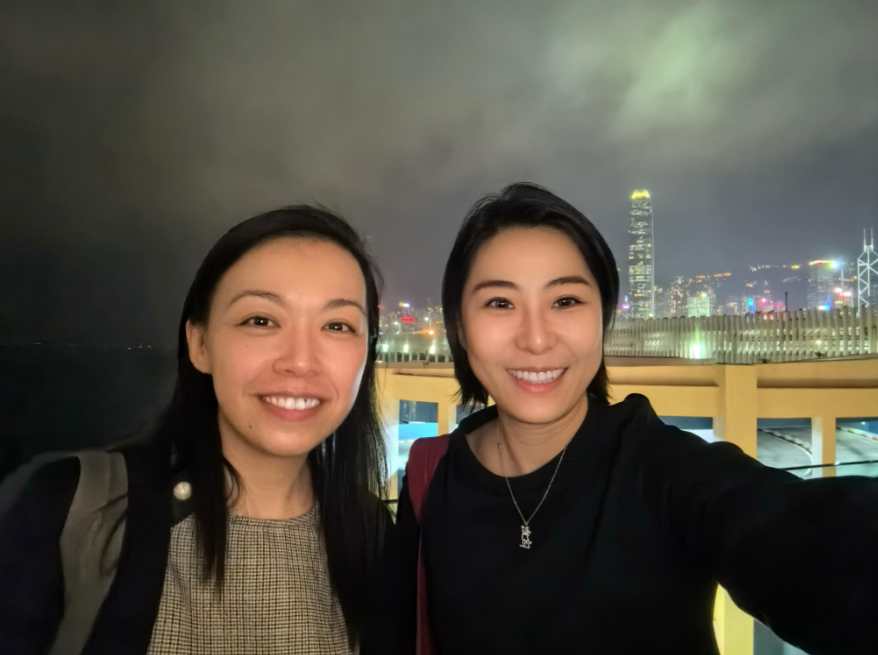
Li said he has known Lai for over three years, noting they both understand the importance of tackling climate change and achieving carbon neutrality for China and the world, and that they hope to work together to contribute to the country.
Joe Qin Sizhao, president of Lingnan University, said the participation of the institution’s researchers in national space and carbon monitoring projects reflects the university’s “Liberal Arts + Technology” strategy and its strength in interdisciplinary research that addresses real-world issues.
Contact the writer at stacyshi@chinadailyhk.com
