

A high bridge slashes travel time, brings people home, and turns a remote valley into a thriving destination, Yang Feiyue reports in Jishou, Hunan.
The steps are slick with salt. A late-January cold snap has glazed the walkway in thin ice, and a sharp wind rises from the canyon floor, cutting clean through thick winter clothes.
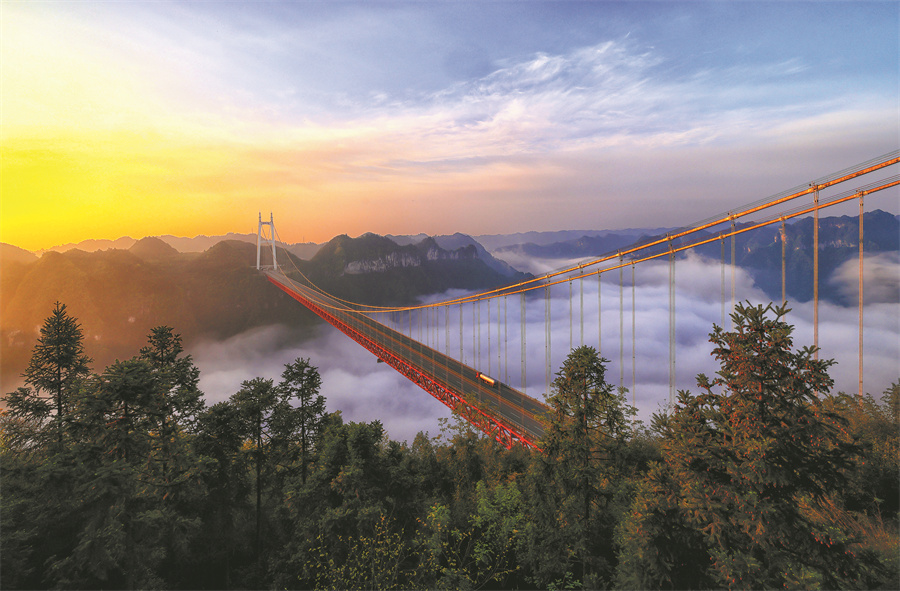
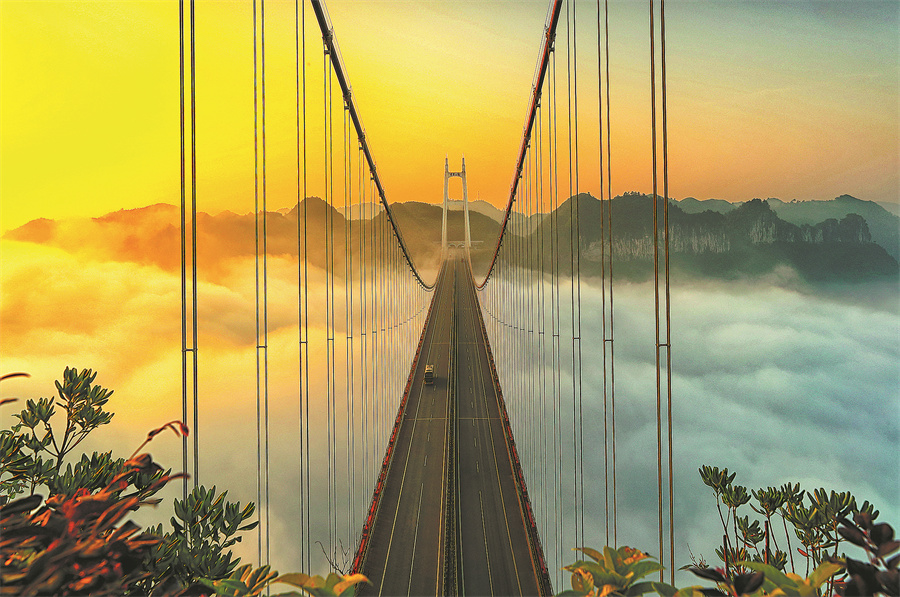
"Walk on the sides," guide Shi Xiuzhi cautions her guests. Behind her, suspended hundreds of meters above the floor of the Dehang Grand Canyon is the Aizhai Bridge, a 1,176-meter sweep of steel and cable.
When it opened in 2012 in the Xiangxi Tujia and Miao autonomous prefecture in western Hunan province, it was one of the longest suspension bridges in the world to span a canyon.
ALSO READ: Tracking a mountain of history
"When I was a student, it took me four or five hours to get home from school," Shi says, recalling life before the bridge was built.
"My grandparents had never been to the city. Back then, it seemed that the birds couldn't fly out of these mountains."
The mountains have never been easy to cross. In the 1930s, as war swept across China, a "wartime lifeline" was carved into these cliffs. More than 2,000 laborers, carrying their own food and tools, spent seven months chiseling out what became the Aizhai Highway.
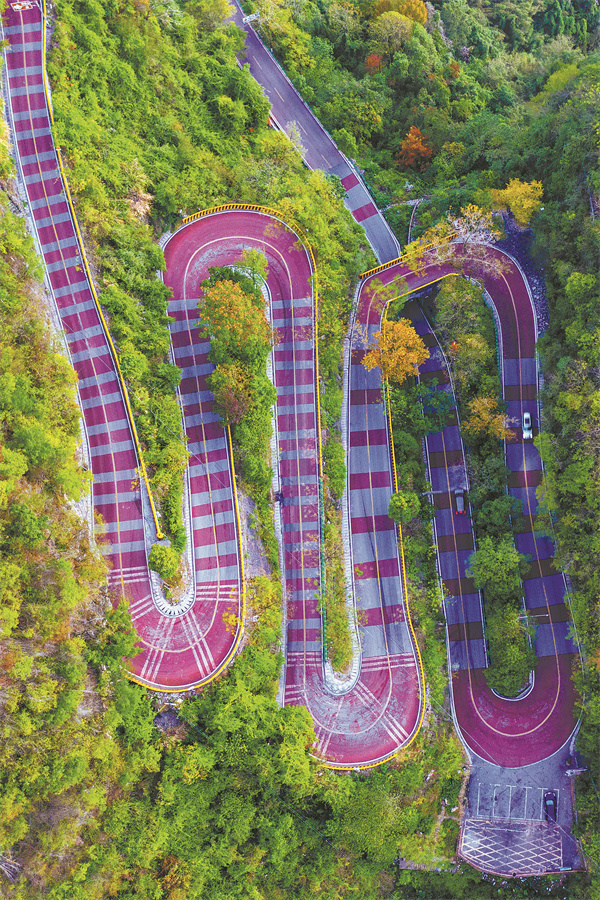
The road they built stretched barely 6 kilometers, yet it twisted through 13 hairpin turns carved into a slope only a few hundred meters high. In places, 26 switchbacks seemed stacked almost on top of each other.
Locals had a saying: "Aizhai slope, mountains upon mountains, 13 turns — each turn, a gate to hell."
Traffic jams could last half a day, and accidents were frequent, sometimes fatal.
In 1992, the Aizhai traffic police squadron was formed. With no flat ground to stand on, the officers built a post in the trees — a few wooden planks nailed between branches, hanging over the cliff's edge. From this precarious perch, they directed traffic, suspended in midair.
By 2004, the provincial authorities had approved a new highway linking Jishou, the urban heart of western Hunan, to Chadong, a town located on the border with Chongqing.
But one challenge remained: they had to cross the Dehang Grand Canyon — a chasm more than 1,000 meters wide, with a 500-meter drop. They had to do it without destroying the fragile canyon ecosystem.

"The microclimate here is extreme," says Zhang Yongjian, a former deputy chief engineer of the bridge project.
Fog blankets the area for nearly half the year. Winter temperatures on the mountain run five degrees lower than in the valley below, sharply limiting the construction window, Zhang adds.
After three years of planning, the engineers arrived at a solution. They separated the towers from the deck. The towers were placed on the peaks, while the deck was suspended below.
This single innovation reduced excavation by 700,000 cubic meters — enough earth to fill a soccer field to the height of a 20-story building.
"This design adapted to the terrain and protected the natural environment on both sides," Zhang says.
When the bridge opened on March 31, 2012, the transformation was immediate: a journey that once took 30 minutes was reduced to just one minute.
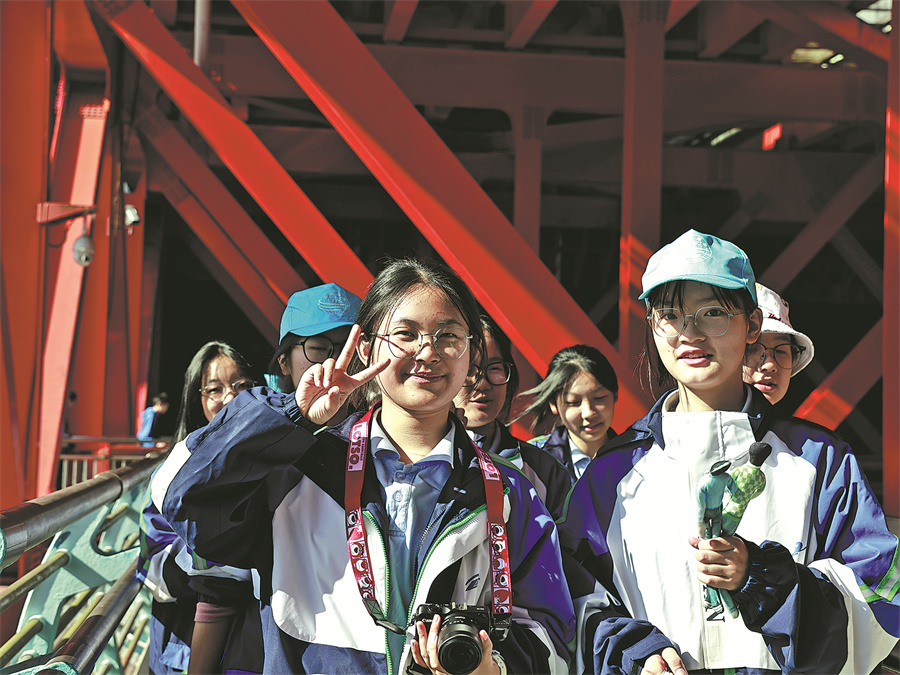
Visitors from across China and abroad traveled to see the engineering feat, recalls Shi, who has spent more than a decade guiding tourists.
During peak season, domestic tourists fill the bridge, with 10,000 people a day — the maximum limit. International travelers from Thailand, Cambodia and Vietnam are now a familiar presence, she says.
She still vividly remembers guiding an Italian tour group. Through a translator, they told her the difference between bridge-building in their country and here was "like heaven and earth".
"That moment, I felt so proud," she says.
Halfway across the bridge, Shi stops to mark the highest point of the bridge — 355 meters above the canyon floor. The walkway runs seven meters below the roadway. It gives visitors chills whenever cars race overhead, as the bridge vibrates faintly.
"This is also where the bungee jumping platform is. Visitors pay to leap off the bridge," Shi says.
"Many are young women, and foreigners love it, too."
Over the course of her career, Shi has watched the landscape around her transform. The high-altitude attractions, including bungee jumping, the skywalk and the giant swing, were added in 2021. A cliffside inn opened the same year.
Shi and her husband both work in tourism now. "We don't worry about money anymore," she says.
At the end of the tour, she leads her group back carefully, checking for icy patches and guiding them around slick spots.
Below, the old winding mountain road is still there, folded against the mountain like a silk ribbon. The treetop police post is gone, and traffic along the old highway has thinned significantly, according to local authorities.
Today, the Aizhai Bridge, together with the Dehang Grand Canyon and local Miao villages, forms a tourist attraction.
Drums greet visitors in rhythm with centuries of tradition in these ethnic villages, while extreme sports on the bridge draw thrill-seekers from around the world.
Along the mountain roads, cycling races and marathons now unfold against a backdrop of sheer cliffs and emerald peaks.
The steady flow of visitors has also fueled local businesses. Restaurants and guesthouses line the approach roads, catering to growing demand.
It has helped open the relatively secluded Xiangxi prefecture and attract many workingage residents who had left to return home.
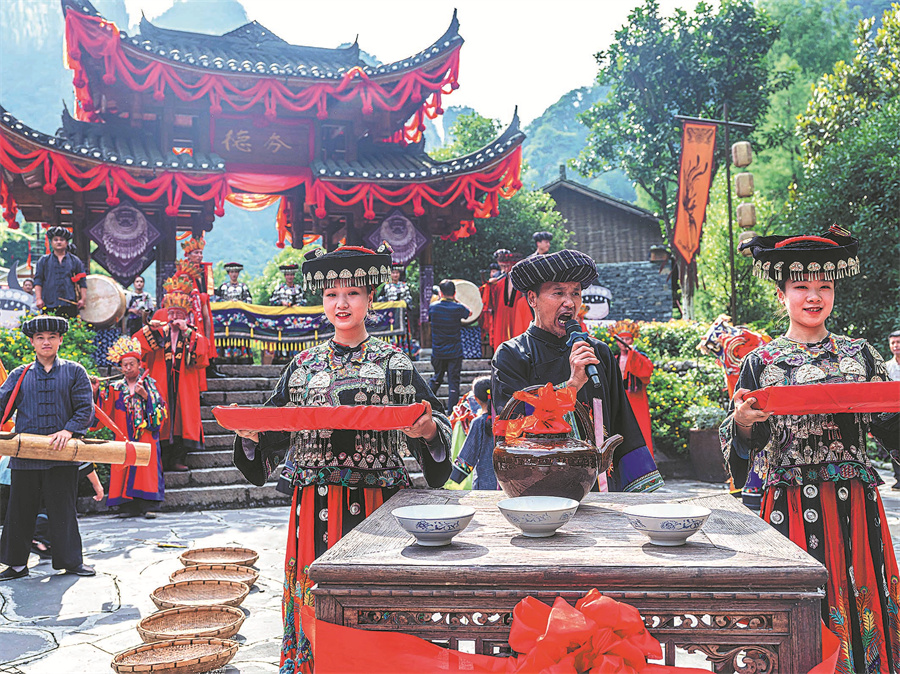
Shi was one of them.
"You hardly saw young people here. Now, they are coming back," she says.
Eighteen kilometers away lies Shibadong village — where a national poverty alleviation campaign was first articulated in 2013. Improved transportation has brought a steady stream of visitors eager to experience local culture and crafts.
Among them is Miao embroidery, a traditional skill now finding new markets.
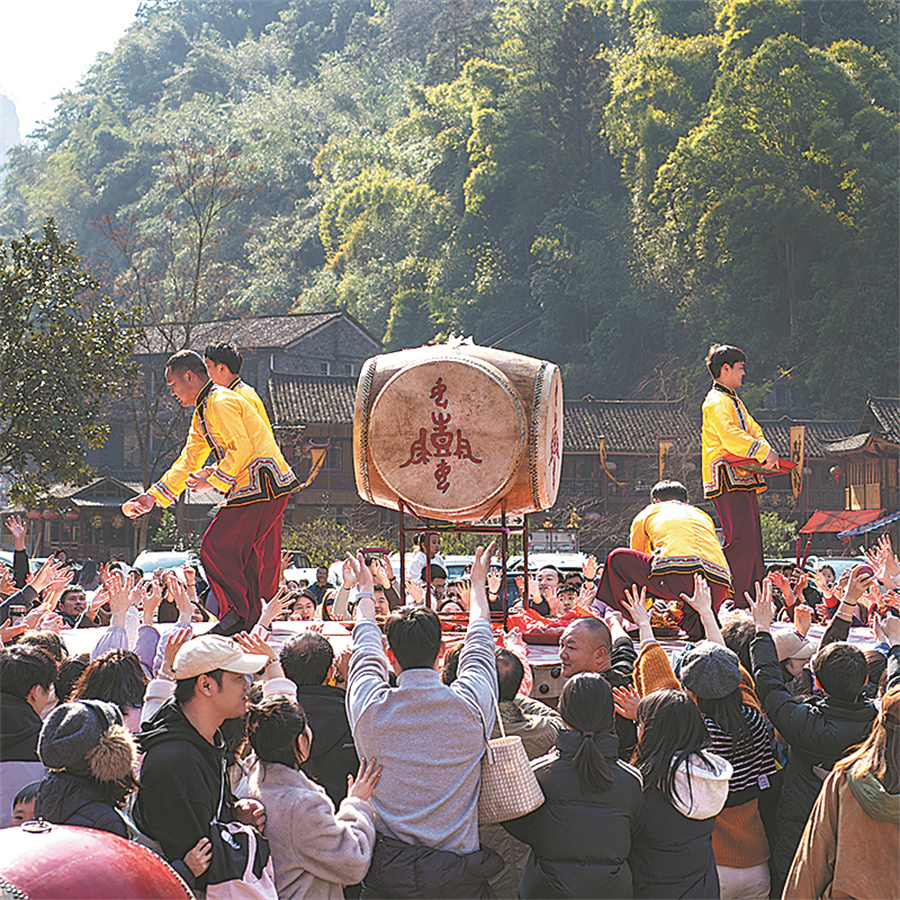
Shi Yanqin, a villager from Shibadong, notes that her embroidery work, along with that of many other local women, is increasingly in demand among tourists.
Wang Shouyong, who runs a travel business in the Dehang canyon area, has witnessed the transformation firsthand.
"It is a living example of turning a natural chasm into a thoroughfare, and then turning that thoroughfare into a catalyst for rural vitalization," he says.
