

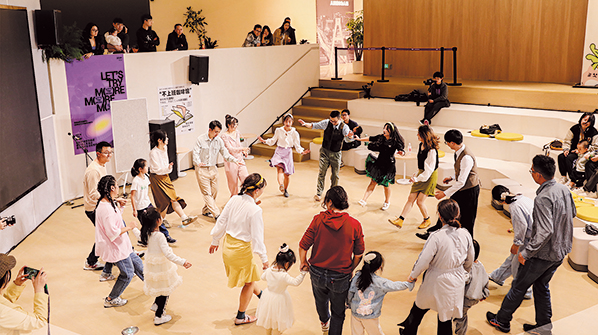
Every morning at 8 am, 24-year-old Yin Wenliang leaves his apartment in Chengdu's Gebizi Community, hops on his electric bike, and rides about 10 minutes to work.
Originally from Neijiang in Sichuan, Yin has spent the past six years in Chengdu, first as a university student and now as a young professional. He rents a 29-square-meter apartment in Gebizi for about 1,500 yuan ($217.03) a month, utilities included — an affordable option for someone just starting out.
But for Yin, the appeal of living here goes beyond rent.
READ MORE: Chengdu a tale of a city with both leisure and diligence
After work, he often heads to the community's 24-hour gym, where he runs on the treadmill with mountain views on clear days. He then grabs dinner at the canteen, where the food is varied and reasonably priced. When he wants a quieter moment, he visits the Chengdu Library branch within the neighborhood.
"Gebizi is not just a place to sleep — it reflects the kind of life young people want in Chengdu," he said.
Developed by Chengdu Rail Transit Group, Gebizi is part of a government-supported rental housing initiative aimed at easing the pressure on young newcomers.
More than 80 percent of residents are under 30, and over 90 percent are from outside Chengdu. Many are part of a growing group known as "rongpiao" — or "drifters in Chengdu" — who come in search of opportunity and a sense of belonging.
"In the Sichuan dialect, 'gebizi' means 'neighbor'," explained Zhu Keyan, who oversees the community's operations.
While Gebizi represents newly built housing, other efforts in Chengdu focus on giving older neighborhoods a second life and making the city more youth-friendly.
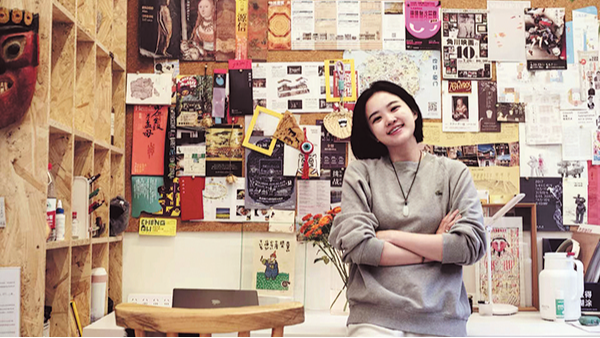
Yang Yingqi, 31, is one of the people behind that transformation. In 2019, she founded Dachengxiaocun, an organization focused on revitalizing aging communities. Since then, she and her team have been working in Beilei Community, drawing on her background in urban planning, rural development, and cultural tourism.
"Before 2021, this area had little vitality," Yang said. "Most of the shops were massage parlors, pharmacies, or noodle places. The buildings were old, and young people were leaving."
Yet older neighborhoods have their own strengths. Beilei's narrow, pedestrian-friendly streets encourage a slower pace of life, while the flexible hours and styles of its shops give young entrepreneurs room to experiment.
One example is Chaos, a space designed and operated by Dachengxiaocun. It combines a vegetarian restaurant, a small retail shop, and a community center. The shop curates products around a different theme each month, and the center is open free of charge for public events.
"This kind of 'non-standard economy' is appealing to young people," Yang said. "When one creative person moves in, it brings others. Gradually, a community forms."
Ideal landscape
For Yang, a truly youth-friendly community rests on a few key ideas.
First, it needs to be affordable — not just for living, but also for creating and starting a business.
"Prime locations in Chengdu can be prohibitively expensive, but here in Beilei, the rent is reasonable," she said." With a subway connection, it's close to the city center and attracts steady foot traffic."
Second, diversity matters. "In the past, industrial parks were solely tech-oriented. But innovation doesn't come from one industry alone. It needs culture, art, and different kinds of people," she said.
Equally important are public spaces where you don't have to spend money." Young people today are surrounded by consumer culture," Yang said." Going out often means paying for something — a movie or a coffee. Older adults have access to free spaces, but what about young people?"
The free community center at Chaos is one answer to that question.

Gebizi follows the same approach. The community offers shared terraces, reading areas, and low-cost study cubicles for just 3 yuan an hour, along with open salon spaces that encourage social interaction.
Zhu describes the community's goal in three words: openness, co-creation, and warmth. She recalls one resident who chose the community's shared space to propose to his girlfriend.
"That's the kind of warm, joyful life we hope to create here," she said. "A real sense of belonging."
In Beilei, that sense of belonging often grows from small, passion-driven initiatives. For example, a resident created a Neighbors' Pickle Map, collecting recipes and stories from locals. An insect specimen maker offers free nature classes, while a middle school teacher leads children in a green living challenge.
"Our role isn't just to redesign space," Yang said. "It's about nurturing the community's own initiatives, empowering residents to shape their neighborhood."
For Yin, that spirit is what makes Chengdu feel unique. He joins Gebizi's evening classes and community events, finding ways to connect beyond work.
READ MORE: Xi, Macron have friendly exchanges in China's Chengdu
"Humans are social creatures. Life can't just be a straight line between work and home," he said.
Yin sums up the city in one word: acceptance.
"Chengdu's charm lies in the connections between people from different places who come here to build a life together," he said.
