

Overseas online writers follow formulas, cultural cues to build fan bases
Esther Akande, a 22-year-old Nigerian, sits in front of her laptop, crafting stories that bridge continents. Under the pen name Lilac Everglade, her fantasy novel Hades' Cursed Luna — a tale about werewolves, betrayal and forbidden love — has garnered millions of readers worldwide on WebNovel, the international portal of China's online publishing giant Yuewen Group.
"My first story earned me about 70 cents," Akande recalled. At the time, she was facing personal crises in both her family life and relationships. Yet, much like the "comeback kid" trope popular in Chinese online literature, Akande made her own turnaround.
"The income from web novels now covers my education and our home renovations. I don't need a man. I can do things when nobody is there for me," she said.
READ MORE: Web novelist turns into 'dream job' for many
Akande is one of millions of authors on international online literature platforms who are not merely consuming Chinese pop culture, but also utilizing its formulas to tell their own stories.
Global appeal
In Akande's story, the male protagonist is powerful and cruel. He seizes the female protagonist to exact revenge, only to unknowingly fall in love, triggering a heart-wrenching romance.
Sound familiar? Avid readers may find the story resembles the "alpha CEO genre", a staple of Chinese web fiction.
But what makes stories written by foreign authors feel so Chinese? The appeal may lie in the distinctive structures of Chinese web novels — rapid progression, satisfaction for readers and imaginative world-building.
"Chinese web novels focus more on humor and quirks," Akande observed. "Even when the novel is dark, there's always something that makes you laugh. The family relations and intrigue are always engaging. I got a lot of inspiration from Chinese novels I've read in the past."
Across the ocean in Mexico, a biologist-turned-author Daniel Dominguez, writing as Dagzo, found success with his novel Weakest Beast Tamer Gets All SSS Dragons. He adapted Eastern literary concepts of cultivation, which refers to spiritual evolution, through a biological lens.
"In Chinese novels, protagonists often gain enlightenment through 1,000-year essences," Dominguez explained. "As a biologist, I understand that in the forest, the mycelium network is the biggest organism. So I transformed that net into a magical network that connects with the entire world."
Dominguez had blogged for over a decade with limited success using traditional writing structures.
"I found web novel readers preferred fast-paced narratives with grand settings," he said." Using key phrases like 'weakest beast tamer'or 'SSS dragon' in my title creates immediate contrast and grabs attention in a crowded field, a technique I learned from Chinese platforms."
Beyond the attraction of magic themes, these writers also include Chinese values in their work.
"The Chinese concept of filial piety isn't a common literary theme in the Americas," Dominguez said. "But after reading Chinese novels, I realized how powerful parental relationships could be as a motivation. I incorporated that into my story, and readers responded instantly."
"While using Chinese elements, I focused on making them accessible to Western readers through familiar storytelling conventions," he added. "My aim is to create a bridge for readers new to Chinese fantasy, potentially leading them to explore more common and traditional works."
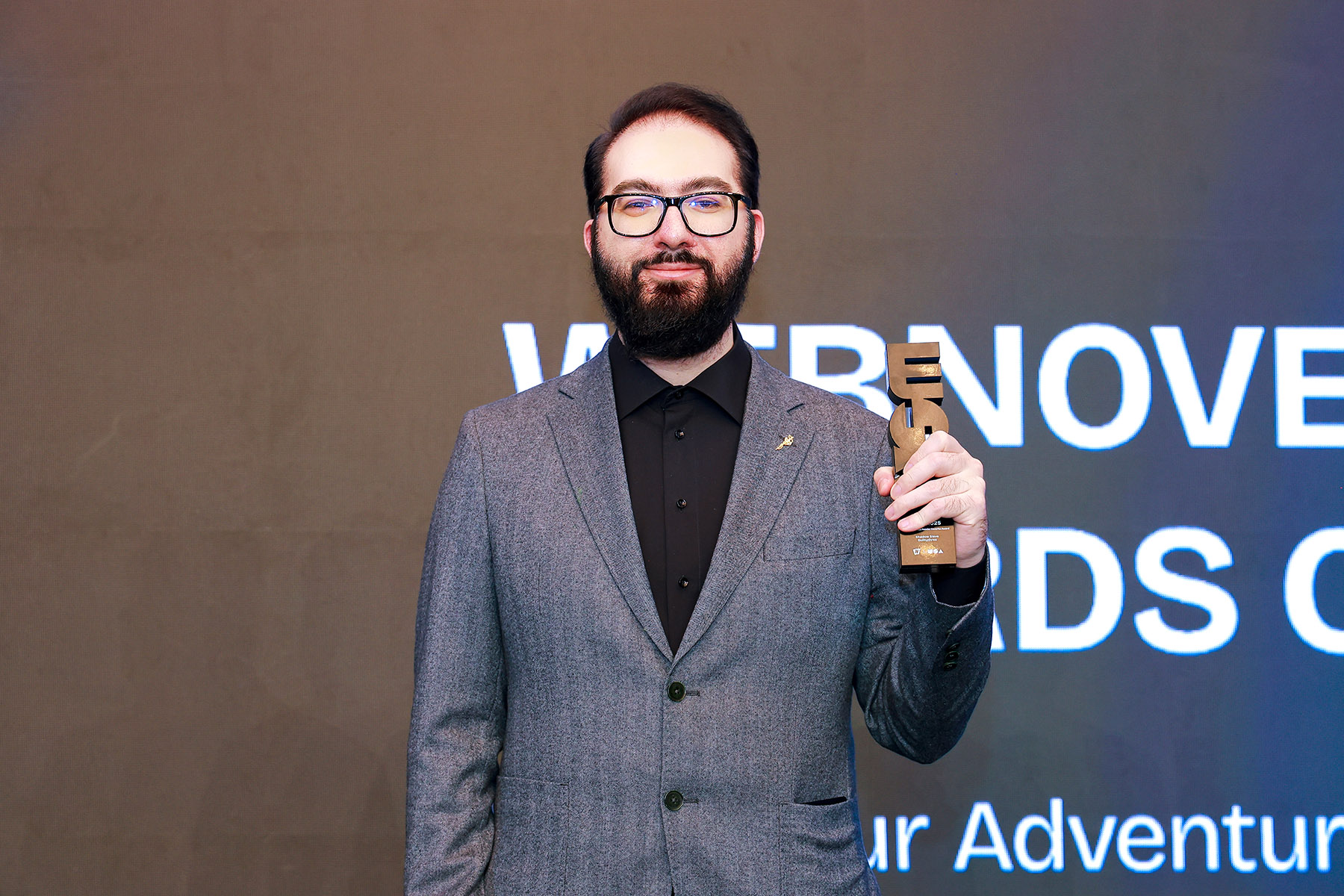
Russian writer Barisbi Alborov, known online as Guiltythree, also exemplifies this global reach. His novel Shadow Slave has amassed over 90 million reads. As a student of classical philology and theology, Alborov found that Western publishing trends had left him cold, but Chinese web novels rekindled his passion.
"I'm a huge fan of Chinese TV dramas and online novels. Since my inspiration comes from them, many Eastern fantasy tropes and the writing philosophy have deeply influenced my work," said Alborov, who has written approximately 3,000 words a day on his laptop for four years straight.
His daily routine is fixed: five hours of writing followed by two to three hours of reading comments, answering questions and interacting with fans.
Unlike traditional publishing, where writing is a solitary act, the online model relies on intense and real-time interactivity. Authors post chapters daily, and readers leave comments, creating a sense of shared ownership over the story.
He also finds that the medium has moved from a niche fan base into the mainstream of pop culture.
"You can see recommended content and fan creations about web novels on every social media platform now," Alborov said.
"There's even a popular meme: your fandom journey starts with anime, moves to comics, and ends at the 'holy grail of entertainment', which is web novels. It's seen as the ultimate form of storytelling for many people."
Industry shift
The numbers reflect the cultural trend. The overseas market for Chinese online literature reached over 4.81 billion yuan ($694.8 million) in 2024, marking 10.68 percent year-on-year growth. According to the 2025 China Online Literature Overseas Trend Report released at the 4th Shanghai International Online Literature Week, the sector's total revenue hit 49.55 billion yuan.
The statistics from the China Writers Association show that approximately 200 million overseas active users engage with Chinese online literature across more than 200 countries and regions. While Asia accounts for 80 percent of readers and an over 50 percent market share, North America holds a 30 percent market share, with Europe and Latin America emerging as new growth areas.
A more significant metric is the creators themselves. By 2025, over 1.3 million overseas authors had published more than 2 million original works on international platforms. Among them, WebNovel connects nearly 530,000 writers worldwide with nearly 400 million readers, yielding over 820,000 original works.
Technology is accelerating this growth. In 2025, AI-powered translation facilitated a leapfrog in content volume, with WebNovel adding over 10,000 new AI-translated works. This has shattered language barriers, allowing works written in Thai, Korean, Filipino and Turkish to achieve significant market breakthroughs.
Yet, industry leaders are now focusing on cultivating local ecosystems rather than merely exporting translations.
"Translating and transporting Chinese web novels is no longer enough," said Wang Zhongjie, general manager of Yuewen Group's overseas business.
"Global audiences crave short, concise, and fast-paced content. The instant gratification design inherent in online literature aligns perfectly with this trend."
"We are encouraging global creation," he added. "We hope to see a deeper integration with local communities overseas, cultivating a truly indigenous content ecosystem."
Wang said the future lies in technology and integration. "AI capabilities are enabling multilingual and multi-format content, unlocking enormous potential. For instance, a Latin American writer focusing on Eastern themes can now have their stories read globally in over 10 languages."
Wang Xingquan, director of the sci-tech innovation office at the Shanghai Academy of Social Sciences, views this as a fundamental shift in the global cultural map.
He said before 2015, global culture was dominated by the "California cluster", which mainly refers to Hollywood and Western pop."But with the mobile internet boom, China gained a first-mover advantage," he said.
"Chinese-style entertainment forms — web novels, short dramas and mobile games — are becoming dominant," Wang added. "It's not just about exporting content, but also about exporting a narrative system and a worldview that serves as a global cultural framework."
From digital to physical
As these digital stories gain traction, they are spilling over into the physical world. The challenge for the industry, however, is bridging the "cultural discount", the loss of meaning or nuance when a story moves from one culture to another.
Universal Studios Singapore integrated the popular web novel IP The Unruly Immortals into the attractions for its Halloween-themed festival last year. Fang Yu, head of China marketing for Resorts World Sentosa, described their approach as a "triple translation" — cultural, commercial, and industrial.
"We didn't just translate the text; we translated the story's core," she explained. They converted abstract Taoist concepts behind the IP into sensory experiences, including visual spectacles and non-player character interactions, which allowed international visitors to "feel" the culture.
"We found that on-the-ground cultural exchange is highly effective," Fang said. "Many of our Singaporean colleagues weren't familiar with the Taoist culture. But when we placed a cauldron in the setting, it sparked curiosity. Through explanation and immersive experience, they gradually understood. It also allowed tourists from around the world to connect with Chinese culture."
Similarly, the Switzerland Tourism partnered with the esports-themed novel The King's Avatar. Capitalizing on a "10-year pact" written into the novel's finale, where the protagonist leads a team to a tournament in Zurich in 2025, the tourism board launched a precision marketing campaign.
Last summer, several hundred fans gathered in Zurich for a 10-year promise event.
"This is not a short-term burst. It is a story grown from a community," said Yu Shiwen, the board's representative in China. "It revealed the potential of integrating IP with cultural tourism. It brings unprecedented precision, letting us know exactly who is visiting."
Tang Qiao, deputy director of the cyber research office at the Institute of Literature of the Chinese Academy of Social Sciences, emphasized that a successful cultural export requires emotional anchoring.
ALSO READ: Making a mint online
"Bringing stories into reality adds a new dimension of value," Tang said. "Immersive entertainment transforms users from readers to story participants. This experiential engagement fosters emotional resonance, allowing a natural transmission of values."
"Cultural discount often stems from surface-level symbols. But human emotional needs are universal. Good stories find that common resonance," she added.
For the writers, the impact can be personal.
Dominguez is looking toward his next chapter with a sense of responsibility. "I feel a moral debt to teach," he said. "The stories I read taught me more about being a good person. Even as entertainment, they speak to the good you must do in the world."
For Akande in Nigeria, this cultural bridge built by her laptop has redefined her horizon."Just getting out of the state I've always known to a different country has shown me that anything is possible," she said. "It has really changed my brain chemistry."
Contact the writers at zhengzheng@chinadaily.com.cn
