

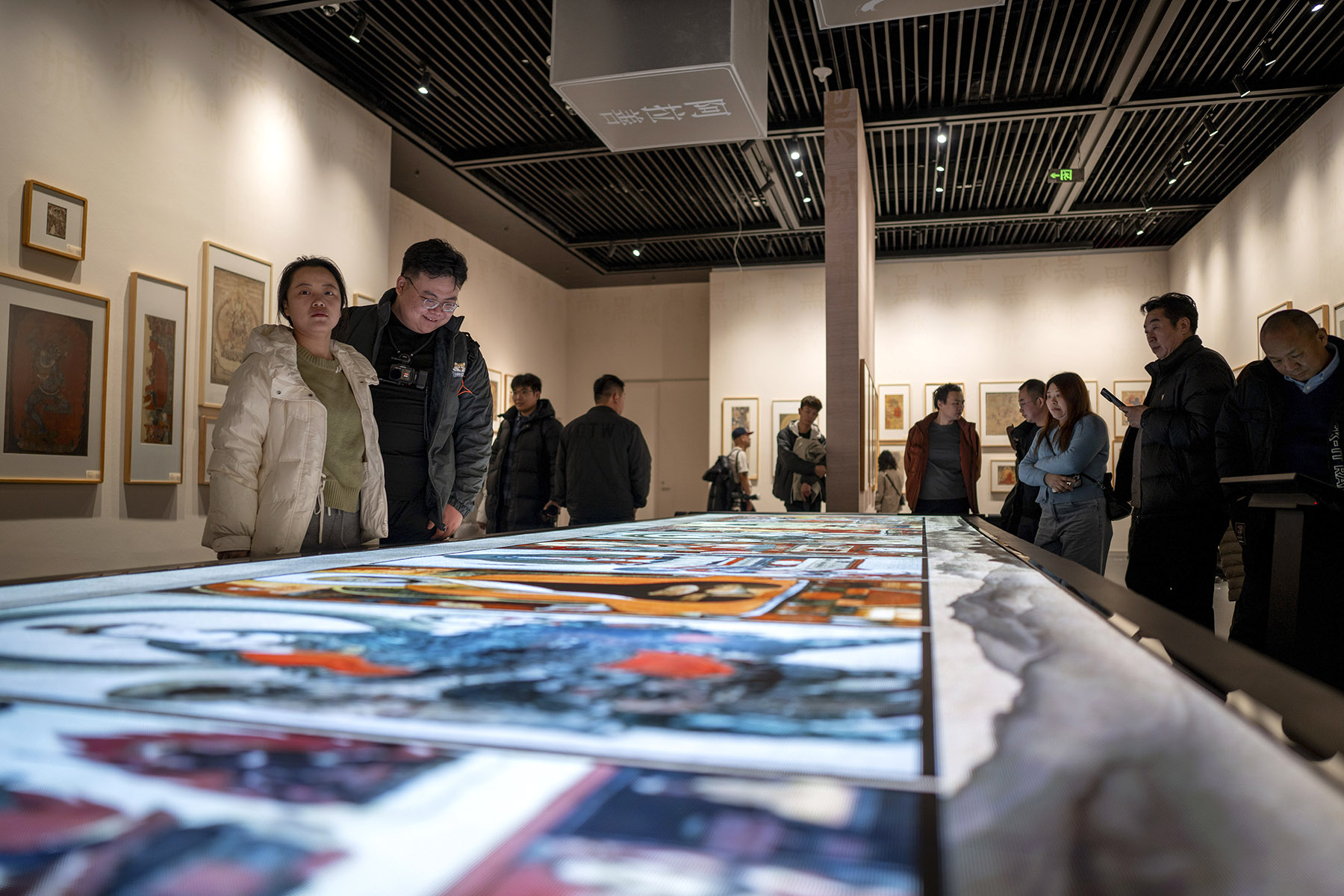
A remarkable collection of art, lost for centuries in the sands of the Gobi Desert before being taken to Russia, has been digitally reunited and is now on display in China for the first time.
An exhibition at the Inner Mongolia Museum in Hohhot, Inner Mongolia autonomous region, is showcasing high-definition reproductions of 197 paintings from the ancient Heishui City (Black Water City), also known by its Mongolian name, Khara-Khoto, which was once a Silk Road outpost.
The original artworks, discovered by a Russian explorer more than a century ago, have been housed in The State Hermitage Museum in St. Petersburg ever since.
The exhibition, titled Black Water City Treasures: Russian-collected Paintings from Khara-Khoto, offers a rare glimpse into the rich, blended cultures of the Xixia (1038-1227) and Yuan (1271-1368) dynasties. It is until March 15.
READ MORE: Voices from the Han frontier
The story begins with Heishui City, once a thriving military and trading center now buried in the deserts of Inner Mongolia. Between 1908 and 1909, Russian adventurer Pyotr Kozlov unearthed a Buddhist shrine outside the city that contained a vast trove of manuscripts, textiles and artworks — a find compared to discovering an entire library.
Among the treasures were over 300 exquisite paintings. They were taken to Russia and entered the collection of The State Hermitage Museum, where they remained, largely unseen by the public in their land of origin.
The 197 reproductions on display were created as part of the book series, A Comprehensive Collection of Ancient Chinese Paintings, which has digitally cataloged Chinese art housed in 263 museums, galleries and cultural institutions both in and outside China.
Through ultra-high-definition digital scanning technology, experts have fully captured the stunning details of these original works — from the mottled textures of ancient pigments to the subtle turns of brushstrokes.
"For visitors, this achieves a dialogue with the originals that feels almost face-to-face," says Miu Zhe, one of the chief editors of the book series and a professor at Zhejiang University. He is also a curator of the exhibition.
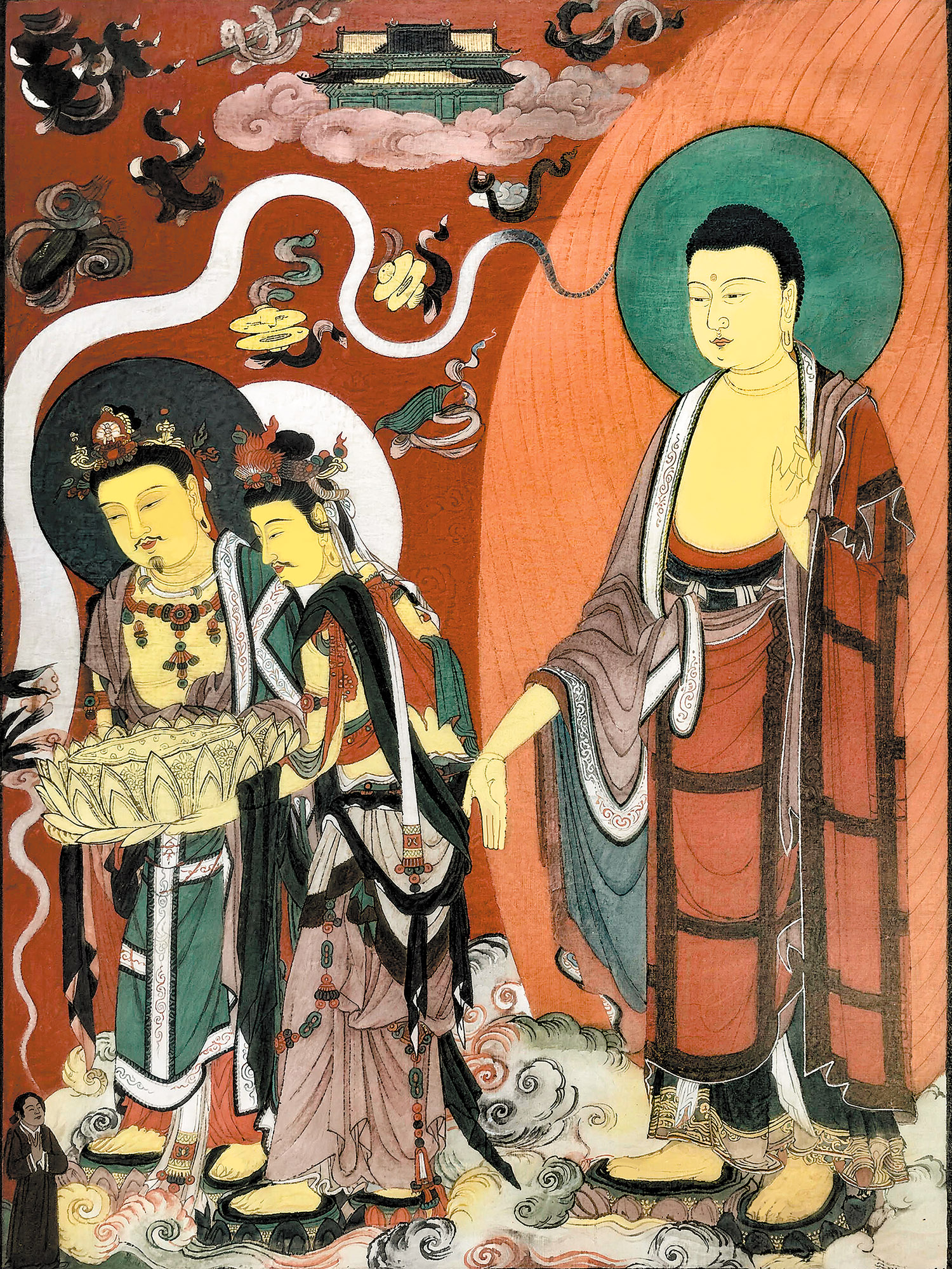
The ruins of Khara-Khoto in the desert of Ejine Banner, Alshaa League, are the source of the 197 pieces on display. Created between the 12th and 14th centuries, these paintings vividly testify to the fusion of diverse cultures along the Silk Road, blending artistic styles from the Central Plains and the Qinghai-Tibet Plateau of China with those of Central Asia.
Miu explains that the exhibits include both religious-themed paintings and secular subjects, such as portraits and scenes of daily life, providing valuable evidence to supplement the historical details of life during the Xixia period.
Among them, the 12th-century Water-Moon Guanyin maintains the elegant linear tradition of Central Plains Buddhist art, while incorporating the distinctive clothing patterns of Xixia patrons; the 13th-century Amitabha Buddha Welcoming Scene adopts classic Chinese composition but is brought to life with the intense blues, reds and golds favored in Central Asian art.
Besides, the artistic scrolls capture snapshots of daily life: portraits outline the ceremonial attire of Xixia rulers and court officials, while simple sketches preserve everyday objects like bows and arrows. Particularly rare is a Taoist painting of the deity, Emperor Zhenwu, which offers evidence of the spread of Taoism to the Xixia Dynasty.
"This collection of artifacts unearthed from Khara-Khoto is the most systematic extant treasure of Xixia relics. The exhibition also marks China's first large-scale collective presentation of The State Hermitage Museum's collection," Miu says.
Reflecting on the digital acquisition process, he describes it as a long and winding journey. Starting in 2010, his team reached out to The State Hermitage Museum through various channels, finally gaining the director's support in 2024. However, the data collection phase posed new challenges, such as dismantling frames for scanning.
ALSO READ: The spirit of 'dark castle' shines
"All efforts have ultimately borne fruit. These artistic treasures, dormant for centuries, have now been reborn in digital form to reunite with their homeland," he says.
To make it more intriguing, the exhibition uses interactive digital scrolls, allowing visitors to zoom in on fine details. Informative notes explain the artistic styles and historical context, making the centuries-old stories accessible to everyone.
"The exhibition is more than just a display; it's a cross-temporal dialogue," says Zhao Yuan, one of the show's organizers and director of the Alshaa Museum in Alshaa League.
Zhao says the show is more like a spiritual homecoming. While the artifacts themselves haven't returned, their essence has come home. "Finally, these long-lost masterpieces can tell their stories where it all began," he adds.
