


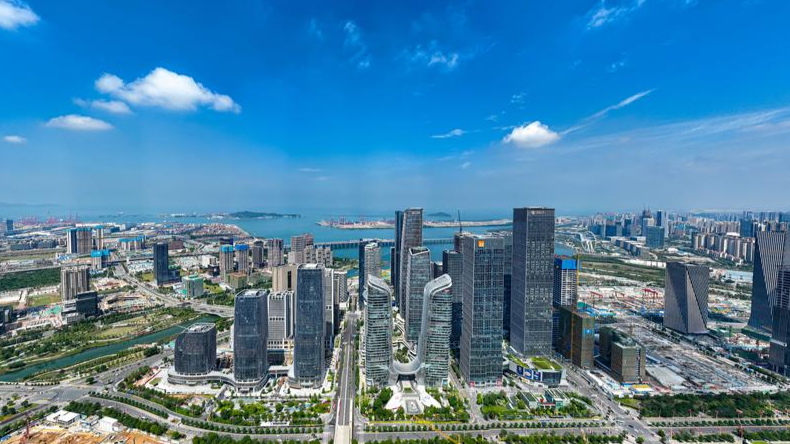
Shenzhen’s Qianhai pilot development zone is accelerating the aggregation of high-quality financial resources to become a regional finance magnet, driven by high-level opening-up policies, deep collaboration with Hong Kong, and synergistic development with other industries.
This year, the zone has added seven key licensed financial institutions, established four insurance asset management fund projects, and nurtured a number of high-quality private equity funds, with several core investment attraction indicators ranking among the top in Shenzhen.
The breakthroughs were unveiled a week before the second anniversary of “The Overall Development Plan for the Qianhai Shenzhen-Hong Kong Modern Service Industry Cooperation Zone”, which was issued by national authorities on Dec 21, 2023.
Outlining the comprehensive development direction for the pilot cooperation zone, the document identifies the deepening of openness and innovation in the financial sector as a key approach for Qianhai to set up a high-quality, efficient modern service industry system.
ALSO READ: Experts: Qianhai to maintain leading role in Shenzhen-HK integration
Yu Lingqu, deputy director of the department of finance industries at the China Development Institute — a Shenzhen-based think tank — said that despite the challenging economic environment in the domestic and international markets, the value added by Qianhai’s financial sector has continued to grow at a double-digit rate, attracting numerous significant financial projects.
Such development is supported by national policy backing, the area’s institutional innovation, deep cooperation with the Hong Kong Special Administrative Region’s financial sector, and integrated development with related industries in Shenzhen, such as technology innovation in Nanshan district and advanced manufacturing in Bao’an district, he said.
Analyzing Qianhai’s appeal to Hong Kong and overseas financial organizations, the expert attributed it to close collaboration with the SAR in the financial technology field, the zone’s role as a gateway for overseas organizations to enter the Chinese mainland market, and its favorable business environment, along with significant business growth potential.
In 2023, the nation’s financial regulatory authorities and Guangdong province revealed 30 measures to support Qianhai’s growth, most of which have already been implemented.
Shenzhen also launched an action plan in February to back the high-quality development of Qianhai’s financial sector, outlining policies focused on enhancing financial openness and promoting the internationalization of the renminbi, further facilitating financial connectivity between Shenzhen and Hong Kong.
To date, the Qianhai Shenzhen-Hong Kong International Financial City has attracted 518 financial institutions, with the SAR and foreign capital accounting for nearly 30 percent of the total.
READ MORE: Foreign investment in Shenzhen's Qianhai exceeds $40b
The Financial City’s financing and lease cluster has accumulated assets exceeding 250 billion yuan ($35.47 billion). Recently, it also facilitated Shenzhen’s first leasing project for China’s domestically produced C919 aircraft.
Wuchan Zhongda Futures — a Fortune Global 500 company — is one of the seven new financial institutions established in Qianhai this year.
Chen Huajie, general manager of its Shenzhen branch, said the company will combine its experience in the commodities industry with Qianhai’s advantages to offer price risk management support for advanced manufacturing, supply chains, and other industries in the region.
Looking forward to the implementation of Qianhai’s initiative of exploring innovative pilot projects for linking spot and futures on commodity trading platforms, he views it as the “most direct and promising empowerment” for the futures industry.
He said a strong spot trading platform can offer a solid foundation for the futures market, and such exploration suggests that Qianhai may achieve deeper integration between the futures and spot markets in many areas, such as trading models, delivery standards and risk-management tool innovation.
Contact the writer at bingcun@chinadailyhk.com
