

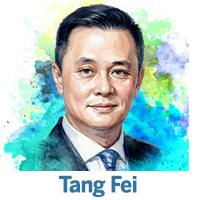
Lawrence Tang Fei says initiatives will boost Hong Kong’s competitiveness
Hong Kong’s first five year plan and the 2026 Policy Address, unveiled on Wednesday, not only complement each other but also map out a clear blueprint for the city’s future socioeconomic development. They also mark Hong Kong’s entry into a new stage of proactively integrating into national development.
 The two documents demonstrate the Hong Kong Special Administrative Region government’s resolve and vision under the “one country, two systems” principle to align itself with national strategies and keep pace with national development.
I welcome and fully support the initiatives proposed in the two documents, particularly the ones on advancing digital education to reduce administrative burdens and boost effectiveness. I have advised the authorities to establish a dedicated large language model platform for education, and advocating the steady integration of artificial intelligence into teaching, learning and assessment. At the same time, technology should be leveraged to streamline school administration, freeing teachers from heavy routine administrative work so they can devote precious time and energy to teaching students in accordance with their aptitude.
READ MORE: HK unveils plan to spur prosperity
The Policy Address explicitly states that a free large scale digital education learning resource platform incorporating AI large language models will be rolled out progressively starting from the 2026-27 school year. “AI teaching assistants” will be extended to more subjects, and measures for the digitalization of kindergarten administration will be announced within 2027.
I fully support the SAR government’s commitment to aligning with the national strategy of “invigorating China through science and education”, as well as its emphasis on deepening patriotic education, national education and national security education. By nurturing a new generation with a strong sense of national identity, cultural confidence and global vision, and drawing on Hong Kong’s unique strengths as a highly internationalized city, Hong Kong can ensure the continuous success of the “one country, two systems” policy, and attract global resources to contribute to the country’s high quality development and modernization.
In expanding the “Study in Hong Kong” brand, the government has raised the cap on self funded nonlocal student intake at subsidized tertiary institutions to 50 percent, increased the quota for the Belt and Road Scholarship to 200 places per annum, and stepped up overseas recruitment activities to attract outstanding talent from across the globe. This will not only replenish high quality workers to help Hong Kong adapt to demographic shifts, but also raise the international standing of Hong Kong’s higher education, which I fully endorse.
The development of the Northern Metropolis University Town is a cornerstone of Hong Kong’s overall planning for future development. The government plans to build a university town spanning over 1,000 hectares (10 square kilometers) in area, including San Tin, Hung Shui Kiu and Ta Kwu Ling under a “one city, five elements” layout. It will deeply integrate education, science and technology with talent cultivation, creating a new engine for Hong Kong’s economic growth. As construction of the Northern Metropolis proceeds, it will foster deeper integration between Hong Kong and neighboring cities in the Guangdong Hong Kong Macao Greater Bay Area and generate powerful synergies.
Against the backdrop of rapid global technological change, both documents stress the importance of advancing digital education and cultivating talent with diverse skill sets. There is a need to raise students’ overall AI literacy as well as enhance the recognition of vocational and professional education. This means Hong Kong’s future education system will become more multifaceted, combining world class fundamental academic research with solid applied technology support to fully meet the human resource demands of industrial upgrading and transformation across sectors.
ALSO READ: Hong Kong's first five-year plan helps chart development vision of the SAR
The Policy Address proposes to “strengthen and expand” primary and secondary schools, a direction worthy of recognition. Nevertheless, concrete policies and pathways must be clearly defined. I hope the government will provide further details. For example, how can relatively disadvantaged schools build up their capabilities? How can high performing schools pursue further excellence? I urge the government to publish clear implementation pathways as soon as possible to give schools clear guidance.
Against a backdrop of growing global geopolitical tensions, Hong Kong’s accelerated development of the university town and active recruitment of talent from home and abroad are timely. These efforts will not only boost Hong Kong’s competitiveness and drive high quality economic development, but also leverage Hong Kong’s unique advantage of “backed by the motherland, connected to the world”, enabling the city to contribute to national development.
The author is a member of the Legislative Council.
The views do not necessarily reflect those of China Daily.
