

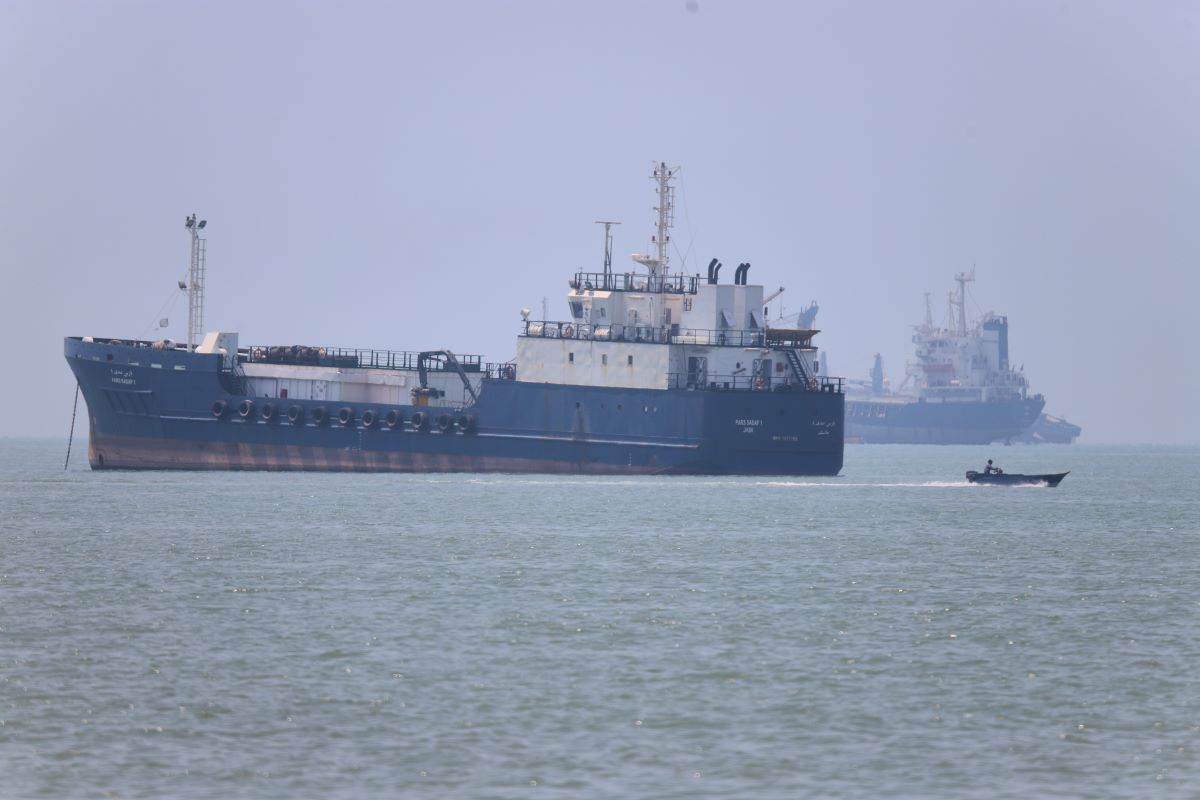
TEHRAN/WASHINGTON – The US airstrikes on Iranian military sites Friday, after accusing Iran of attacking a commercial vessel transiting the Strait of Hormuz on Thursday, put the fragile ceasefire agreement to the test.
Ebrahim Azizi, head of the Iranian parliament's national security and foreign policy committee, said US President Donald Trump has shown "no commitment" to the principles of negotiation or a ceasefire, Al Jazeera reported Saturday.
Azizi also warned that what he described as a "reckless violation of the ceasefire" would lead to "retreat and regret" on the part of the United States.
US Vice President JD Vance on Friday warned Iran it will face "violence" if it carries out any further attacks.
"Iran signed a ceasefire agreement. We have honored it. If they have disagreements about how the MOU is being applied, they can pick up the phone. But violence will be met with violence," Vance wrote on X, reposting the US Central Command announcement of the strikes.
The command post on X said that its forces conducted strikes against Iran Friday night "as a powerful response to yesterday's attack on a commercial ship that was transiting the Strait of Hormuz."
It vowed to "continue to provide safe passage coordination and support to commercial vessels transiting the strait" while remaining "present and vigilant" to ensure the newly signed US-Iran peace deal is "obeyed, and in full force and effect."
Earlier Friday, Trump said that Iran violated the ceasefire agreement between the two sides by launching at least four one-way attack drones at commercial ships transiting the Strait of Hormuz.
"One of the Drones solidly hit the upper deck of a large and very expensive Cargo Carrying Ship," Trump wrote in a post on Truth Social.
"Damage was done, but the Ship was able to proceed on its way," he said. "We knocked down three other Drones."
RELATED ARTICLES
- IAEA head: 'Initial exchange' held with Iran over nuclear inspections
- Shipping rules emerge as next flashpoint in US-Iran friction
- Pakistan: Iran-US technical talks to resume next Tuesday
- US-Iran negotiations 'encouraging'
UN Secretary-General Antonio Guterres expressed hope that the Strait of Hormuz could return to its status quo ante, said his spokesperson Stephane Dujarric on Friday. "I think we have to remain determined. The Strait of Hormuz, prior to the opening of this conflict, actually worked, right? So we know it can, and we should go back to that."
The Navy of Iran's Islamic Revolution Guard Corps on Thursday stressed that the only authorized routes for vessels' passage through the strait are the ones announced by Iranian authorities, warning that ships' movement through other routes is prohibited.
The latest exchange of strikes came after Iran and the US on June 18 signed a memorandum of understanding (MoU) on ending the war and are currently in the midst of negotiations to reach a final agreement.
The MoU called for reopening the Strait of Hormuz, a vital waterway that carried about 20 percent of the world's oil and liquefied natural gas before the war, and required Iran to allow commercial vessels to pass without charge for 60 days.
The latest shipping data pointed to a partial rebound in traffic through the strait following the MoU signing, though current flows remained well below prewar levels.
Commitment to GCC security
Iran’s Foreign Ministry on Friday dismissed a US claim of an "enduring commitment to Gulf Cooperation Council (GCC) security" as mere "rhetoric and a distortion of reality."
US Secretary of State Marco Rubio made the claim in a US-GCC joint statement issued after their ministerial meeting in the Bahraini capital Manama on Thursday.
In response, the ministry said in a statement that US military presence in GCC countries is merely a "burden on regional nations and a cause of insecurity and division."
It said the US use of bases in regional states to commit "the crime of aggression" against Iran during the 40-day war proved Washington places no value on those states' security or mutual relations. It reminded GCC countries of their "explicit obligation" in accordance with international law and the principle of good neighborliness to prevent any use by third parties of their territories and facilities to plan, organize and support "military aggression" against Iran.
Also on Friday, Iran's main military command, Khatam al-Anbiya Central Headquarters, warned in a statement against Israeli military aircraft's "movements" in some neighboring states' airspace, calling those "a dangerous action and a threat" against Iran.
It did not provide further details on the movements.
Iran briefs foreign diplomats on MoU implementation
Iranian Foreign Minister Seyed Abbas Araghchi held separate phone calls on Friday with his counterparts of Uzbekistan, South Korea, Romania, Britain, and Pakistan to discuss the implementation of a recently signed peace MoU between Iran and the US.
Araghchi briefed his counterparts on the latest developments regarding the MoU's implementation, including the process of negotiations between Tehran and Washington toward a final agreement, and the consultations held within that framework, according to statements from the Iranian Foreign Ministry.
Uzbek Foreign Minister Bakhtiyor Saidov and Romanian Foreign Minister Oana-Silvia Toiu welcomed ongoing diplomatic efforts to de-escalate tensions in West Asia, stressing the need for the continuation of the process and the involved parties' fulfillment of their mutual commitments, the statements said.
South Korean Foreign Minister Cho Hyun voiced his country's support for diplomatic efforts aimed at ensuring peace and stability, and shipping security in the region, according to the ministry.
Araghchi and his counterparts also called for continued diplomatic and political consultations to guarantee lasting regional stability, and the expansion of bilateral relations and cooperation, said the statements.
