

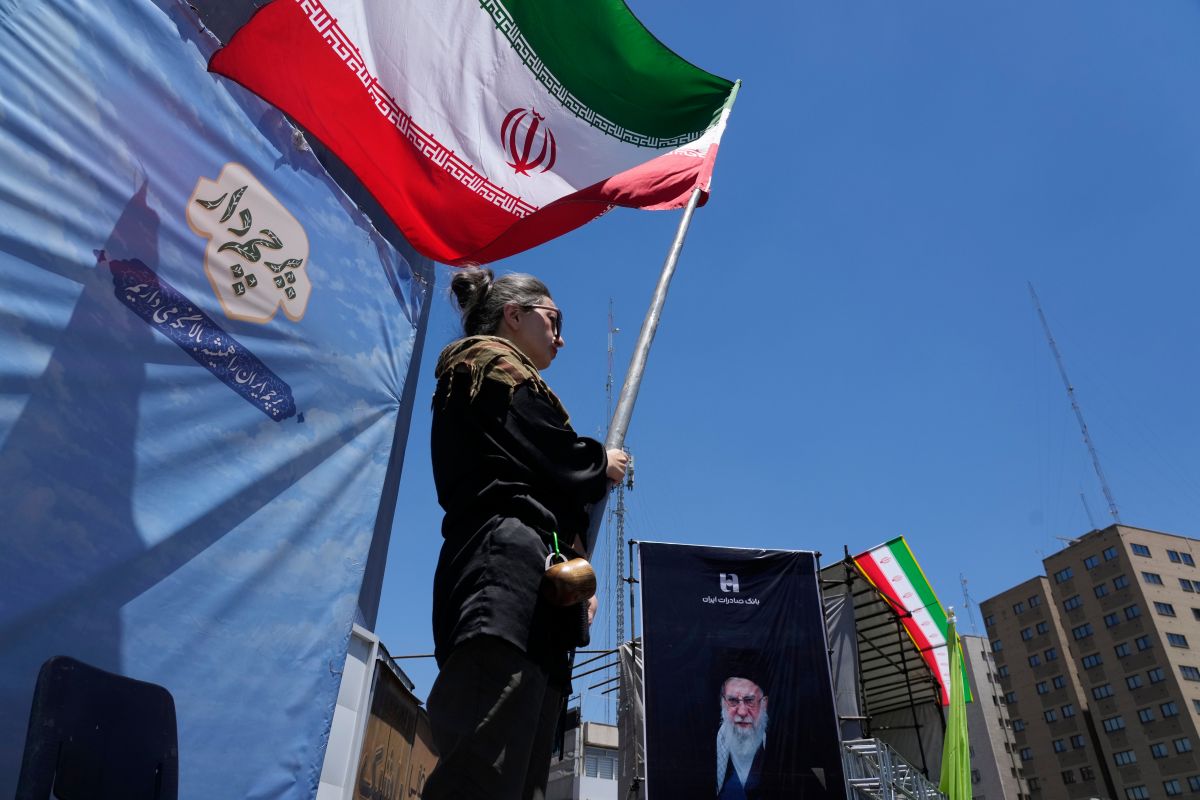
TEHRAN/WASHINGTON/KUWAIT/BAKU – The White House on Wednesday asked the US Congress for $87.6 billion for Iran war costs and a few other programs, one day after the Senate passed a war powers resolution on Iran in a symbolic protest against President Donald Trump's handling of the war.
"Most of this request will address urgent needs related to Operation Epic Fury (OEF), in addition to other critical needs such as responding to the Ebola outbreak in Central Africa and supporting hardworking American farmers," the White House Office of Management and Budget said in a letter to the House.
The bulk of the request – nearly $70 billion – would go to the Pentagon, addressing operational costs incurred during OEF, including funding for military personnel and readiness expenses, operational costs to rebuild stocks expended by the department, classified programs, and other key expenses.
The request also includes $11 billion for American farmers and $1.4 billion to respond to the Ebola outbreak in Africa. The administration also requested $500 million to support ongoing efforts to complete restoration and construction projects in and around Washington, D.C., and $1 billion to complete the renovation of Penn Station in New York City.
RELATED ARTICLES
- Pakistan: Iran-US technical talks to resume next Tuesday
- Iran's chief negotiator: Hormuz will be administered by Iran
- Report: Strait of Hormuz sees record traffic since start of conflict
The newly released package faces an uphill battle as lawmakers from both parties increasingly resist major new spending on a deeply unpopular war.
The US Senate on Tuesday passed a war powers resolution on Iran, restricting Trump from launching further military operations in Iran without congressional approval. The passage of the resolution marked the first time such a measure had cleared both chambers of Congress since the conflict began in late February.
In a social media post on Tuesday, Trump lashed out at the four Republicans who voted with Democrats, calling them "losers."
"These Senators have just made my job more difficult, but I will get it done, one way or the other," Trump said.
'No IAEA inspections before final deal'
Iran has no plan to provide the International Atomic Energy Agency (IAEA) with access to its nuclear facilities bombed by the United States and Israel, a senior Iranian diplomat said Wednesday, noting that such issues will be resolved solely within the framework of a potential final agreement with Washington.
Iranian Deputy Foreign Minister for Legal and International Affairs Kazem Gharibabadi said on social media platform X that access to Iran's nuclear facilities and materials "will be reviewed and resolved solely within the framework of the final agreement and as a result of the other party's practical action to terminate all sanctions."
He also said no meeting was held between Iran's negotiating team and IAEA Director General Rafael Grossi in Switzerland in recent days, despite Grossi's request.
His remarks came after Grossi said earlier in the day that the IAEA would carry out inspections in Iran in view of the recently-signed US-Iran peace memorandum of understanding (MoU).
The MoU, signed on June 18, provides for 60 days of negotiations, which are already underway, toward a final agreement on Iran's nuclear program and sanctions removal. The first round of negotiations was held in Switzerland on Sunday and Monday.
Iran's three main nuclear facilities at Fordow, Natanz and Isfahan were bombed by the United States during the "12-day war" in June 2025. The sites have again been at the center of the conflict that erupted on Feb 28 this year, with the United States and Israel launching strikes on Iranian nuclear and military targets.
Trump threatens to end talks
In Washington, US President Donald Trump said Wednesday that Iran had assured the US it is not seeking tolls, insurance fees or other charges from ships transiting the Strait of Hormuz, warning that negotiations between the two sides would end immediately if the information proved false.
"Iran has informed the US that, despite troublemaking Fake News reporting to the contrary, there are 'NO TOLLS, NO INSURANCE COSTS, & NO OTHER CHARGES OF ANY KIND BEING SOUGHT OR RECEIVED BY IRAN ON SHIPS TRAVELING THE STRAIT OF HORMUZ,'" Trump wrote on his Truth Social.
"If this is false information, negotiations would end, immediately!" Trump warned.
Rubio: Technical talks to resume next week
In Kuwait, US Secretary of State Marco Rubio said Wednesday that US-Iran technical talks are expected to resume next week, likely on June 29 or 30 in Switzerland Rubio made the announcement during an official visit to Kuwait, where he met with Kuwait's Emir Sheikh Mishal Al-Ahmad Al-Jaber Al-Sabah, the Kuwait News Agency reported.
The meeting focused on bilateral cooperation and regional developments, it reported.
Speaking to reporters in Kuwait City, Rubio said the United States remains committed to close coordination with its Gulf partners.
He did not provide further details on the upcoming technical talks.
Rubio's Kuwait visit is part of a three-day regional tour running from Tuesday to Thursday, which includes the United Arab Emirates and Bahrain, where he is scheduled to attend a Gulf Cooperation Council meeting on regional security.
Before meeting the emir, Rubio attended a flag-raising ceremony at the US Embassy in Kuwait, marking its reopening after a nearly four-month closure. The embassy had temporarily suspended its services following drone and missile attacks in early March amid the latest regional conflict.
The embassy said on social media platform X that it officially resumed operations at midnight on Wednesday and will begin providing emergency services to US citizens, with other consular services to be restored gradually.
Islamabad deal 'a declaration of US defeat'
Also on Wednesday, Iranian Parliament Speaker Mohammad Baqer Qalibaf called the Islamabad MoU "a declaration of US defeat" at a parliamentary conference of the Organization of Islamic Cooperation in Baku.
"The Islamabad agreement came not as a result of pressure and coercion, but (as a result) of the resilience and strength of the Iranian people. This is why we regard the Islamabad MoU as a declaration of US defeat," Qalibaf said, according to Azerbaijani news outlet Vesti.az.
The recent conflict was not merely a military confrontation but an attempt to alter the strategic balance in the region and impose external will on an independent nation, and those who organized the "aggression" had miscalculated Iran's response to military pressure, blockades and psychological operations, he said.
"This war inflicted serious damage on our people, but it also showed that even under the most difficult conditions, the steadfastness and will of a people can shatter all the calculations of aggressors," he said. "Lasting peace is built not on capitulation, pressure and humiliation, but on strength, dignity and mutual respect."
Regional stability
Meanwhile, Iranian Foreign Minister Seyed Abbas Araghchi and his Saudi counterpart Faisal bin Farhan Al Saud held a phone call on Wednesday, stressing efforts to support stability in West Asia and advance Iran-US negotiations, Iran's official IRNA news agency reported.
The two sides stressed the importance of continued consultations and joint cooperation to achieve positive and lasting results in the negotiations, it reported.
Araghchi briefed his Saudi counterpart on progress in implementing the recently signed Iran-US peace MoU and the consultations held within that framework, it added.
