

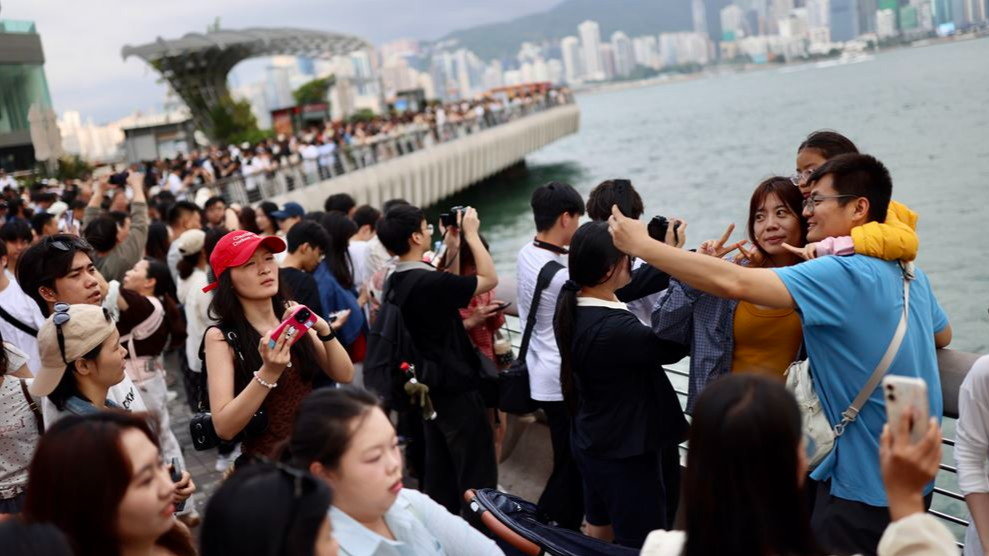
Chinese mainland visitors made around 1.01 million trips to Hong Kong during the Labor Day holiday from Friday through Tuesday, a 10 percent increase from last year and surpassing the 2019 level, giving a boost to the catering, hotel and retail sectors.
The figure surpassed the special administrative region government’s pre-holiday forecast of 980,000 arrivals and marked the fourth consecutive year of growth, with 625,000, 766,000 and 919,000 trips recorded respectively in 2023, 2024 and 2025.
Saturday, the second day of the five-day break, saw the peak in mainland visitor traffic — with over 263,000 arrivals and 250,000 departures recorded. Lok Ma Chau Spur Line/Futian, Lo Wu/Luohu, Shenzhen Bay, and West Kowloon Station remained the most popular entry points for mainland tourists.
ALSO READ: Experts: Hordes of eco-tourists need to be better managed
The catering industry benefited from the traveler inflows, with overall turnover rising about 10 percent year on year, Simon Wong Ka-wo, president of the Hong Kong Federation of Restaurants and Related Trades, told China Daily.
Although the wet weather reduced foot traffic in some areas, business grew more in tourist hot spots. Some small shops with local characteristics, even those away from tourist hubs, attracted crowds thanks to social media. Many tourists set aside time specifically to visit them, Wong said.
Wong urged more eateries to adopt new marketing strategies to align with young people’s habits, and to embrace new technologies to create fresh experiences for customers.
Cultural elements are another new driver for the catering sector, according to Wong. With over 500 intangible cultural heritage items in Hong Kong, he called on stakeholders to creatively showcase these assets and integrate them with dining and retail, attracting more visitors and truly realizing the concept of “tourism is everywhere”.
In the hotel industry, insiders said that occupancies at both small and large hotels reached 90 percent, with midrange and budget hotel room rates rising 10 to 15 percent year-on-year.
READ MORE: Golden Week: Local tourism revival anchors broader economic resilience
Timothy Chui Ting-pong, executive director of the Hong Kong Tourism Association, told a radio program that the number of visitors who stay in Hong Kong for one night, mainly on multidestination trips, and those who stay longer are roughly equal. He noted that thanks to convenient transportation links within the Guangdong-Hong Kong-Macao Greater Bay Area, some short to medium haul visitors decide on overnight stays only after arrival in the city, so hotels are very restrained in setting their prices.
Regarding the growing popularity of camping among tourists and whether the trend will affect the hotel industry, Chui said some tourists combine hotel stays with camping.
Different travelers can have different ways of enjoying the city, Chui said, adding that what matters is how to attract more visitors.
Holiday vibes breathed new air into the shopping sector. Data shows that during the first four days of the holiday, tourist spending at K11 MUSEA — a popular shopping destination in Tsim Sha Tsui — increased 1.25 times year-on-year, with the largest single purchase close to HK$2 million ($255,215). International luxury brands continued to see strong growth, with sales surging nearly twofold year-on-year, while those of watches and jewelry rose by nearly 90 percent.
Hong Kong residents also made over 1 million outbound trips from Friday through Sunday – the city’s Labor Day break, with many spending their holiday in the mainland.
During her three-day stay in Shenzhen, Hong Kong resident Coco Lee attended a baking-and-coffee-themed carnival and bought trendy toys. She said cross-border transportation and supporting services between the two cities are highly developed, offering a more tangible experience than online shopping.
Contact the writer at amberwu@chinadailyhk.com
