

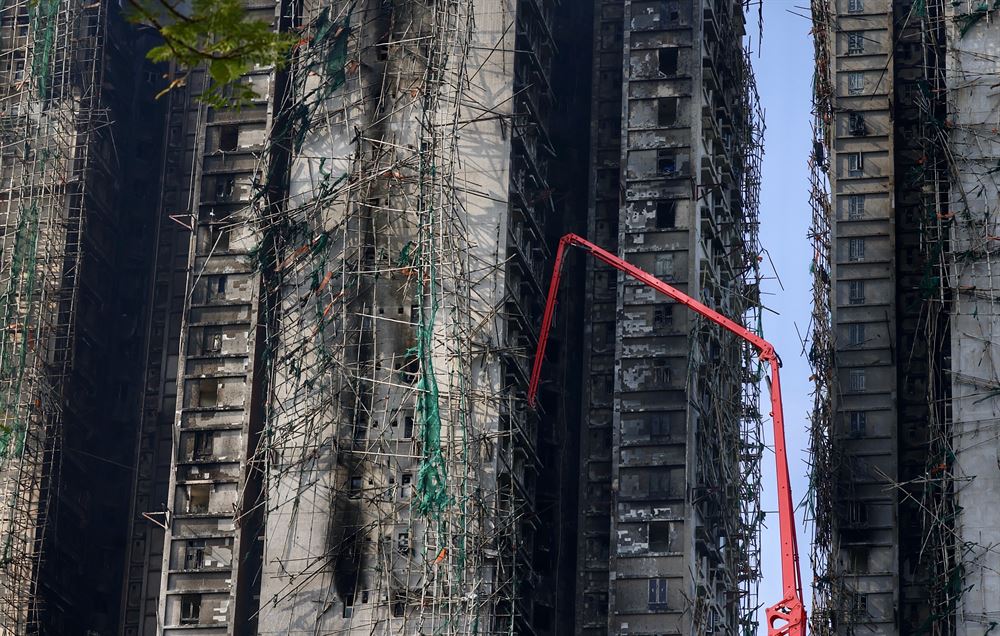
An independent committee established to investigate November’s fatal fire at Wang Fuk Court in Tai Po revealed systemic failures that left residents with virtually no protection.
Evidence presented on Thursday at the panel’s first public hearing showed that nearly every fire safety measure intended to save lives “completely failed” because of human error, said Victor Dawes, the counsel leading the committee established in December by Hong Kong Chief Executive John Lee Ka-chiu.
The fire broke out on Nov 26 and burned for more than 40 hours, resulting in the deaths of 58 men and 110 women, ranging from 6 months to 98 years old. Among the deceased, 114 were aged 65 or above, and seven were younger than 18. Thirty-seven households lost two or more members.
READ MORE: Tai Po fire Independent Committee hears of ignored warnings
In his opening address, Dawes said the committee had collected over 1 million files, including crucial closed-circuit television footage, resident complaints about building maintenance and SAR government responses, and previously undisclosed internal records.
“The cause of the fire, and how the overlapping effects of multiple factors allowed it to spread and cause such devastation, will be examined in detail,” Dawes said. “The role each individual factor played in this entire event will be explored piece by piece through expert testimony in the coming sessions.”
He outlined several critical breaches uncovered during the investigation. The fire alarm systems were turned off in seven of the court’s eight blocks, and the main contractor had repeatedly applied to the Fire Services Department for extensions to deactivate fire hydrants and hose reel systems for several months.
In addition, windows in stairwells and corridors had been removed to give workers access to the external scaffolding, resulting in smoke pouring directly inside and trapping residents who were trying to escape.
Revealing evidence regarding the fire’s origin, Dawes said cigarette butts were found on the external scaffolding and on the light well platform outside Wang Cheong House’s Units 104 and 105, which are suspected to be the source of the fire.
Residents had lodged multiple complaints about workers smoking on site, but these warnings were not acted upon. The Labour Department had received repeated complaints about workers smoking at the renovation site as early as July 2024. Despite conducting 16 inspections, officers reported no violations, saying “no workers found smoking” and “no cigarette stubs were found at the complaint location”, and issued no smoking bans.
Some complaints were referred to the Fire Services Department, which responded that the issue fell outside its jurisdiction.
However, after the fire, police reviewed worker chat groups belonging to the main contractor, Prestige Construction and Engineering Co Ltd, and uncovered over 80 instances of illegal smoking documented in internal communications — averaging more than one violation per week.
Netting controversy
The committee also examined troubling evidence regarding the scaffolding netting used at the site. A subcontractor reported that after two super typhoons in July and September caused significant damage to the original nets, the contractor instructed the subcontractor to buy cheaper, nonfire-retardant netting.
In late October, after the Housing Bureau’s Independent Checking Unit notified the contractor of an upcoming inspection, they immediately directed the subcontractor to order fire-retardant netting and ensure its delivery before authorities arrived.
Dawes questioned why the contractor had advance notice of the inspection, describing the situation as “extremely concerning”.
During the Oct 28 inspection, the checking unit provided testing footage that showed an inspector using a lighter to ignite the netting. Although it caught fire after about 15 seconds, and burned for roughly 10 seconds before being blown out, inspectors appeared to believe the netting was fire-retardant.
Dawes also said that both the Wang Fuk Court Incorporated Owners and the contractor had submitted their own video records of the same netting test. However, when compared with the footage from the Housing Bureau inspectors, these versions were suspected to have been edited, as they omitted key segments showing the netting catching fire.
ALSO READ: Shocking evidence of systemic failures as Tai Po fire hearing begins
The committee also uncovered a WhatsApp voice message from the subcontractor after the blaze broke out: “Get the Wang Fuk Court fire sorted out quickly. Coordinate our statements and come up with an explanation, because the nets we used weren’t fire-retardant.”
Details of the final movements of firefighter Ho Wai-ho, 37, who died in the blaze, were also discussed. Ho was among the first to respond to the fire, arriving at about 3 pm, and was assigned to Unit 2701 at Wang Cheong House for search-and-rescue operations.
Disoriented by the chaos, Ho entered Wang Tai House instead at 3:15 pm. At 3:22 pm, he broadcast a “Mayday” call, trapped on the 30th floor. His body was found at 3:55 pm in the lobby of Wang Tai House without his breathing mask, left glove, or hammer. Some of his gear was later recovered on the 31st floor.
Dawes suggested that Ho may have broken a 31st-floor window in a desperate escape attempt before falling to his death.
Contact the writers at stacyshi@chinadailyhk.com
