

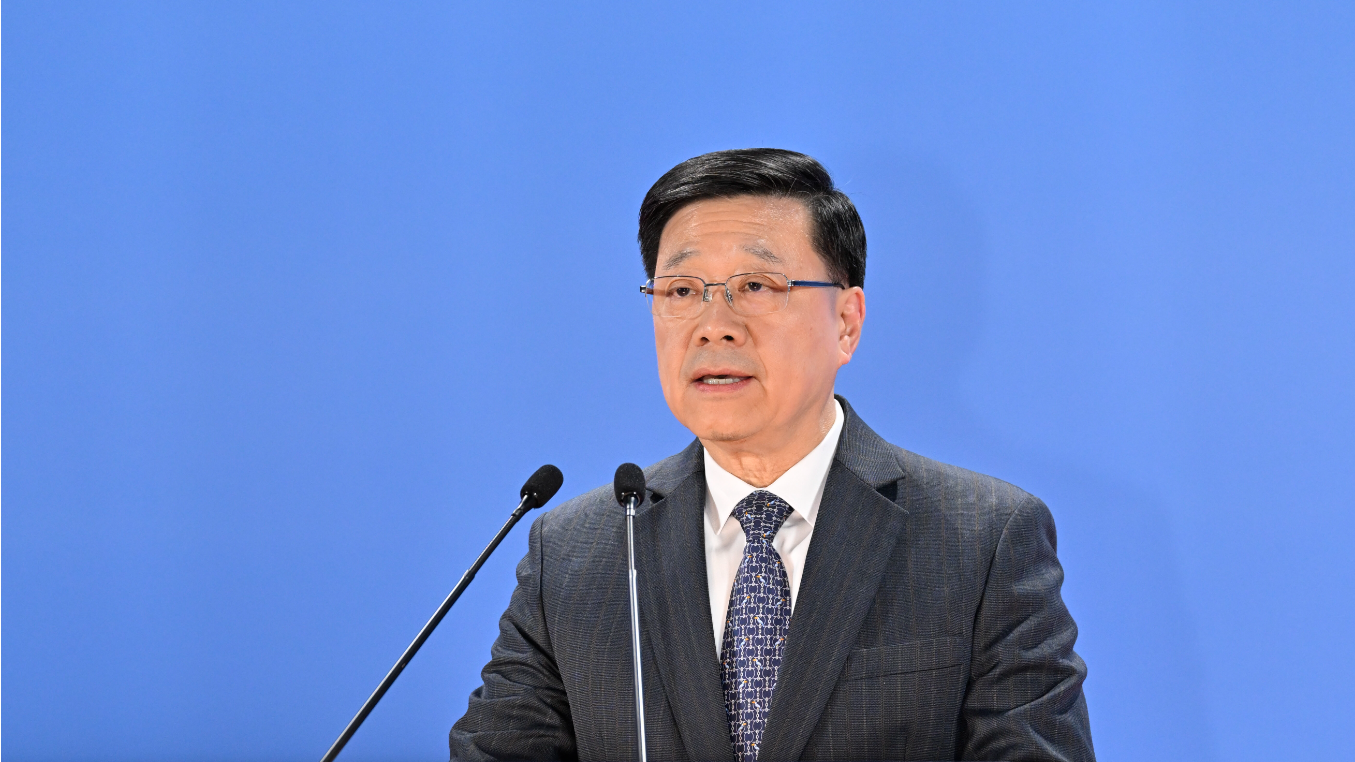
In a significant move to bolster regional sports collaboration, Hong Kong Chief Executive John Lee Ka-chiu signed a comprehensive four-party agreement with top officials from the central government, Guangdong province, and Macao in Shenzhen on Nov 21, the concluding day of the 15th National Games.
The pact’s promulgation on Monday coincided with the Hong Kong sports chief’s morale-boosting message to the 280 participating athletes at a flag presentation ceremony, in which he said the spotlight has now swung on them to continue the city’s winning streak at the remaining two of the nation’s triple games events.
The combined 12th National Games for Persons with Disabilities and the 9th National Special Olympic Games, slated for Dec 8 to 15, too, will be staged across the border by the two special administrative regions alongside Guangdong province in a historic first.
ALSO READ: China's first cross-boundary National Games ends with a bang
The “Four-Party Agreement” -- designed to build on the cooperative spirit fostered by the Guangdong-Hong Kong-Macao Greater Bay Area’s co-hosting of the National Games -- was inked with director of the General Administration of Sport of China, Gao Zhidan, governor of Guangdong Province, Meng Fanli, and chief executive of the Macao SAR, Sam Hou-fai.
The agreement lists 10 key provisions, including: strengthening sports exchanges and co-operation between young people, athletes, international organizations, and the sports industries of the Chinese mainland and the two SARs; achieving the synergized use of resources; promoting Chinese sports spirit and cultivating Chinese sports culture; bolstering the region’s sports governance capacity; and safeguarding the overall interests of the Chinese nation and strengthening communication on issues of mutual concern in sports system development, sports dispute resolution and foreign-related sports affairs.
READ MORE: Hong Kong powers the nation’s equestrian development
Officials and sports figures in Hong Kong threw their support behind the official pledge, seeing it as a “much-appreciated and needed” push to perpetuate the collaboration momentum forged by the first cross-border national sports gala and maintain momentum to strategically align the three places’ strengths in sports development to deliver the ultimate materialization of a regional sporting powerhouse.
Lee said the agreement further empowers the city to deepen regional cooperation under “one country, two systems”, adding that it will be used to guide the integration of sports in the Greater Bay Area by consolidating related resources, co-hosting events, and jointly nurturing talent to help build the country into a leading sports stronghold.
Guangdong brings to the table considerable “hardware resources” – including massive sports facilities befitting large-scale elite training, public fitness facilities, and high-level international competitions – which are now increasingly accessible to athletes and residents from the two SARs’ thanks to the Greater Bay Area’s efficient “One-Hour Living Circle” transport network, said Louie Lobo Hung-tak, a senior lecturer in health and physical education at The Education University of Hong Kong.
He added that Hong Kong and Macao’s “software advantages” as East-meets-West hubs position them well to lead international sports exchanges. Their long-standing global ties and internationally attuned legal systems make them ideal for this role, he said.
READ MORE: Wushu needs more events in GBA, coaches in Macao say
On Monday, a flag was presented to Hong Kong’s record 400-member delegation for the National Para Games and Special Olympics.
The 280 athletes will compete in 14 Para Olympics medal sports, four mass sports events, and seven Special Olympics disciplines.
In her opening remarks, Secretary for Culture, Sports and Tourism, Rosanna Law Shuk-pui, called the twin games a stage for athletes to “showcase grit”, a “national spectacle” for the public, and “an important opportunity” to reinforce national pride for all.
She said the tripartite co-hosting arrangement signals a shared “resolve and capability” to stage top-tier events within the region.
Hong Kong will stage four medal sports and the mass-participation para dance sport. Law described competing at home as a “rare, valuable opportunity”, citing the city team’s haul of three gold and three silver medals in the para dance sport, already completed in September.
Hong Kong has a strong record of success, with its delegations winning 10 golds at the last National Para Games, 25 at the Special Olympics, and three at the Paris 2024 Paralympics.
Contact the writer at stacyshi@chinadailyhk.com
