

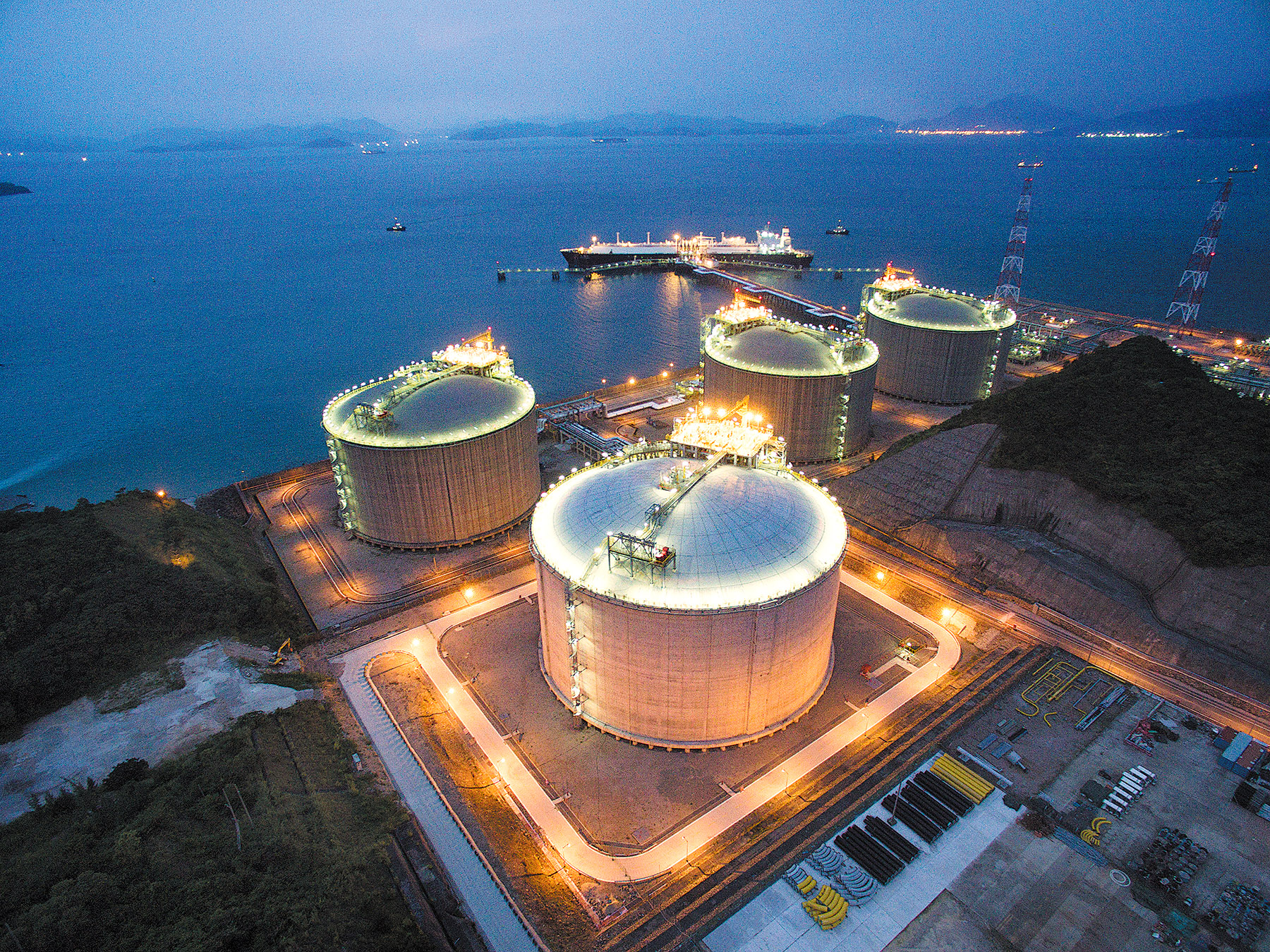
As a hub of innovation and marine industry, the Guangdong-Hong Kong-Macao Greater Bay Area is well-positioned to fuel the development of marine technology across the Asia-Pacific region, where high-end marine industrial clusters are emerging and gaining a competitive edge, scholars told China Daily.
Across the region, economies are focusing on fields such as deep-sea exploration, marine renewable energy, marine biotechnology, smart fisheries, and digital ocean technologies.
Under the framework of Asia-Pacific Economic Cooperation, or APEC, such initiatives could help open new avenues for economic growth and enhance supply chain security in one of the world's most important trade markets.
READ MORE: Sailing together toward shared maritime community
They could also consolidate the technological foundation for the economies to jointly address marine disasters and boost cross-economy innovation, according to Hu Zhenyu, director of the Department of Sustainable Development and Blue Economy Research at the China Development Institute.
The Greater Bay Area can play a pivotal role, drawing on its strong research capabilities, well-integrated industrial chain, and diverse marine application scenarios, Hu said.
Building on research strengths in basic marine science, marine engineering, and international scientific collaboration, the Greater Bay Area is developing a diverse marine innovation landscape centered on Guangzhou, Shenzhen, Hong Kong, and Macao.
The cluster's outstanding capabilities in high-end manufacturing also enable it to meet the complex requirements of producing intelligent marine equipment for sectors such as deep-sea operations and remote sensing and monitoring, Hu added.
By 2025, Guangdong province had nearly 50 underwater robotics companies, the most in the country. It has led the nation in achieving breakthroughs in unmanned vessels, intelligent aquaculture, deep-sea scientific exploration, as well as smart ports.
The Greater Bay Area can also provide a wide range of application scenarios for marine technology, from nearshore to deep-sea environments and from scientific research and testing to commercial operations.
Building on this advantage, Shenzhen's Bao'an district has established a pioneering open-water testing zone for intelligent marine equipment. Zhuhai is also actively exploring new offshore infrastructure with a focus on green energy and submarine communications, among others.
Regional hub
Underlying the significance of moving from individual technical exchanges to industrial chain collaboration, Hu expects the Greater Bay Area to serve as a regional hub for closer coordination in the marine industry under the APEC framework.
It could help different economies leverage comparative advantages through joint research and development, mutual recognition of standards, talent exchanges, technology transfer, and industrial investment.
He also said that, based on favorable maritime conditions, the Greater Bay Area could gradually develop a shared marine technology testing platform for APEC economies, guided by internationally aligned standards. Such a move would help address the significant challenges of testing technologies in real-world marine environments.
In addition, Hong Kong and Shenzhen's strengths in international capital, fintech, and venture capital also help finance marine technology projects and realize marine ecological value through financial instruments.
Gan Jianping, head of the Department of Ocean Science at the Hong Kong University of Science and Technology, highlighted the importance of APEC economies to jointly establish in-situ ocean monitoring systems, and artificial intelligence-based digital systems.
These could assess ocean health, forecast future trends, and remain alert to potential risks, he said.
ALSO READ: HK sees opportunity to kickstart blue economy
These systems can serve a wide range of needs in fisheries and aquaculture, biodiversity conservation, climate change response, and early warning and adaptation to marine environmental disasters, he added.
Gan said that marine ecological monitoring is one of the priorities among Hong Kong's maritime development initiatives, as outlined in the city's first five-year plan (2026-30), and a key focus of marine research at local universities.
For example, Hong Kong recently developed WavyOcean, a leading 3D immersive digital twin Earth system for marine environmental retrospection and forecasting. The system aims to advance digital ocean research in the Asia-Pacific and promote the region's transition to a sustainable blue economy.
In recent years, the Hong Kong Special Administrative Region government has launched several large-scale marine science and technology initiatives.
Drawing on the city's geographic, academic, economic and financial advantages, Gan said he is confident that Hong Kong can become an Asia-Pacific hub in this field, particularly in education, technology, blue economy and blue finance.
