

Imports and exports with other APEC economies climb 40 percent in first three quarters from a year earlier
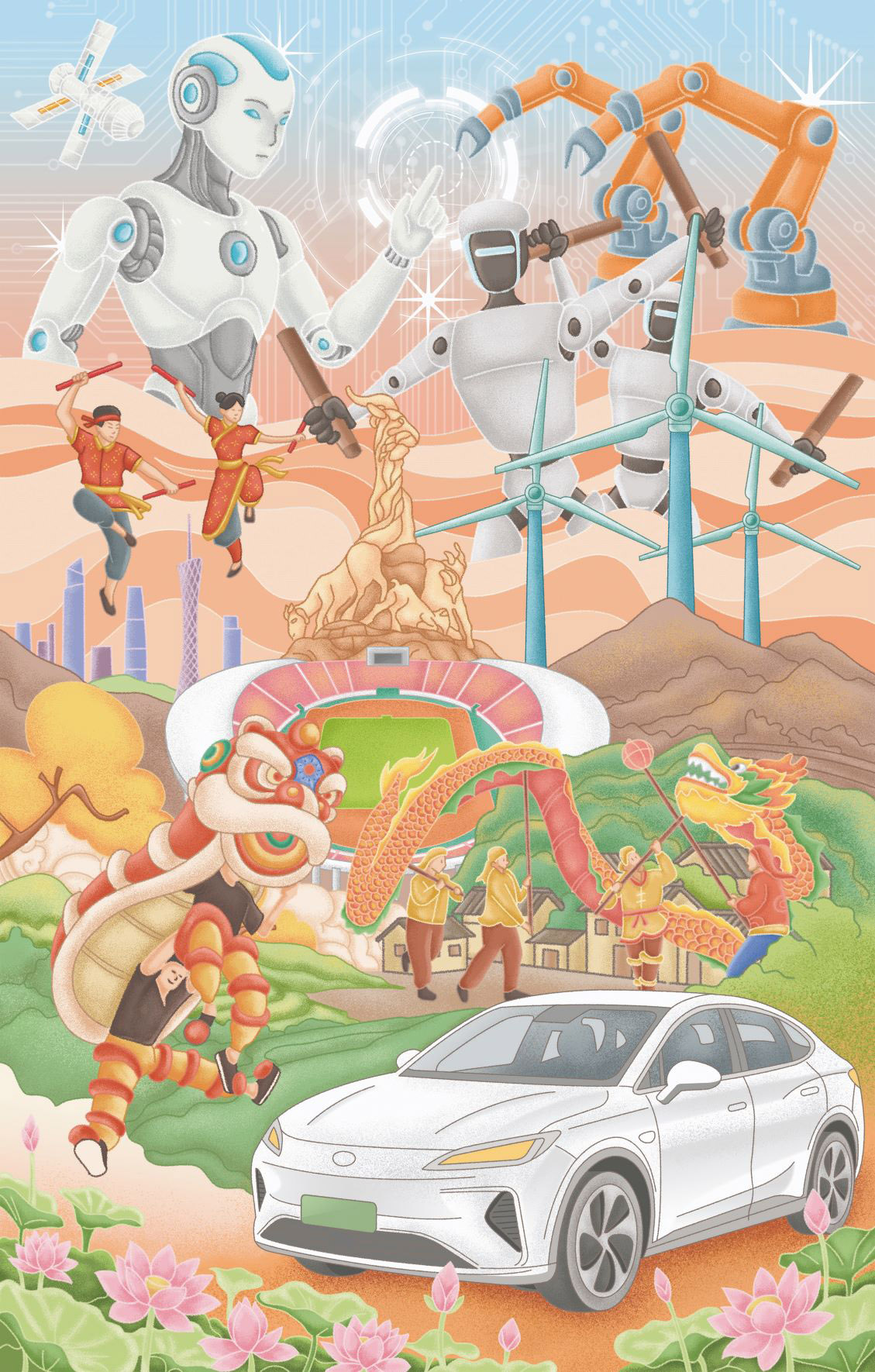
As China's top industrial city, Shenzhen is accelerating the development of a globally leading advanced manufacturing hub, upgrading its industries toward higher value, newer frontiers and better quality, and building a modern industrial system with distinct local strengths.
The city is leveraging its role as host of the 33rd Asia-Pacific Economic Cooperation Economic Leaders' Meeting to open a high-level dialogue channel with Asia-Pacific economies and showcase the Guangdong-Hong Kong-Macao Greater Bay Area's trade vitality, with roughly 150 local companies meeting executives from leading domestic and overseas companies, city authorities noted.
The meeting has deepened commercial ties with APEC members. Shenzhen's imports and exports with other APEC economies climbed 40 percent from a year earlier in the first three quarters, accounting for nearly 70 percent of its total foreign trade.
READ MORE: Openness, innovation and cooperation urged
The APEC Futian special session yielded more than 60 letters of intent across biomedicine, smart terminals, artificial intelligence and semiconductors in June. A Longhua district trade mission to Malaysia secured tentative orders worth 12 billion yuan ($1.8 billion) in May.
Manufacturing upgrades underpin this opening-up momentum. The city released the 3.0 version of the "20+8" industrial cluster plan for strategic emerging and future industries in July, targeting 2.3 trillion yuan in value added from strategic emerging sectors by 2030, equal to 45 percent of its GDP.
First revealed in 2022, the framework underpins an industrial system built around 20 clusters in strategic emerging industries and eight future industry tracks. The revised 3.0 version defines 10 strategic emerging fields: next-generation information technology, biotech, new energy, new materials, high-end equipment, intelligent connected electric vehicles, environmental protection, low-altitude economy and aerospace, traditional and creative industries, and marine industries.
It also identifies five future-industry priorities: manufacturing, information, energy, space and health.
The revision realigns categories to match real technological boundaries. Smart sensors have been folded into semiconductors, reflecting tight technical and supply-chain integration between chips and sensors. New tracks for physical intelligence and 6G have been added to position the city ahead of embodied intelligence and next-generation communications.
The city said the framework will push industries into higher-value, newer and more competitive segments and build an industrial system tailored to its strengths.
The cluster strategy is showing up in export numbers and global corporate expansion. High-tech shipments including new energy vehicles, consumer drones, digital cameras and 3D printers rose 10.1 percent year-on-year in 2025.
BYD, a new energy vehicle maker based in Pingshan district, shipped more than 1 million NEVs overseas in 2025. The automaker is surrounded by more than 300 component suppliers in the district, which also hosts more than 1,300 biopharma and medical-device companies, more than 200 integrated-circuit companies that generate over 60 percent of Shenzhen's chip manufacturing output, and nearly 600 AI enterprises.
Upgrades extend beyond NEVs and chips to mature consumer electronics lines. At the smart manufacturing park of smartphone maker Honor, a Level-4 automated production line runs at above 85 percent automation, churning out one smartphone every 28.5 seconds. As of 2025, R&D staff made up more than 70 percent of Honor's global workforce, and the company held over 2,100 AI patents.
Robotics output is scaling fast and an embodied intelligence ecosystem is taking shape. In 2025, Shenzhen produced 194,900 industrial robots and 7.97 million service robots, both ranked first nationwide.
The city has built a full industry chain for embodied intelligence covering core components, humanoid robot development, R&D and commercial deployment.
For example, Orbbec has launched ultra-compact binocular 3D cameras for collaborative robots, humanoids and flexible industrial gripping; PaXini Technology's multidimensional tactile sensors deliver fine sensing for dexterous robot hands; and Zhaowei's micro-drive systems, Inovance's servo systems, D-Robotics' computing chips and RoboSense's LiDAR help plug critical technical gaps and build domestic component capacity.
"Shenzhen's complete hardware supply chain lets us quickly source servo motors, sensors and controllers locally and slash R&D costs substantially," said Zhao Tongyang, founder of EngineAI Robotics.
The strong industrial output rests on basic research. The Shenzhen Medical Academy of Research and Translation and Shenzhen Bay Laboratory attract scientists from around the globe. Research platforms for synthetic biology, brain mapping and material genomics shorten the timeline from lab discovery to commercial use. Local teams and companies have made breakthroughs in semiconductor equipment, high-end medical instruments, industrial software and advanced materials.
ALSO READ: Guangdong creating opportunities at rapid pace for foreign investors
By the end of 2025, more than 400 biomanufacturing companies had set up operations in Shenzhen, with 160 new arrivals in three years. Around 80 percent of these new entrants chose Guangming Science City as their base, among which 12 are listed companies and 21 are startups, each valued above 1 billion yuan.
The World Intellectual Property Organization's 2026 Global Innovation Index placed the Shenzhen-Hong Kong-Guangzhou innovation cluster first among the world's top 100, for a second straight year.
Shenzhen has led China in Patent Cooperation Treaty filings for 22 consecutive years and domestic patent grants for eight years. Huawei, Tencent, BYD and ZTE all appear on the European Commission's ranking of global top-100 Industrial R&D Investment Scoreboard.
Contact the writers at caoyingying@chinadaily.com.cn
