

The low-altitude economy is making big strides in Hong Kong. Cross-jurisdiction routes have started in the Greater Bay Area with guidelines unlocking much of the city’s strengths and contributing to national development. As Jessica Chen reports, such moves will go a long way to accelerating the sector’s commercialization.
When a flying car, the Roadster, lit up screens in the United States, low-altitude economy stocks in China’s A-share market surged to their daily limits almost in unison.
The irony was hard to miss — a vehicle on jets of vapor in America had set off a rally in the low-altitude economy across the Pacific.
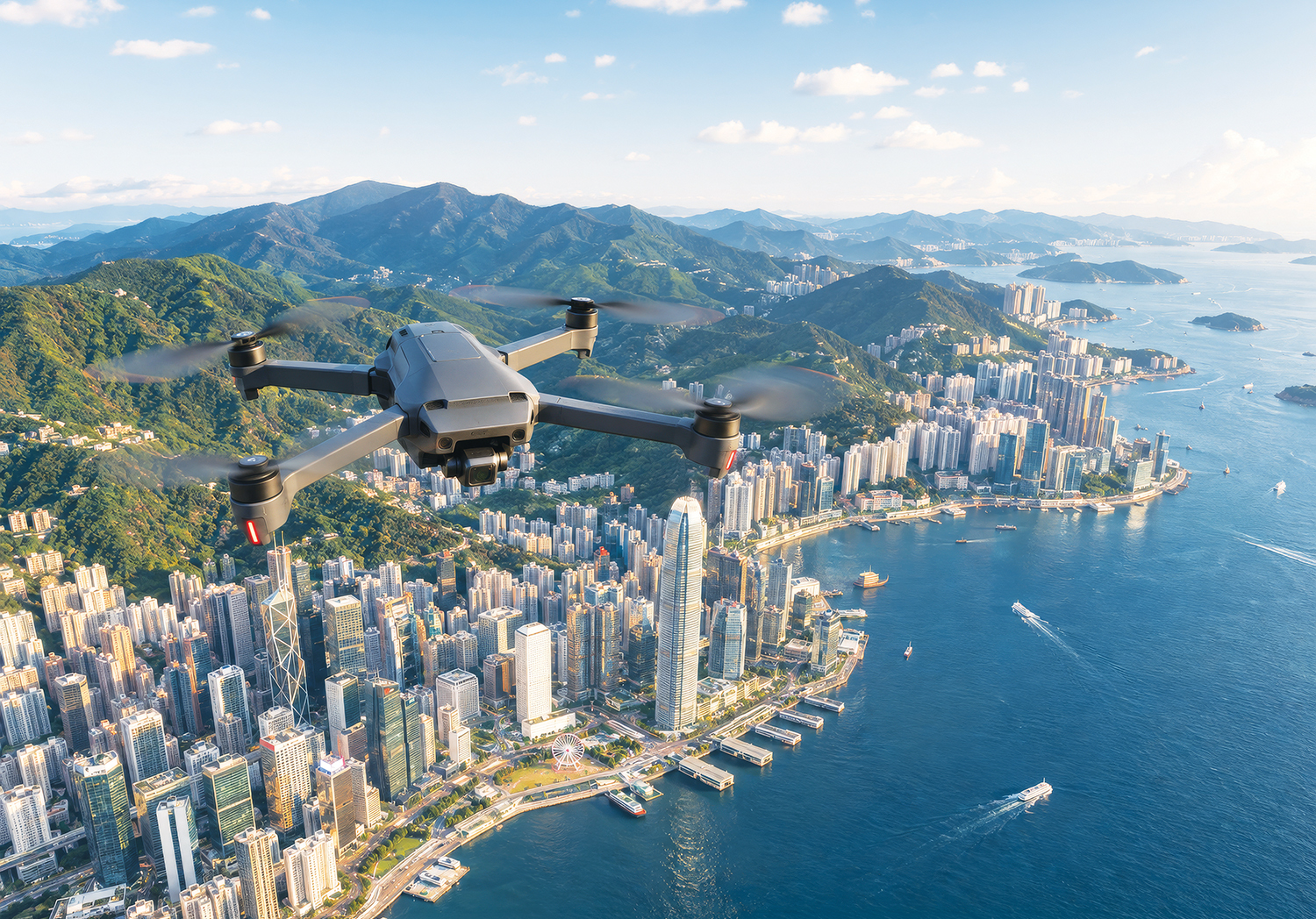
Hong Kong — a place where different worlds converge — is a challenging space for such an industry. The city’s airspace is crowded, its skyscrapers are among the tallest and most densely-packed in the world, while its airport — one of the world’s busiest — diverts traffic overhead to adjacent cities in the Guangdong-Hong Kong-Macao Greater Bay Area, like Shenzhen, Macao and Zhuhai. Drones, nonetheless, now weave between the high-rises, delivering medicine to hospitals and inspecting subway tunnels.
A pioneering unmanned delivery experiment was recently carried out in Nansha — a high-tech district of the Guangdong provincial capital, Guangzhou, about 145 kilometers via highway from Hong Kong. An unmanned air logistics route was opened on Oct 23 in Nansha and livestreamed from Hong Kong Science and Technology Park, as unmanned drones made door-to-door express deliveries below 250 meters, humming among high-rises and zipping above waters.
READ MORE: Cross-jurisdictional trials strengthen HK’s gateway role in LAE
The route, a joint effort between Yuexiu Intelligent Manufacturing and SF Express, was led by Nansha-based International Advanced Technology Application and Promotion Center (Greater Bay Area) — the authority teaming up with the Hong Kong Special Administrative Region government in operating the regulatory sandbox.
Cross-jurisdiction synergy
As Nansha takes a bold step toward commercializing the fledgling low-altitude economy in Guangzhou and its satellite regions, the HKSAR is looking beyond the hardware itself to develop a workable regulatory playbook.
Being the nation’s only common-law jurisdiction, Hong Kong is focused on regulation and rule-making — work that could prove valuable well beyond its borders.
Since its establishment in 2024, the Working Group on Developing the Low-altitude Economy, a multi-sector task force, has used regulatory sandboxes to test applications, including drone delivery, tunnel inspection and city patrolling.
It is the rule book, rather than cutting-edge know-how, that will unlock much of the HKSAR’s strengths and contribute to the country’s broader development, says Joan Hung Sze-man, deputy secretary for transport and logistics of the HKSAR and co-convener of the task force.
The task force launched Regulatory Sandbox X in November last year — the city’s second iteration of its live-testing regime for low-altitude aviation — extending the approach to cross-jurisdiction routes linking Hong Kong with the rest of the Greater Bay Area. It has also joined forces with Nansha in coordinating regulations and developing a cross-jurisdiction cooperation playbook.
Hung calls such an effort “regularization”, packaging Hong Kong’s regulatory experience into a compliance framework that other jurisdictions can adopt. The city is assembling something more exportable — a repeatable template for governments to coordinate with multiple agencies, harmonize standards across jurisdictions and turn ad hoc trials into durable regulations.
Hung tells China Daily the HKSAR government, along with market-driven industry players from the Chinese mainland and worldwide, is shaping the regulatory sandbox into a kind of “universal adaptor” to accelerate commercialization in the low-altitude business.
The aim is to enable industry players to conduct cross-market commercial activities — from flight regulation to product standardization — more smoothly, she says. The logic is straightforward — cross-boundary regularization is what makes Hong Kong’s playbook “exportable” and is proof that the model can work beyond a single jurisdiction.
Why HK playbook values
The phrase “exportable regularization” derives from Hong Kong lawmaker Elizabeth Quat Pui-fan who is founding president of the Greater Bay Area Low Altitude Economy Alliance. She has repeatedly stressed that Hong Kong is vital to setting global standards for the low-altitude economy.
She points to the city’s “rare combination of advantages” — from its legal framework to its innate ties with the mainland.
That thesis is clearly visible in the government machinery. The task force Hung co-convenes with Dominic Chow Wing-hang, deputy director-general of civil aviation, routinely brings together more than 20 bureaus and departments — including the police, fire services, highways, transport, planning and lands, and even relevant mainland authorities — around a single drone application.
According to Chow, the task force’s signature innovation is what officials call a “one‑stop service”. Instead of an operator waiting in line through each regulator sequentially, the agencies convene jointly, work out the necessary rule changes, and, once a use case proves viable, “regularize” the resulting guidance into standing policy.
Meituan — the parent company of the Keeta food‑delivery platform — is a leading success story, followed by CLP Power’s surveillance of the power supply infrastructure in Hong Kong’s remote areas, as well as MTR Corp’s tunnel inspections. All have passed through this pipeline and now operate on a recurrent basis. More than 140 regularized applications have been approved so far following the successful trial of over 20 sandbox pilot projects, Chow reveals.
It is an unremarkable efficiency gain with an exceptional implication. Hong Kong is testing not just aircraft, but the institutional architecture of multi-agency airspace governance itself — precisely the kind of “system-level infrastructure” that Quat says is “transferable” in ways hardware manufacturing is not.
The pipeline behind it is filling fast. Regulatory Sandbox X had drawn more than 100 applications by February. In April, the task force announced 15 demonstration projects for unmanned aircraft traffic management systems and four pilots for unconventional aircraft, among them an electric vertical take-off and landing (eVTOL) trial by EHang, Kwoon Chung Smart Mobility and Cyberport, according to government reports.
The HKSAR government named the first batch of five shared-platform projects on June 29, alongside nine other pilots that include a new CLP Power project.
Sandbox X also incorporates a cross-boundary module. Preparatory work covers air route planning, customs clearance arrangements and supporting infrastructure, with pilot flights to follow.
The ambition fits in with national policy under the 15th Five-Year Plan period (2026-30) that stresses safe and orderly growth — cargo before passengers, isolated airspace before integrated, outskirts before city cores — says Hung.
Quat has proposed that Guangzhou and Shenzhen work with Hong Kong on what would be the world’s first regular cross-boundary low-altitude route, starting with logistics.
Local solutions — Asia first
The export mechanism is already running. At the Belt and Road Summit in September, Hong Kong signed a memorandum of understanding with Kazakhstan on a joint low-altitude economy platform, with Kazakh officials framing local drone patrols and smart-city functions as a natural fit for the city’s sandbox methodology.
Hung and Quat, together with a team of stakeholders from the mainland and Hong Kong, have since taken the same pitch to Malaysia and Indonesia.
Hung is candid about the sequencing. Hong Kong does not simply hand over a finished standard. Instead, it offers to run a sandbox alongside the partner jurisdiction first, generating the empirical, trial-based evidence on which subsequent regulation can be built — the same evidence-first sequencing — with the government moving after the pilot rather than before it, producing the backbone of “Hong Kong solutions”.
Notably, standard-setting is being pursued through economic cooperation forums rather than technical bodies alone — a choice Hong Kong officials say reflects the regulatory development of partner countries and regions, many within the Belt and Road. They want investment and capacity-building, not merely a rule book imposed from outside.
The Hong Kong Productivity Council and academic institutions provide the training and technical support to fill that gap, according to Chow. This is also where the Joint Statement of Intent on Low-Altitude Aviation Standards and Interoperability, signed on Sept 10 by more than 50 organizations spanning the Guangdong-Hong Kong-Macao Greater Bay Area, positions the HKSAR, with support from the nation, as a hub for the sustainable and scalable cross-boundary development of the low-altitude economy.
The statement, initiated by the Productivity Council and the Greater Bay Area Low-Altitude Economy Alliance, sets four priorities — benchmarking airworthiness and safety certification; air traffic management, infrastructure and cybersecurity; cross-boundary interoperability and data protocols; and scaling the resulting standards for international use. Its longer-term goal is to get a permanent International Low-altitude Standards and Interoperability Association headquartered in Hong Kong.
Supporters include aircraft makers like EHang and AutoFlight, Keeta Drone Technologies, Thales and universities on both sides of the boundary.
According to Chow, Hong Kong is feeding benchmarks into the International Civil Aviation Organization (ICAO), the International Organization for Standardization and the Institute of Electrical and Electronics Engineers Standards Association.
He notes that IEEE consensus-building requires the approval of three-quarters of its members — a slower, more contested process than a bilateral memorandum, but one that would lend Hong Kong-originated standards genuine international weight rather than regional convenience.
Footage of the HKSAR’s first eVTOL flight was shown at a recent ICAO regional conference at which it was well received.
Gao Yang — director of the InnoHK-backed Hong Kong Space Robotics and Energy Centre — welcomed the HKSAR government’s commitment to rulemaking, saying the city’s comparative advantage never lies in manufacturing drones or eVTOL aircraft that can be done more cheaply on the mainland.
Hong Kong’s edge lies instead in cross‑border regulatory coordination and compliance design — converting its accumulated sandbox practice into frameworks and services that can be replicated and sold onward, much as the city has long institutionalized uncertainty into predictable transactions in finance and trade, according to Chow and Hung.
Pains and gains
The low-altitude economy may be gaining momentum, but players in the sector are not without pains.
“For businesses like ours, the pressing need is a practical route from trials to routine commercial work,” says Dylan Tyack, managing director of Drone Solutions Asia — a Hong Kong-based drone cleaning and inspection services company.
“Obtaining (government) approval can take around three weeks to a month. That makes it difficult to respond to customers, schedule crews efficiently and build a sustainable pipeline of work,” says Tyack, a South African-born Australian entrepreneur who founded Drone Solutions Asia in Hong Kong in late 2024.
ALSO READ: Hong Kong's first five-year plan stakes its claim in LAE
Legislation is on the way. Hung says the drafting of the relevant legislation for unconventional aircraft weighing above 150 kilograms has begun and is expected to be completed next year.
At the same time, with Nansha pushing ahead in the north and industry players tapping the local market, the HKSAR government has launched a technical study on the conceptual design and requirements for a smart low-altitude air traffic management system. The procedure will be crucial for managing low-altitude airspace and enabling future integrated airspace use, with initial services slated for launch in 2028.
Hong Kong’s proposition to the world rests on regulation keeping pace with the sandbox that produced it — a wager that governance, not hardware, is the low-altitude economy’s true scarce commodity.
Contact the writer at jessicachen@chinadailyhk.com
