

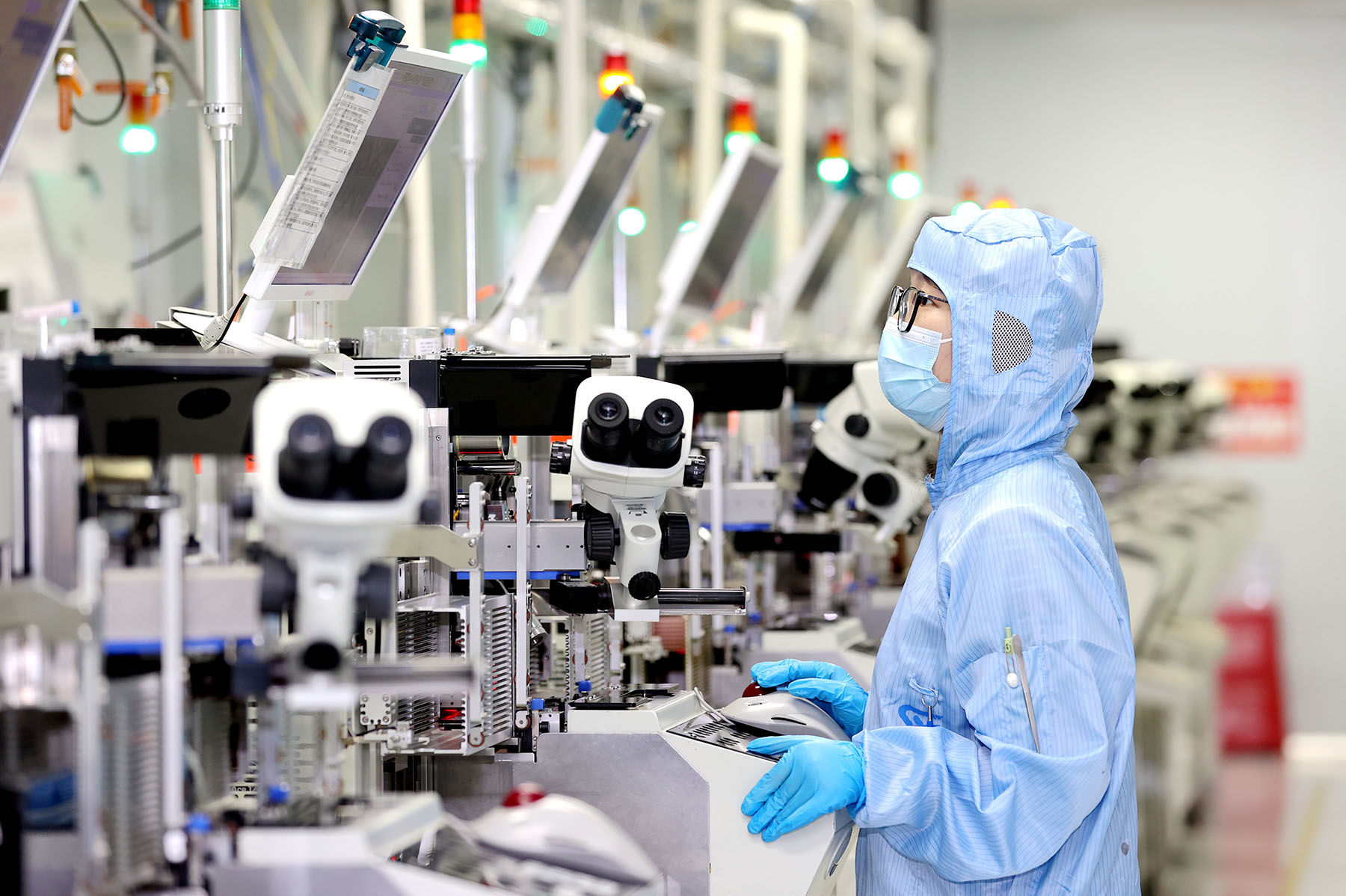
China will deepen its "AI Plus" initiative during the 15th Five-Year Plan period (2026-30), expanding the use of artificial intelligence across industries to foster new drivers of economic growth, officials with the National Development and Reform Commission said at a news conference in Beijing on Tuesday.
AI applications in China are moving from individual pilot projects toward coordinated use across research, production and distribution, said Wang Ruomeng, deputy director of the department of innovation and high-tech development at the NDRC.
Wang said that China has built more than 10,000 advanced-level smart factories, where AI is widely used in quality inspection, production monitoring and fault diagnosis. Such applications have shown potential to improve efficiency, reduce risks and cut costs.
READ MORE: AI integration fuels manufacturing upgrade
China will prioritize six emerging pillar industries, including integrated circuits, aerospace and biomedicine, said Ren Zhongbao, another deputy director of the department of innovation and high-tech development at the NDRC.
Their combined output value, which approached 6 trillion yuan ($898.8 billion) in 2025, is expected to exceed 10 trillion yuan by 2030, becoming an important force supporting high-quality development, Ren said.
During the 15th Five-Year Plan period, China will strengthen basic research and original innovation, pursue breakthroughs in key core technologies and reinforce the leading role of enterprises in technological innovation, Ren added.
Authorities will also support enterprises in taking the lead in national science and technology projects and expand major application scenarios to accelerate the adoption and commercialization of new technologies and products, said Ren.
On AI development, Wang said China will continue building national AI application pilot bases in manufacturing, energy, transportation and healthcare. By coordinating computing resources, models and data, the bases will address common industry challenges, accelerate standard-setting and lower barriers to adoption.
China will develop high-quality datasets, strengthen data labeling and improve data circulation and utilization to better support AI development, said Luan Jie, deputy head of the policy and planning department at the National Data Administration.
Yang Chao, a researcher at the Development Research Center of the State Council, said the main obstacles to large-scale AI adoption in manufacturing do not stem primarily from limitations in large AI models.
Instead, strict data and reliability requirements, varied production scenarios and cost considerations make it difficult to deploy AI projects at scale, said Yang. He added that AI's contribution to economic growth would depend on computing infrastructure investment in the short term.
On international cooperation, Wang said China will promote open-source AI and inclusive development, seeking to make AI a global public good that benefits all humanity.
China is working to make the World Artificial Intelligence Cooperation Organization operational, with 38 countries having joined as founding members. China will also strengthen coordination with other countries on AI development strategies, governance rules and technical standards, Wang said.
ALSO READ: China to beef up support for emerging pillar industries
Turning these international cooperation efforts into lasting results will require moving beyond broad agreement on AI governance principles to sustained practical cooperation, said Lu Chuanying, a professor at Tongji University.
Lu said WAICO aims to better integrate AI governance with development by promoting inclusive AI innovation and applications, expanding international cooperation, narrowing the AI divide and addressing risks.
Through technical cooperation and capacity-building, the organization could also help countries with relatively limited AI capabilities participate more fully in AI development, Lu added.
Contact the writers at tanguoling@chinadaily.com.cn
