

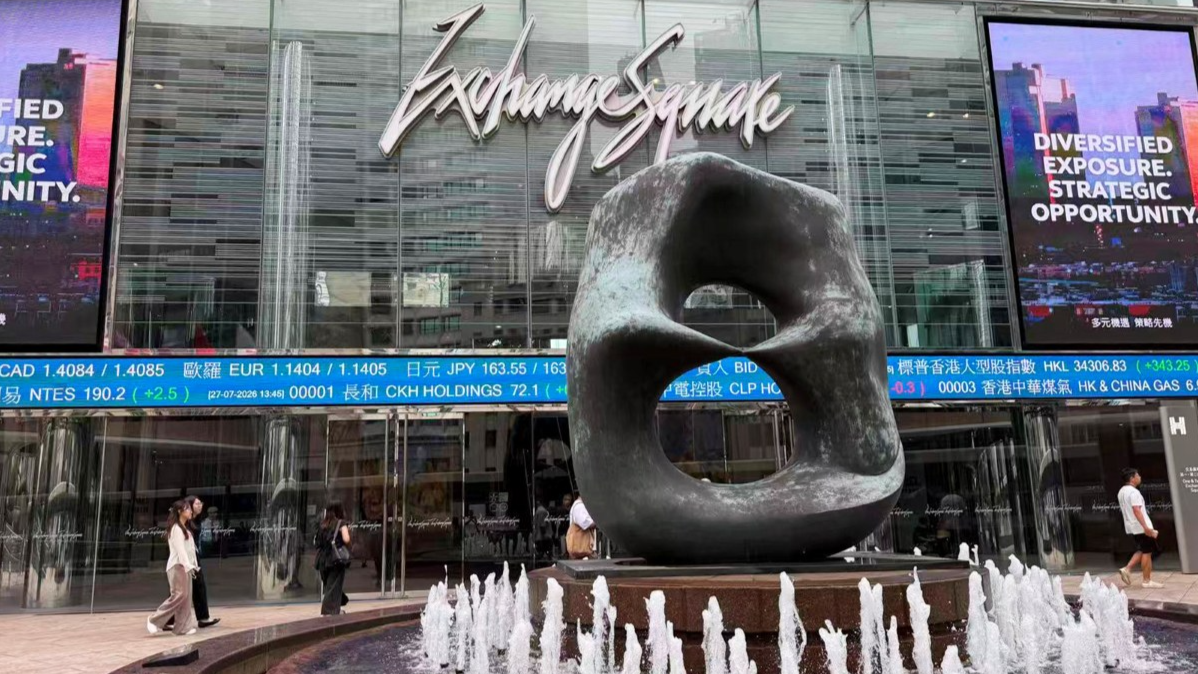
The evolution of technology-themed and cross-market index exchange-traded products (ETPs) will further cement Hong Kong’s multi-asset ETP ecosystem and its strategic capital connectivity role by enabling global investors to participate the Chinese mainland’s innovation sector.
Panelists made the observation on Thursday at the HKEX ETF Summit 2026.
The summit, organized by Hong Kong Exchanges and Clearing, gathered 900 participants from institutional and private-wealth investors, asset managers, issuers and market participants to discuss the latest developments shaping the exchange-traded fund (ETF) market, including growing institutional adoption, evolving investor needs, product innovation, cross-border opportunities, and tokenization.
“There has been an increasing number of international investors eager to participate in the Chinese mainland’s innovation story, among other opportunities. But fully capturing Asia’s opportunity will require more than just primary market listings,” HKEX Head of Markets Gregory Yu Hock-ken said at the opening remarks session. “Therefore, ETPs have an important role to play because they give investors more ways to diversify, generate income, and express different market views.
“Building a successful ETF market is about more than just the products on our shelves. It requires an ecosystem in which indexes and benchmarks provide the building blocks for innovation, broader product choice attracts more investors and strategies, and deeper participation supports liquidity and scale,” he added.
ALSO READ: HKEX posts record nine-month earnings
Hong Kong’s ETP market has continued to demonstrate strong momentum. Assets under management of ETFs and leveraged and inverse (L&I) products reached HK$616.5 billion ($78.6 billion) at the end of October, while average daily turnover rose 23 percent year-on-year to a record HK$46.5 billion. As of the end of October, Hong Kong had 246 ETFs and 29 L&I products, while three new ETFs were listed in October.
Trading of ETFs through the Stock Connect program also grew, with average daily turnover of northbound and southbound ETF trading reaching 5 billion yuan ($749 million), up 48 percent from a year earlier, and HK$4.6 billion, up 8 percent annually in the first 10 months of this year.
Launched in July 2022, ETF Connect is a mutual market access program that integrates eligible ETFs into the existing Stock Connect program, allowing cross-border trading between mainland and Hong Kong investors without requiring separate local accounts.
At the discussion panel of the summit, panelists said that as the Chinese mainland has made achievements in innovation sectors such as clean energy, high-end chips, embodied artificial intelligence, biotech, and smart driving, investors can consider investing in those technology-themed and cross-market themes ETFs to capture the mainland’s innovation growth journey.
Carter Shi, chief sales and marketing officer at E Fund Management (Hong Kong) Co, said that if investors want to allocate their portfolios to the Chinese mainland’s innovation sector, they can consider investing in some Hong Kong-listed technology ETFs that can prevent single-company dominance in the investment.
“The demand has transformed into a full portfolio mindset focusing on risk-to-return profile and asset rotation. Investors can consider strategies like adding ETFs that trace major AI and semiconductor companies to complete sector coverage, and adding cross-market ETFs that can help investors to capture the regional economic cycle,” said Chole Tao, head of Product and Development at Bosera Asset Management (International) Co.
READ MORE: Hong Kong’s ETF market daily turnover surges 22%
Tan Hongxiang, head of ETF & Index Investments Department and senior ETF portfolio manager at Huatai-PB Fund Management Co, added: “By investing in cross-market ETFs, investors can capture entire industry value chains while optimizing risk-return profiles through strategies like pairing dividend stocks or small caps across different regions.”
Panelists also said that the ETF Connect has transformed from a trading channel into an ecosystem by injecting market liquidity and bringing more products.
“ETF Connect have a very good value proposition of bringing the same level of product innovation to Hong Kong and mainland investors, bringing in (market) dynamics and (product) offerings to market participants and enrich Hong Kong’s position in the ETF market as a bridge,” said Jason Ye, senior director at S&P Dow Jones Indices.
He added that the “Hong Kong (ETF market) is really a kind of bridge that connects Chinese mainland institutional demand with the global markets and vice versa.”
Sebastian Born, head of Asia Pacific ETF Institutional Sales at Optiver, said, “We need to continue to innovate and make sure that we stay on the top of the innovation cycle, especially if we look at other regions and what is possible there. ETF as the investment vehicle is so diverse and dynamic that virtually any strategy can be wrapped.”
