

10-year-old docent tells story of historic Red Army alliance
Editor's note: This year marks the 90th anniversary of the victory of the Long March — a monumental feat in human history. China Daily is publishing a series of reports reflecting on this historic journey and exploring how the spirit of the Long March continues to inspire the Chinese people on their new path toward national rejuvenation.
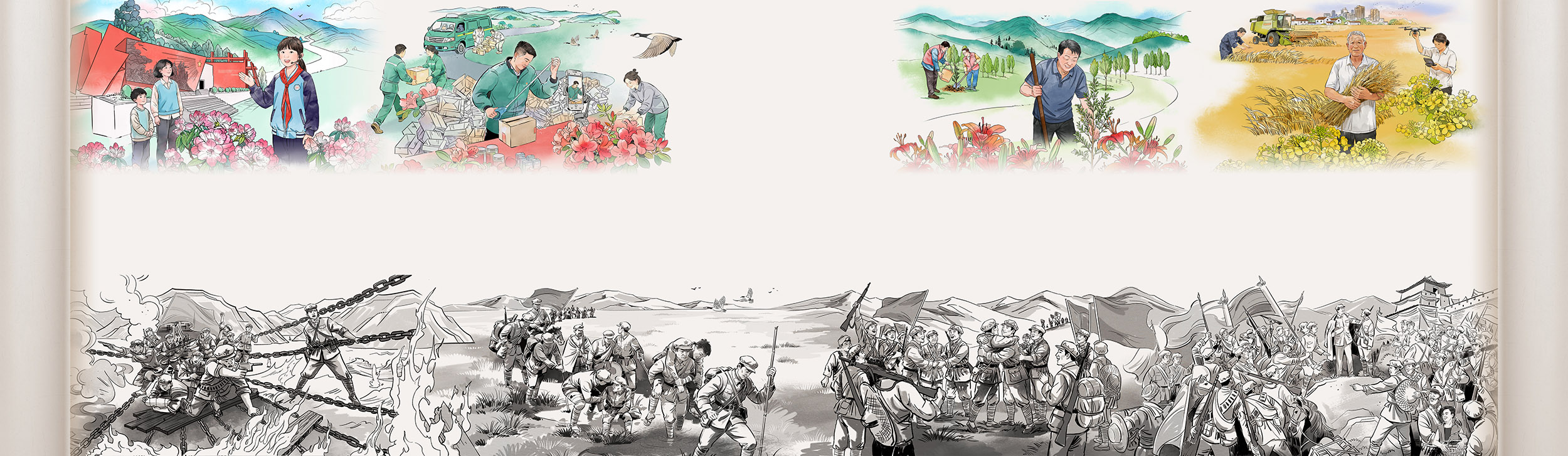
At the edge of a tranquil mountain lake in Liangshan Yi autonomous prefecture, Sichuan province, a small figure in a neat jacket adjusts her microphone. Tong Yuxin is just 10 years old, but she has already taken on the responsibility of keeping history alive.
As visitors gather by Yihai Lake in Mianning county, she begins recounting an oath that brought together a Red Army commander and a Yi chieftain, helping pave the way for the Red Army's advance during the Long March.
READ MORE: Long March spirit the touchstone of modern prosperity
"I think I got the chance to be a museum docent because I speak Mandarin well, so they let me have a try," said Yuxin, a primary school student from the county.
She is now a volunteer docent at the Yihai Alliance Memorial Museum, where she tells visitors the story of the blood oath sworn in 1935 between Red Army commander Liu Bocheng and Xiao Yedan, then head of the Guoji clan of the Yi ethnic group. The two drank chicken blood to pledge brotherhood, enabling the Red Army to pass safely through the Yi-inhabited area and making subsequent crucial operations possible, including the Dadu River crossing and the storming of Luding Bridge.
Yuxin spent a week memorizing two pages of script before beginning her work. "I used an artificial intelligence tool to condense two pages down to a few lines. I memorized those lines first. I read them until I got the gist, and then recited line by line," she said.
Her first tours also taught her how to manage her nerves. When guiding visitors along the lakeside near the museum, she sometimes turned to the surrounding scenery for a moment of relief.
"Sometimes I just pointed at the scenery to make them look at it, while I tried to calm myself down so that I could perform the way I practiced at home. I got more nervous when there were fewer people, because they listened much more carefully," she said.
Despite her initial nervousness, Yuxin has come to enjoy the experience. "Every time I guide tourists, I feel really happy. They never ignore me and do their own thing just because I'm a kid," she said.
Behind her growing confidence is a family that has long treated storytelling as a way to pass on history and values. Her grandfather, a former soldier, would recount wartime episodes whenever she sat down to eat or watch television.
"He wanted me to know that moving stories happened in their generation, and to understand that I must unite with my classmates and help anyone who is in trouble," she said.
That lesson in solidarity resonates with the story she tells at the museum. Reflecting on the Yihai Alliance, Yuxin explained the significance of the oath in bringing the two sides together.
ALSO READ: Long March legacy remains strong
"A blood oath is a very solemn ritual among the Yi people. At that time, there was huge distrust between Yi and Han peoples. Liu Bocheng and Xiao Yedan used this ritual to put aside their guard. Between them, there was not only brotherhood, but also a sincere promise to care for each other," she said.
The experience has also helped Yuxin grow beyond the museum. Before becoming a docent, she often struggled to put together an answer in class, even when she knew the facts. Explaining historical stories to visitors has since helped her express herself more clearly.
"After I started explaining stories at the museum, I improved a lot," she said.
Her family has supported her efforts in practical ways, buying her a portable speaker, showing her videos of professional docents and getting her sportswear for days when she might lead tours uphill.
Yuxin has two clear ambitions for the future. "I want to be a teacher. I also want to be a docent, telling all the stories that happened here in Mianning," she said.
Her connection to the Yihai Alliance story deepened after an encounter with an elderly visitor.
"Once, after I finished telling the story, a granny touched my head and said, 'You must tell this story to more people'."
The woman's words reinforced Yuxin's sense of responsibility toward the history she has been entrusted to share.
"I feel it's a huge honor being a docent. That helps more people know that Mianning is a sacred place with revolutionary history," she said.
Since last year, more than 80 primary school students in Mianning county have participated in the docent training program, helping ensure that the story of the Yihai Alliance continues to reach new generations.
Planting trees lifts Shaanxi village out of poverty
For decades, when the summer sun relentlessly beat down on the hillsides of northern Shaanxi province, farmers had to drape clothes over their heads just to escape the heat. Today, they can walk up the mountain and cool off under any tree they like.
Yan Zhixiong, former Party secretary of Nangou village in Wuqi county, looks back on a transformation that took more than two decades to achieve.
When the Grain for Green Program reached Wuqi in the 1990s, the county was among the first in China to return farmland to forest and grassland. But the villagers were initially reluctant to give up their fields. They were more concerned about putting food on the table than planting trees.
"When we talked about returning farmland to forest and grassland, the key was to get villagers on board," said Yan, 62.
"The villagers said to me, 'Yan Zhixiong, we plant so much and still don't have enough to eat. Now you want to leave us just 2 mu (0.13 hectares) of flat land per person. What are we supposed to eat?'"
The government promised to provide grain to compensate farmers for the crops they would lose, but many remained skeptical until they saw large carts hauling grain back and forth through the village.
"In the end, everyone returned their farmland. And did anyone starve? No one," Yan said.
Then came the planting.
Before dawn, technicians with the program distributed saplings. Tricycles hauled the seedlings and cans of water up the hillsides, where villagers worked to establish trees in the dry, unforgiving terrain.
"We had to tend every tree the way we look after a child. If we didn't plant that way, they all died," Yan said, explaining that afforestation in northern Shaanxi was no easy task.
After planting a sapling, villagers would grasp it with both hands and pull upward. If it came loose, they had to plant it again, Yan said. In the region's dry climate, trees had to be planted deep, with the soil firmly tamped down around their roots, to help them survive.
The work took a physical toll. The villagers' palms were covered in calluses. Their hands blistered and bled, before the wounds dried into hard scabs. A handshake with them felt rough and abrasive.
"In those days, we were so poor. No gloves, just bare hands," Yan said.
The figures tell the story of how much has changed.
In 1996, the year Yan became Party secretary, the village's average annual income was just 660 yuan ($97.82).
Today, trees help hold the soil in place, and the village relies on a fraction of its former farmland.
Residents have diversified their sources of income, drawing earnings from forestry, crops grown under the tree canopy, small businesses, livestock and tourism. Average annual income in the village now exceeds 10,000 yuan.
Bai Tao, 56, a Nangou villager, said he built a campsite in 2024 to cater to tourists looking for places to eat and stay. A longtime cooking enthusiast, he enjoys being able to run his business right on his doorstep. He said the campsite could bring him more than 100,000 yuan in annual income.
The transformation has also changed how villagers view their relationship with the land.
"Before, when you went up the mountain and the wind blew, your nostrils and mouth were full of yellow dust. Now look at it. We can say clear waters and green mountains make people prosperous," Yan said.
He sees the effort as a collective achievement built on years of hard work.
"I always remember Chairman Mao Zedong's words: the masses are the real heroes. He was absolutely right," Yan said. "Without ordinary people grinding away out there, one or two people could never have taken this on."
He described the more than 20-year effort as a new Long March.
In October 1935, the Central Red Army arrived in Wuqi, marking the victorious conclusion of its Long March. At the time, the Loess Plateau was characterized by barren hills and deeply eroded gullies.
According to the local government, the county's green coverage rate rose from 19.6 percent in 1997 to 72.9 percent.
For Yan, the results are visible not only in the figures but also in the everyday lives of the people who once struggled to survive on the hillsides. Trees now cover the slopes, offering shade to farmers and helping create new opportunities for the village.
The change, he said, is a testament to what ordinary people can accomplish through perseverance and collective effort.
Second-generation postman connects isolated communities
For nearly two decades, postman Lhalung Dorje has navigated rocky mountain roads, icy winter routes and remote grassland pastures along what locals call the "Long March mail route".
High on the plateau in Sichuan province's Aba Tibetan and Qiang autonomous prefecture, this winding corridor crosses some of the most unforgiving terrain once traversed by Red Army soldiers during the Communist Party of China's historic Long March.
The strategic transfer, which lasted from 1934 to 1936 and covered more than 12,500 kilometers, carried CPC forces from their main base in Ruijin, Jiangxi province, as well as from other bases, to northern Shaanxi province.
More than 90 years after Red Army troops embarked on that journey, Lhalung Dorje embodies the spirit of the Long March — defined by authorities as devotion to the public interest, dogged perseverance in the face of hardship, self-sacrifice and solidarity with ordinary people — by making daily deliveries to isolated villages.
Cost considerations keep most private delivery firms confined to county-level hubs in Zoige, a sprawling county covering more than 10,600 square kilometers, with just over 80,000 residents spread across 13 township-level administrative units.
Under China Post's universal service mandate, Lhalung Dorje and his team press on to remote hamlets and nomadic grazing grounds. Postal workers provide a critical public service lifeline, delivering supplies such as medicine to far-flung nomadic communities and transporting local dairy products and handicrafts to outside markets, helping residents earn an income.
At 42, Lhalung Dorje has spent much of his life immersed in postal work, following in the footsteps of his father. The elder postman began his career in the 1970s, initially traveling on horseback along muddy tracks before switching to a bicycle. Decades of riding through choking road dust left him with occupational lung disease.
"My father told me, once you choose this path, you must see it through to the end, do not give up halfway," Lhalung Dorje recalled. He joined China Post in April 2007, carrying on the family tradition.
Peril is a constant companion on these routes. On one occasion, a massive boulder crashed onto the road and struck the front of his van. "I hit the gas and accelerated through. When I saw how huge that rock was, I felt real fear," he said.
Long hours on these punishing routes have forged bonds between Lhalung Dorje and local residents that go well beyond typical customer-provider relationships. Limited communications and little contact with the outside world make postal workers one of the communities' most reliable links to the world.
During one bitter winter, he deviated from his scheduled route to deliver urgently needed medication to a sick village child. When he arrived, the boy's elderly grandfather was waiting in the falling snow, flakes settling on his head.
"Our hardship cannot compare with what the Red Army endured, but the spirit is the same," Lhalung Dorje said. "Each generation has its own Long March to walk."
This modern-day Long March also requires learning new skills. Though naturally reserved, Lhalung Dorje began hosting free public-welfare livestreams in 2021 to help plateau farmers sell yak meat, chickens and local fruit. One two-hour livestream promoting locally grown green plums generated 800,000 yuan ($119,600) in sales.
"My calves trembled, my face burned hot behind the camera, I feared missing every line on the teleprompter," he said.
Eager to explore further innovations, he studied for about 40 days and retook two exams to earn a civilian drone pilot license.
"For me, studying drone flight is my own snow mountain and grassland to cross," he said, invoking the Long March's brutal terrain. He hopes drones will one day help deliver mail to areas cut off by winter snow or landslides while transporting highland agricultural products to outside markets.
Co-workers describe him as reliable and generous. Tsering Lhamo, a fellow postal employee, said Lhalung Dorje always steps up when the office is overwhelmed with parcels.
"He bears heavy responsibility. When workloads pile up, he is the first one to come and help," she said.
Lhalung Dorje plans to remain on rural mail routes until retirement, he said.
"My original wish is simple: to serve local ordinary people and bring them convenience," he said.
Tales of momentous journey linger in rural Gansu
Long before asphalt roads and university degrees came to Hongbuzi village in Huining county, Gansu province, a family's quiet acts of kindness helped sustain the Red Army during one of the most pivotal chapters of Chinese history.
Today, 75-year-old farmer Ma Guitang spends his mornings in the fields, keeping both his crops and that 90-year-old legacy alive.
Ma was not yet born when the Red Army spent more than 50 days in Hongbuzi in the autumn of 1936. But the stories have lived on through generations of his family.
"My father was born in 1914, and my mother in 1920. In the 1960s, when things were quieter on the farm, they would tell me stories about the Long March. I was in my teens, and I just listened," Ma said.
He is no historian, but a farmer who has spent a lifetime tending both his land and his family's oral history.
In October 1936, the First and Fourth Front armies of the Red Army joined forces in Huining. While the troops were stationed in Hongbuzi, Ma's father followed them to help collect grain.
"They would weigh the grain and write us a receipt," Ma said, recounting his father's words. "They said, 'Don't worry. When the revolution succeeds, we will repay you'."
One soldier, in particular, forged a bond with the family that no receipt could capture.
Wang Rong was just 14 when he fell dangerously ill with a high fever. Ma's mother spotted him from a mill house about 20 meters from the command post.
"She immediately made him a bowl of ginger soup. Then she went to the medical station and got a herbal remedy. She boiled it and had him drink it. He recovered quickly," Ma said.
Grateful for her care, the young soldier began calling her "elder sister".
For Ma, such stories were more than childhood memories. His admiration for the Red Army inspired him to retrace its footsteps.
"I admired the Red Army's history so much that I walked almost all the routes they took near my home. I investigated it myself," he said.
That admiration is reflected not only in the stories he tells but also in how he lives. Although meat is now on the table almost every day, Ma is careful not to waste food.
"Sometimes the little ones, too young to know better, drop food on the floor. I tell them to pick it up. This life did not come easily," he said.
The village has changed considerably during Ma's lifetime. Its roads are now paved with concrete, and every April, the township sends medical staff members to provide residents aged 60 and above with health checks, including blood pressure and blood sugar measurements and ultrasound examinations.
He still spends two hours tending his land every morning.
"It's my exercise. We eat what we grow, and we barely spray pesticide," he said.
His two grandsons — one a university graduate and the other a sophomore — embody a transformation that his parents could hardly have imagined.
"In the old days, only the landlord's sons went to school. Now most of the young people here are educated," he said.
Ma is not alone in preserving the memory of the Red Army. In nearby Tuoying village, a group of farmers has formed a folk music ensemble to perform traditional ballads about the Long March.
"If nobody digs these things up now, the memories might disappear forever," said Xing Jiankuan, the troupe's director.
Since June 2021, the ensemble has staged 116 performances for an audience of about 289,000 people.
One of its plays recounts the death of a military officer surnamed Huang in a skirmish and the story of an elderly Huining villager surnamed Song who gave up her own coffin so that he could be buried.
"The performance touched audiences deeply. Once, after the play, no one left. Everyone was absorbed in it. An old man came onstage and said his two grandsons had been moved to tears and had really understood the story," 68-year-old Xing said.
"The happy life we have today didn't come easily. We must never forget the revolutionary martyrs. It was the Long March, one step at a time, that got us here," he added.
