

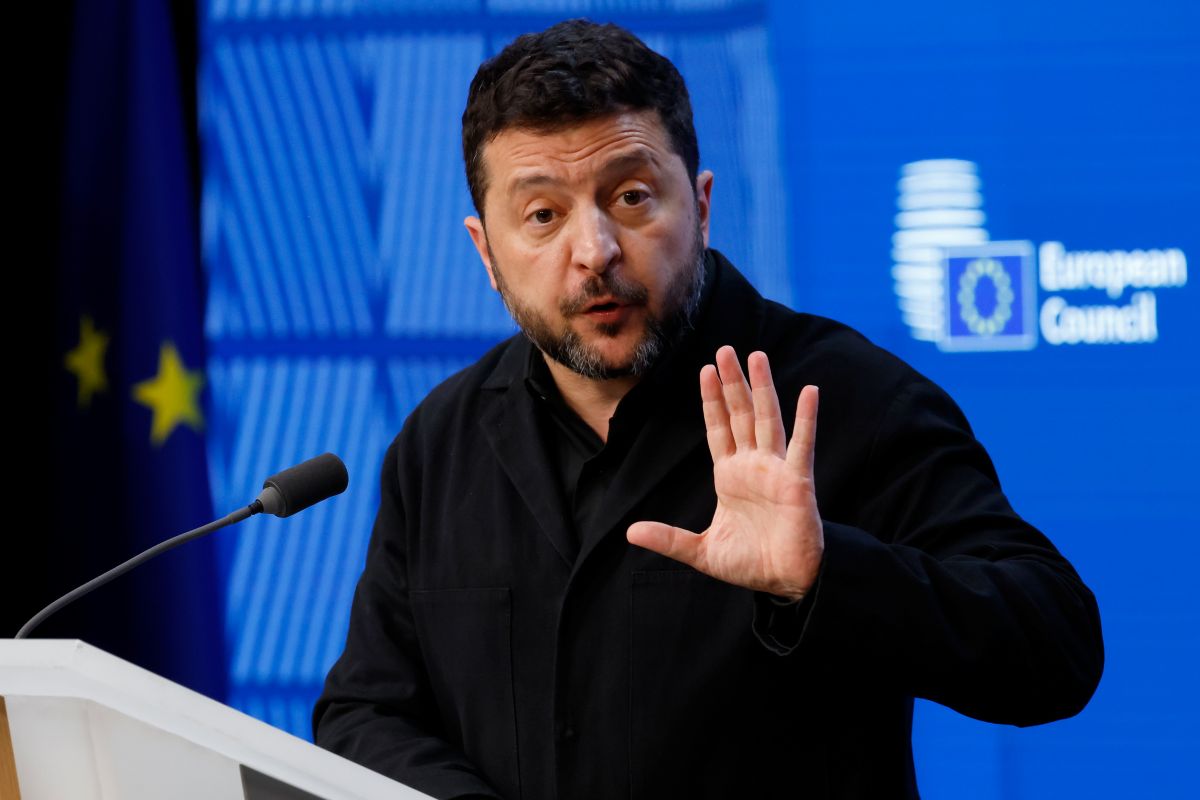
MOSCOW/BRUSSELS – Ukrainian President Volodymyr Zelensky on Friday requested at least another 70 billion euros ($78.8 billion) in European Union assistance for 2027, while expressing frustration over recent restrictions on US-controlled Starlink services and Washington's dealings with Moscow.
Addressing EU leaders at a summit in Brussels, Zelensky said Ukraine's war costs would reach 155 billion euros next year and appealed for additional funding for defense, weapons and resilience.
"We need at least 70 billion euros more from you – for defense, for weapons, and for our resilience. This is a realistic amount. And I ask you to find this support," he said.
At a subsequent press conference, he acknowledged Ukraine's heavy reliance on the US-controlled Starlink satellite communications system, saying recent restrictions had disrupted drone interceptions and military logistics.
"Starlink was not turned off, but the speed limits were lowered," the Ukrainian leader said, describing the restrictions as a "very dangerous and unpleasant surprise."
Zelensky also criticized Washington's recent diesel agreement with Moscow and the easing of sanctions, saying Ukraine had not been informed in advance, while adding that Ukrainian and American negotiating teams remained in contact.
EU pledges continued support
The EU leaders vowed to continue financial and military support for Ukraine, and reaffirmed their commitment to advancing its EU accession process.
The bloc must increase its support for Ukraine and pressure on Russia to bring Moscow to the negotiating table, said European Council President Antonio Costa.
"This is no time to withdraw the support to Ukraine. This is no time to relieve Russia's sanctions," Costa told reporters alongside Zelensky and European Commission President Ursula von der Leyen.
Von der Leyen said the EU was working on its 22nd package of sanctions against Russia, accusing Moscow of failing to respect an energy ceasefire proposed by US President Donald Trump.
The EU leaders also discussed Ukraine's preparations for the coming winter and its financial and military needs for 2026 and 2027.
Zelensky thanked the EU for its continued support and said Ukraine's top priority was securing energy supplies ahead of winter, along with air defense systems and funding.
EU foreign policy chief Kaja Kallas also called for stronger support for Ukraine ahead of winter, while acknowledging Europe's dependence on US military technology.
"Starlink is really necessary for Ukraine, and unfortunately, in the short term Europe can't replace this capability," Kallas told reporters ahead of the summit.
She also acknowledged difficulties in coordinating with Washington over the conflict, saying the EU was trying to persuade its American partners to increase pressure on Russia.
Costa and von der Leyen reaffirmed their support for Ukraine's EU accession, welcoming the opening of two additional negotiating clusters. Von der Leyen said the goal was to open the final two clusters by the end of the year, while Zelensky pledged to continue implementing necessary reforms.
Defense ministry: 8 Russian strikes in a week
Russian forces seized 12 settlements and carried out one massive and seven group strikes against Ukrainian targets over the past week, the Russian Defense Ministry said on Friday.
The strikes targeted Ukrainian military-industrial enterprises, logistics and telecommunications centers, transport infrastructure used by Ukrainian forces, drone production and storage sites, ammunition and military equipment depots, and temporary deployment sites of Ukrainian forces and foreign mercenaries, the ministry said.
The settlements included Lukashovo, Lobanovka, Reznikovo, Kupino, Nefedovka, Chernoye, Varvarovka and Nikolayevka in the Kharkov region; Novotroitskoye, Petrovskoye and Lidino in the Donetsk region; and Nikolskoye in the Zaporizhzhia region.
The ministry also said Russian forces struck 15 dry cargo ships used to deliver weapons, military equipment, fuel and other supplies to Ukrainian forces.
Russian air defenses shot down seven guided aerial bombs, two US-made HIMARS rockets, four Flamingo cruise missiles, one Neptune missile and 5,695 drones during the period, it added.
