

To meet rising solo entrepreneurship, targeted training, cross-disciplinary education reform and deeper industry-education integration are urged to equip workers-turned-founders and students for building businesses in the AI age. Zhou Mo reports from Shenzhen.

Editor’s note: A new wave of entrepreneurship is sweeping across the Chinese mainland, driven by the rapid rise of AI-powered one-person companies. This third article in our series looks at efforts to nurture qualified entrepreneurial talent.
Dozens of people packed a 200-square-meter classroom at Shenzhen’s Shuibei Night School on a September evening, listening attentively to a workshop on solo entrepreneurship.
Among them were entrepreneurs, office workers and the jobless. With the same objective, they hope to pick up practical know‑how to build or run a one‑person company.
To instructor Li Liqin’s surprise, the entrepreneurial training session drew more full-time employees than company founders. “More than half of them were corporate workers, the others being entrepreneurs and the unemployed. It’s a far cry from what we had expected,” she says.
READ MORE: All-out to prop up solo bosses
“They came to figure out what an OPC is, whether they could develop an avocation or become bosses themselves. They were creating a safety net for themselves.”
The composition of the participants reflects a trend that more workers are keen to be solo entrepreneurs to cope with the evolving job market and industrial transformation in Shenzhen as artificial intelligence triggers sweeping changes across economic sectors.
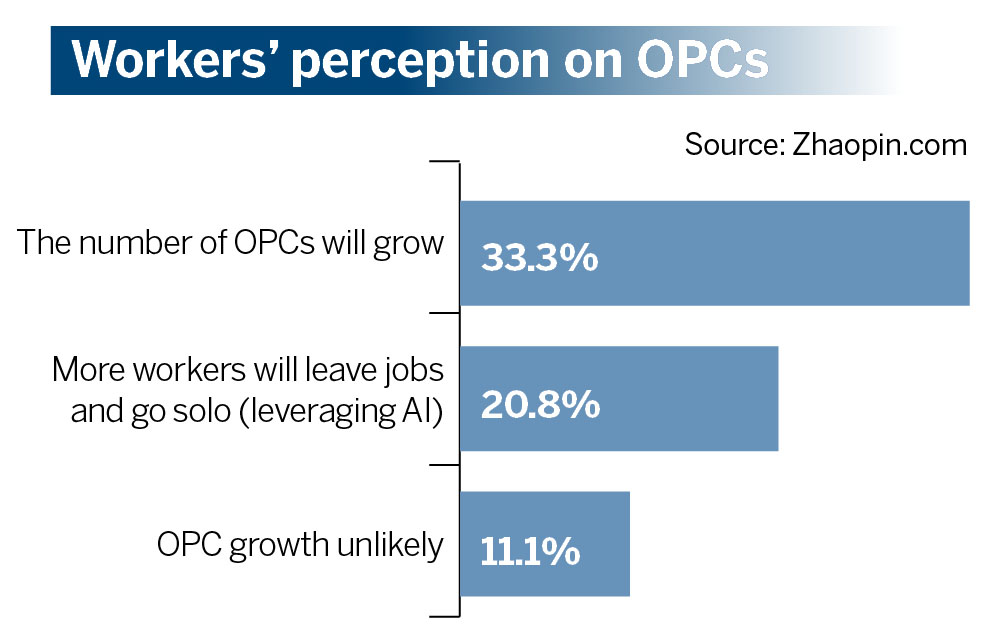
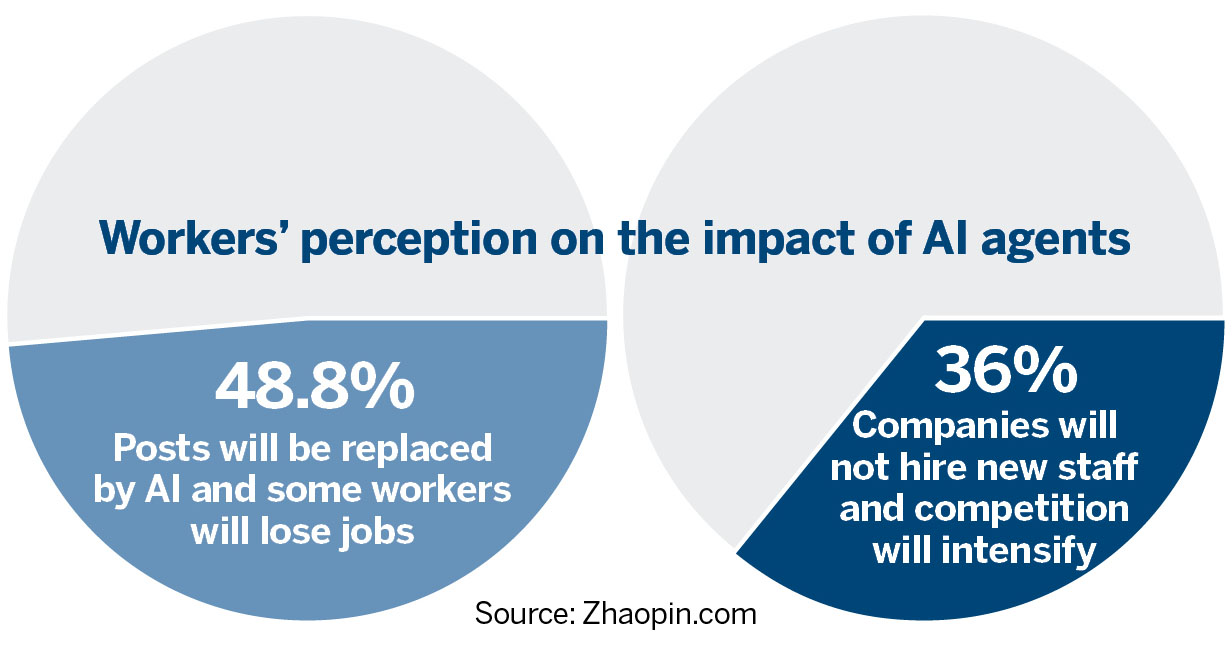
According to a report published by Chinese recruitment portal Zhaopin.com earlier this year, 48.8 percent of respondents believe AI will replace certain jobs, leading to unemployment for some workers. About 33 percent think that OPCs will keep rising, while 20.8 percent say more workers will use AI to leave full-time employment and go solo.
This societal shift calls for an optimized talent cultivation and development system to prepare potential OPC entrepreneurs for opportunities and challenges in the new business landscape.
Talent work has been high on Shenzhen’s policy agenda. The city’s action plan for building a leading hub for AI and OPC entrepreneurial ecosystem (2026-27), released early this year, allocated a dedicated chapter to improving talent-related services. Supportive measures mainly come from three aspects — granting financial incentives, offering office spaces and providing housing support.
According to the Shenzhen Human Resources and Social Security Bureau, eligible OPC entrepreneurs are entitled to a one‑off financial incentive of 10,000 yuan ($1,500), office rental subsidies of up to 45,000 yuan, and access to personal startup guaranteed loans of up to 600,000 yuan, with fiscal interest subsidies covering 50 percent of the actual interest rate.
Enterprises settled in OPC communities are offered an area of up to 50 square meters in low-cost office space. Eligible young professionals can also apply for transitional housing at roughly 60 percent of the market rent for a maximum tenure of three years.
Bridging the gap
While such initiatives have created fertile ground for OPC professionals, they fail to solve the problem of how to cultivate them. To many workers in traditional industries, transition to AI-powered OPC entrepreneurship is riddled with challenges.
Zheng Xuejun has firsthand experience of the thorny process. Having witnessed shrinking industry dividends, cutthroat price competitions and thinning profit margins, the veteran foreign trade practitioner realized that the old business model was unsustainable and was determined to transform it.
She set up an OPC in Shenzhen last year, leveraging AI to facilitate foreign trade of laptop external monitors. Her expertise gained from 15 years’ work experience in the industry couldn’t carry her through the full business cycle.
“I’m good at finding customers and negotiating trade deals, but running an OPC is far more than that. I’m missing several critical pieces of the puzzle, such as product graphic design, operations and content creation, as well as clerical work, and these are areas I hope AI can help,” she says.
It wasn’t smooth sailing for Zheng who lacked a technological background. She joined OPC training sessions at Shuibei Night School, making use of every spare minute to study during her daily commute after work and before going to bed. So far, she has completed 37 courses.
“After the training, for the first time in my career, I feel like I can ‘travel light’,” she beams with delight.
Like Zheng, many working professionals without any AI experience are pursuing career shifts amid the OPC boom. However, a dearth of technological knowledge and business operational capabilities has created a bottleneck for them. To tackle the challenge and build up a talent pipeline for OPC development, Shenzhen is striving to foster a multi-layered entrepreneurial services system.
The Shenzhen Human Resources and Social Security Bureau has designated a batch of entrepreneurial training institutions to offer free training courses for people with entrepreneurial aspirations.
“So far, 4,570 trainees have acquired knowledge and skills to start a business through these programs,” says Huang Changan, deputy director of Shenzhen’s public employment services center which is affiliated to the bureau.
The bureau has selected 308 experts, including entrepreneurs, professionals from industry associations, and scholars from universities and research institutes, to serve as entrepreneurship mentors. “OPC founders can book online or offline sessions with the mentors for entrepreneurial guidance covering project assessment, market analysis or management consulting,” says Huang.
Rethinking education
Still, the journey from learning to putting ideas into practice is long and arduous.
Li, who has been conducting OPC training courses at Shuibei Night School for months, observes that the biggest challenge in cultivating OPC talent lies not in their professional capabilities, but in perseverance.
“Most participants did not drop out due to a lack of ability, but a lack of persistence,” she explains. “Without consistent returns, whether they’re financial gains or positive progress feedback, they struggle to hold on and tend to switch tracks halfway.”
Zhang Yifei — a senior lecturer at The University of Hong Kong Business School — said in an article the success rate of entrepreneurship stands at just 10 percent, with 80 percent of startups being able to survive no more than three years. “AI doesn’t change this inexorable law,” he wrote.
Scholars and industry insiders say education holds the key to breaking talent bottlenecks, calling for reforms at universities and vocational colleges to nurture interdisciplinary and high-skilled talent ready for the AI age.
The fast technological advance driven by AI has created a growing mismatch between high-education curricula and real-world market demands, notes Shen Minghao — vice-president of the Guangdong University of Foreign Studies.
“Technologies are evolving at such a fast rate. It usually takes 12 to 18 months for university curricula and certification to finalize. Quite often, we’re teaching last year’s material while industries need knowledge for today,” he said in an interview with local media.
He explained that traditional education prioritized training students to acquire knowledge quickly and accurately, but as knowledge renews far faster than people can learn it, universities should shift focus to cultivating students’ capabilities that “combine depth and breadth of knowledge”.
“We need to stick to the philosophy of cultivating interdisciplinary and innovative professionals. Teaching should be project‑driven or task‑oriented, so students can master more practical tools.”
“At the same time, we should further promote industry‑education integration and boost interactions with industry players. This will allow students to learn and grow in real‑world work scenarios,” urges Shen.
Chen Xiaohong — an academician at the Chinese Academy of Engineering — calls on universities to speed up reforms by shifting disciplinary building from fragmented specialization to cross-disciplinary integration, and reorienting talent cultivation from theory-driven research to practical application.
ALSO READ: Keeping heads above the water
Some educational institutions are already moving in this direction. The Chongqing Institute of Engineering in Chongqing municipality launched the nation’s first OPC industrial college in May. The facility aims to nurture the first group of 50 university students for future OPC entrepreneurship and offer free OPC entrepreneurial services to 200 students each year.
In the Guangdong-Hong Kong-Macao Greater Bay Area, an OPC industrial college focusing on healthcare was launched in Guangzhou in July. The college, co-built by Guangdong Pharmaceutical University and two industry players, focuses on cultivating interdisciplinary professionals with traditional Chinese medicine and AI knowledge, and incubating OPCs in healthcare.
Zhuhai, for the first time, rolled out a dedicated OPC cultivation program for university students and an OPC entrepreneurship competition last month, aiming to nurture over 100 young professionals and incubate high-quality OPC projects.
“Developing talent is a long-distance race. As the old Chinese saying goes, ‘it’s better to teach a man to fish than to give him a fish’,” says Li. “Cultivating OPC talent should be more than just skills training. It’s about fostering entrepreneurial competencies. This is what underpins solo entrepreneurs as they navigate market uncertainties to sustain long-term development.”
Contact the writer at sally@chinadailyhk.com
