

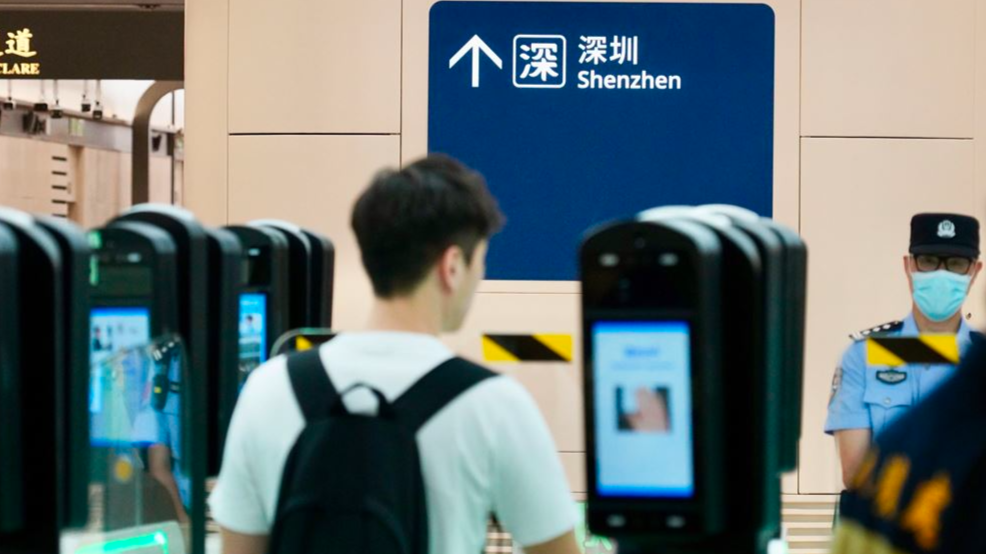
Authorities are stepping up preparations for the opening of the redeveloped Huanggang Port by improving transportation arrangements, customs clearance procedures, and contingency planning, as reports indicate that the new crossing will begin operation on Monday.
The Hong Kong government announced on Wednesday that the new port will be served by seven franchised bus routes, six dedicated minibus routes, and five short-haul cross-boundary coach routes operating round the clock, providing direct access to various districts across the city.
Deputy Commissioner of Transport Kwok Wai-ying said that these public transportation routes connect 13 major stations, offering more comprehensive coverage than other border crossings.
The government has arranged dedicated public transport lanes leading to the port from Fanling Highway and San Tin Highway, bypassing the much-strained San Tin Interchange, thereby enhancing traveling efficiency. It also set up dedicated lanes for buses and minibuses at the interchange to divert traffic.
Buffer zones have also been set up near the port for backup vehicles to park. During peak times, they can quickly reach the transfer point to pick up passengers, Kwok said.
She added that the overall public transportation system is ready. Given that traffic may be heavy during the initial phase of opening, she urged the public not to rush to use the new crossing, but to choose a suitable crossing based on their needs.
ALSO READ: Huanggang Port: Spurring tech innovation across frontiers
On Thursday, Party Secretary of Guangdong Province Huang Kunming visited Shenzhen to inspect the new Huanggang Port. A day earlier, the Hong Kong Immigration Department and Shenzhen border control authorities held a meeting to continue refining border clearance procedures.
During the community experience day on Sunday, 1,500 Hong Kong residents were invited to experience the new port’s public transport services and various facilities.
Victor Kwok, deputy research director of Our Hong Kong Foundation, noted that once border clearance times are reduced, shuttle services will become a key factor in enabling same-day round trips between Hong Kong’s Northern Metropolis and Shenzhen.
Kwok said he was satisfied with the arrangements for the dedicated lanes and backup vehicles, and added that the New Lantao Bus route B12 connects Huanggang Port with the Hong Kong Science Park, directly benefiting researchers’ commutes.
He called for more overnight bus routes in addition to the one connecting to Sha Tin, and said he also believes that it may be necessary to consider launching dedicated routes connecting the Hetao technology park and San Tin Technopole in the future as they continue to develop.
Yiu Ming, a legislator representing New Territories North, said that although road improvement projects have been carried out in the vicinity of the San Tin Interchange and the surrounding highway, the capacity of the key transfer hub in northern Hong Kong still needs to be assessed.
He also noted that the renovated Huanggang Port can handle up to 200,000 passenger trips per day, and the expected surge in cross-boundary travelers may put pressure on the daily commuting of residents near the interchange. If the situation becomes unmanageable, transportation authorities will need to develop new response measures, he cautioned.
In addition, registration for the revamped Huanggang Port’s cooperative inspection self-service lanes for eligible Hong Kong residents began on Tuesday. Yiu reminded residents that only those who have already registered for the mainland express pass can take this step. Also, when crossing the border via the new port afterward, they still need to carry valid travel documents for both Hong Kong and the mainland. He said he hopes the government will step up its efforts to publicize these tips.
