

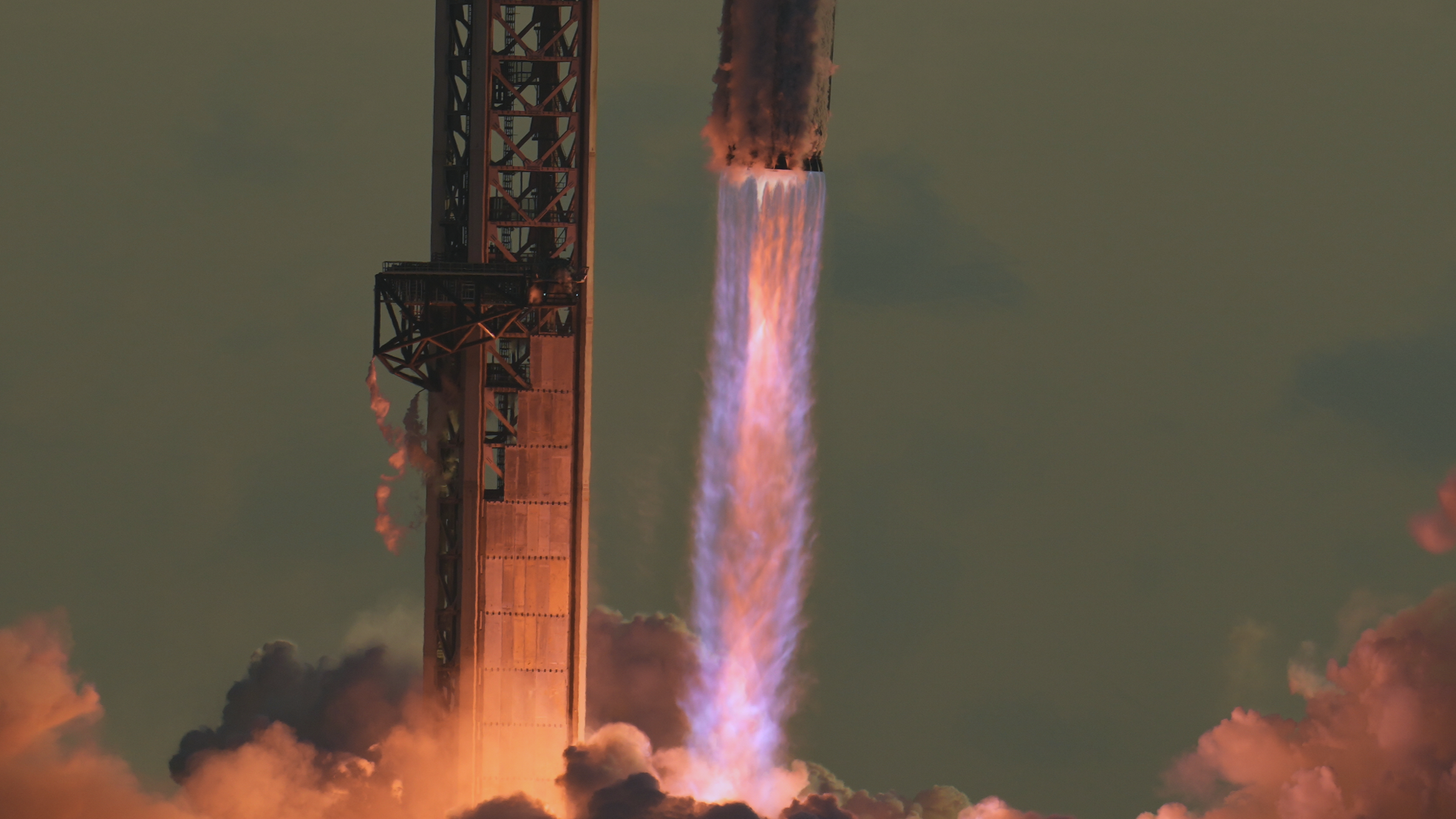
SpaceX’s massive Starship rocket reached orbit for the first time on Monday morning, achieving a milestone for the program even though the company cut the mission short after an earlier engine failure.
Starship took off at 7:49 am local time out of the Starbase launch facility in South Texas. The rocket was carrying 26 of the company’s upgraded Starlink satellites, which the vehicle successfully placed in orbit to join the existing internet-from-space network.
“First orbital flight of Starship successful!” SpaceX Chief Executive Officer Elon Musk wrote on X.
The 26 satellites deployed during the mission were able to successfully connect with the broader Starlink network, SpaceX spokesperson Dan Huot said during a company livestream that attracted more than 1.7 million viewers.
However, the company brought Starship home earlier than planned, a decision seemingly influenced by the engine failure. The vehicle splashed down in the Pacific Ocean near Hawaii around 3 hours into the mission, cutting short the roughly 10-hour-long flight initially targeted.
As Starship initially climbed to space, one of its six Raptor engines cut out early, leading SpaceX engineers to temporarily call off the attempt to send the rocket to orbit. However, after looking through the data, the team pressed on with the attempt, burning one of Starship’s Raptor engines and putting the vehicle in orbit for the first time.
SpaceX fell 0.8 percent to $147.52 as of 11:58 am New York time.
Monday’s test flight — Starship’s 14th — is a key moment for SpaceX, as all of the rocket’s other space launches until now have purposefully fallen short of orbit to maximize safety. Now, US regulators have approved SpaceX to take Starship to the next step, trusting that the company can safely transport the rocket to orbital speeds and bring the vehicle back to Earth in a controlled manner.
The flight could open the door to many more orbital flights. With this launch, SpaceX will be adding its first upgraded Starlink satellites, known as V3s, to the company’s growing 11,000-plus spacecraft network already in orbit. Starship deployed V3 Starlink satellites on a previous launch, but they ultimately burned up in Earth’s atmosphere as planned.
ALSO READ: Anthropic expects to match or top SpaceX’s record IPO size
SpaceX Chief Financial Officer Bret Johnsen has called this mission a “revenue-generating flight” for the company, since the V3 satellites are production quality and will be integrated in the overall network. Musk has also made big claims about the V3 spacecraft increasing the overall capacity of Starlink.
“We do expect a very rapid increase in revenue from Starlink communications from the V3 satellite,” Musk said during SpaceX’s first-ever earnings call in August. He added that the satellite is “more than 10 times the capability of the V2 satellite, and we’ll be launching 10 times as many.”
Starship is instrumental to all of SpaceX’s grandiose ambitions. Not only is the rocket solely responsible for launching V3 Starlink satellites, it is also tasked with lofting as many as one million future satellites to serve as AI data centers in Earth orbit — a project that fueled SpaceX’s blockbuster IPO this summer.
Ultimately, Starship is meant to unlock Musk’s goal of sending humans to other worlds, such as the moon and Mars. However, there is still a lengthy amount of development work that SpaceX must undertake in order to reach distant locations in space, such as demonstrating the ability to refuel Starship while in orbit.
ALSO READ: SpaceX surges past $2 trillion in Nasdaq debut, closes in on Amazon
Additionally, SpaceX wants Starship to be fully reusable, a feat that no other rocket has achieved. To do this, SpaceX aims to “catch” the two major portions of Starship — the Super Heavy booster and the Starship spacecraft — back on Earth at the launchpad after each flight.
SpaceX has caught the Super Heavy booster using the Starship launch tower three times. Musk said at the All-In Summit that if this upcoming flight goes well, SpaceX will attempt to catch the Starship spacecraft for the first time on the 15th test launch.
“And then either end of this year, but more likely early next, we will refly the ship and refly the booster,” Musk said.
The Super Heavy booster, which sends the Starship spacecraft to orbit, splashed down in a controlled manner off the coast of Texas about seven minutes after takeoff.
Around three hours into the flight, Starship left orbit and plunged through Earth’s atmosphere, topping 26,900 kilometers (16,715 miles) per hour before maneuvering into a controlled ocean dive near Hawaii. It then blew up.
The mission was a key chance for SpaceX to test the vehicle’s heat shield, which protects Starship from scorching temperatures as it plunges through Earth’s atmosphere. On Starship’s previous flight, Starship successfully survived its return and even remained intact when it splashed down in the Indian Ocean. SpaceX was able to retrieve that Starship and study how the heat shield handled the descent.
Some experts have cautioned that Starship’s heat shield design is still not robust enough in order for the rocket to be fully and rapidly reusable. However, Musk said during SpaceX’s August earnings call that he considers the “heat shield problem solved.”
