

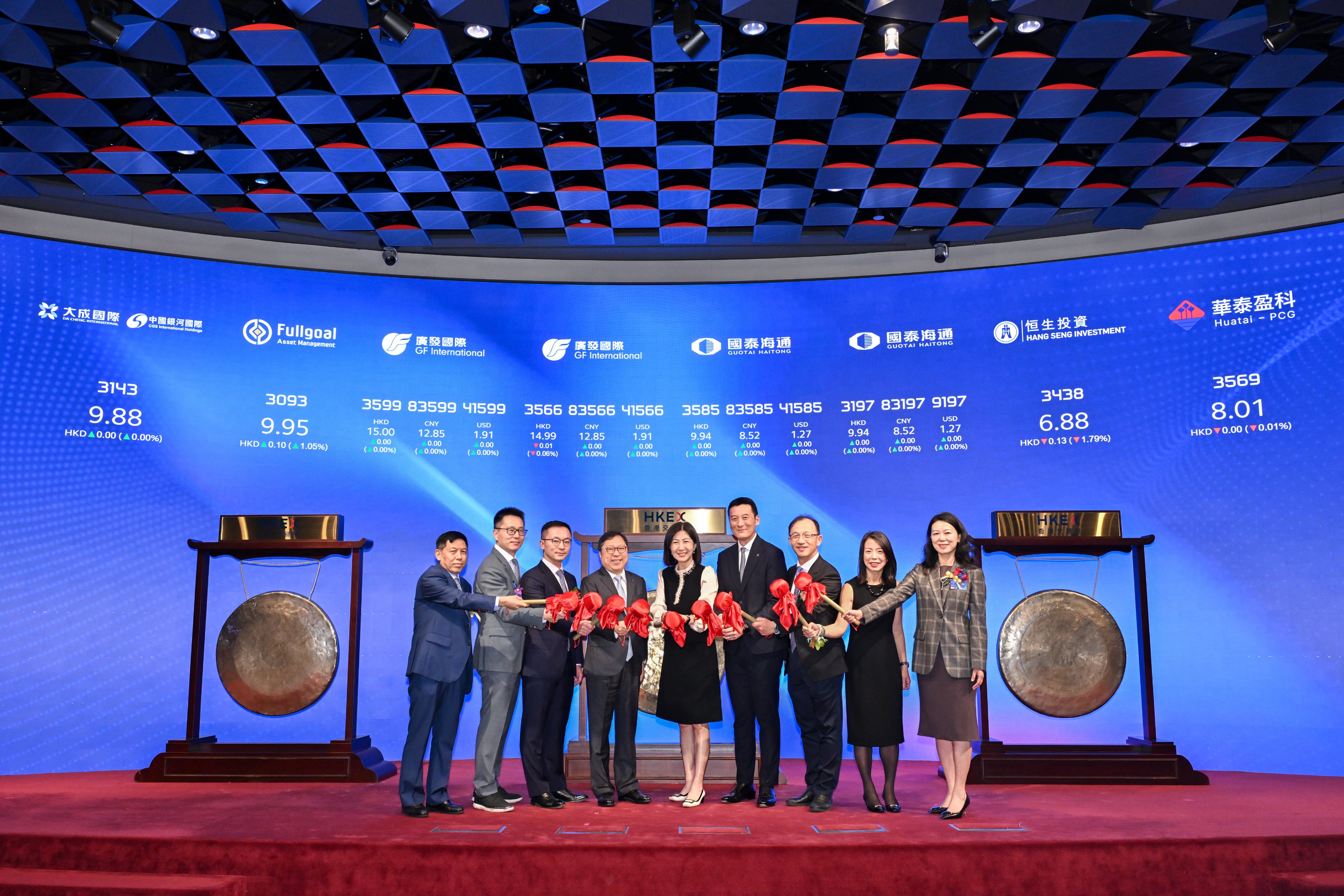
Eight exchange-traded funds (ETFs) went public in Hong Kong on Monday. Three of them track three new cross-market indexes, while the other five focus on themes like robotics, strategic resources, and artificial intelligence.
The listings further diversify the city’s ETF offerings and strengthen its appeal as an investment platform for global investors.
It was the highest number of ETFs to list on Hong Kong Exchanges and Clearing in a single day so far this year. This month alone, 21 ETFs have gone public.
The cross-market ETFs are the first investment products tracking three benchmarks — the HKEX Bursa Malaysia Large Cap Index, the HKEX KRX Semiconductor Index and the HKEX Tech & US Tech 100 Index.
Launched earlier this year, the three indexes aim to strengthen connectivity between the special administrative region and key regional and international markets. Two of the indexes are part of co-branded partnerships of HKEX with Bursa Malaysia Berhad and Korea Exchange, respectively.
“Their launch marks an important step in our efforts to connect Hong Kong with international markets by working with exchanges and partners across Asia and beyond to broaden investor choice,” said HKEX Chief Executive Officer Bonnie Chan Yi-ting. “These benchmarks respond to investors’ growing demand for diversification and reinforce Hong Kong’s role as a gateway linking the Chinese mainland with the world.”
She added that HKEX supports the development of a multiasset ecosystem in the SAR by spurring product innovation, facilitating capital flows, and creating opportunities for issuers, asset managers, and investors.
The three new cross-market benchmarks are structured with about 60 percent weighting in Hong Kong-listed securities and 40 percent in overseas securities. The design supports the eligibility of ETFs tracking the indexes for potential inclusion under the Southbound Stock Connect.
ALSO READ: Hong Kong’s ETF market daily turnover surges 22%
Fad’l Mohamed, chief executive officer of Bursa Malaysia, welcomed Da Cheng International’s ETF that tracks the HKEX Bursa Malaysia Large Cap Index. “Bringing together 30 leading listed companies each from Malaysia and Hong Kong, the index provides investors with a new pathway to access opportunities across both markets, and also elevates the visibility of Malaysian companies among investors in Hong Kong and the Chinese mainland,” he said.
Buyeon Yi, president of Korea Exchange’s KRX futures strategy division, said the latest ETF listings demonstrate how exchanges can combine their expertise in market operations and index development to foster cross-market collaboration and support investors’ regional asset allocation. “The index offers a new way to access Asia’s semiconductor ecosystem,” he said.
Hang Seng Investment Management launched the Hang Seng AI Advancement ETF, the city’s first AI-themed ETF investing exclusively in Hong Kong-listed equities.
“The product reflects Hong Kong’s commitment to providing the market with simple investment tools based on transparent indexes and regular reviews, and also demonstrates Hang Seng’s support for building a deeper and more resilient ETF market in Hong Kong,” said Luanne Lim Hui-hung, executive director and chief executive of Hang Seng Bank, the parent company of Hang Seng Investment Management.
READ MORE: Hong Kong debuts largest local physical-gold ETF
The listing boom came after the mainland authorities broadened authorized channels for mainland investors to access external assets. Last month, mainland insurance firms were permitted to invest in Hong Kong-listed ETFs through the Southbound Stock Connect, opening a new route for the sector to bolster investment returns and asset diversification.
Contact the writers at oswald@chinadailyhk.com
