

China-led mechanism to strengthen law enforcement, fight cross-border crimes
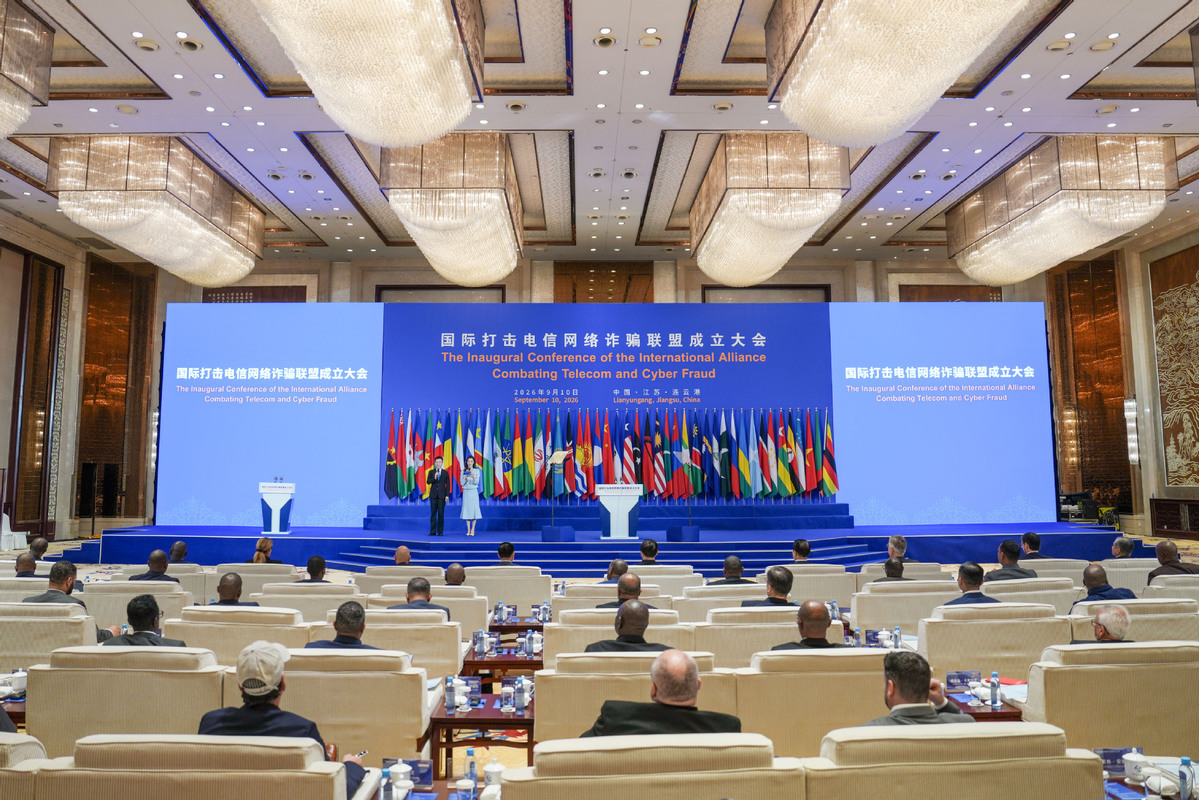
Thai experts have welcomed a China-initiated international alliance to combat telecom and cyber fraud, calling it a significant step toward building a stronger common front against a crime that no country can tackle alone.
Established on Thursday, the International Alliance Combating Telecom and Cyber Fraud brings together 46 founding countries, 34 observer countries and four international organizations, including the United Nations. It aims to strengthen law enforcement cooperation in tackling cross-border telecom and cyber fraud and related crimes.
Peerasit Kamnuansilpa, former dean of the College of Local Administration at Khon Kaen University, said the alliance is particularly important for Southeast Asia, where criminal networks increasingly exploit differences in countries' legal systems, financial channels and enforcement capabilities.
READ MORE: Intl alliance forged to fight telecom fraud
"It is an important development because it recognizes that online scams are no longer simply national or regional problems. For Thailand and Southeast Asia, the alliance can provide a much wider network for sharing intelligence, conducting joint investigations, tracing financial flows and learning from other countries," he said.
Telecom and online fraud has evolved from a nuisance affecting individual victims into a serious transnational threat, posing growing challenges to public security, economic activity and development across Southeast Asia.
In June, Thai police said they arrested about 30,000 scammers, including gang leaders, seized assets worth about 24 billion baht ($720 million) and took legal action against 1,450 proxy companies over the previous nine months.
Attakrit Patchimnan, a professor at the Faculty of Political Science at Thammasat University in Bangkok, said that the region's central problem is not the lack of awareness but the gap between the speed at which criminals operate and governments' ability to respond collectively.
"The biggest gap is that criminal networks often move faster than governments. Governments, meanwhile, must navigate different legal systems, data protection rules and procedures for requesting information or freezing assets," he said.
For Thailand, Attakrit said the immediate priority should be to strengthen around-the-clock operational coordination with neighboring countries, financial institutions, telecom operators and digital platforms so that suspicious accounts can be frozen, transactions traced and investigations launched more quickly.
The longer-term challenge is to establish common standards for digital evidence, cross-border data exchange, asset recovery and extradition, he said.
These challenges underscore the importance of a broad international platform, with China's initiative offering an opportunity to deepen such cooperation.
Chayodom Sabhasri, an associate professor at the Faculty of Economics at Chulalongkorn University, said combating scams requires international cooperation backed by strong commitments from participating countries, as well as political will at the national level.
China's push for a dedicated international mechanism builds on years of domestic crime prevention and cross-border law enforcement cooperation. In the first half of this year, the number of telecom fraud cases registered in China fell 15.6 percent year-on-year, according to the Ministry of Public Security.
China has also carried out law enforcement cooperation with more than 40 countries, establishing mechanisms and conducting joint efforts to combat cross-border telecom fraud.
ALSO READ: China-initiated international alliance to combat telecom, cyber fraud established
For Thailand and its neighbors, Attakrit said China can play a valuable role not only in enforcement but also in long-term capacity building.
Cooperation could cover digital forensics, financial tracing, telecom analytics, AI-based fraud detection, and intelligence-sharing on suspicious accounts, websites and communication networks, he said.
"But such cooperation should focus on coinvestment and human capital development so that countries can eventually operate and maintain these capabilities independently," he added.
The creation of the China-initiated alliance marks an important beginning. Peerasit said its significance lies not merely in bringing dozens of countries to the same table, but in creating a mechanism for them to begin acting together.
Contact the writers at yangwanli@chinadaily.com.cn
