

Xi’s attendance at SCO Summit, visits to Kyrgyzstan and Egypt, help ‘improve global governance’
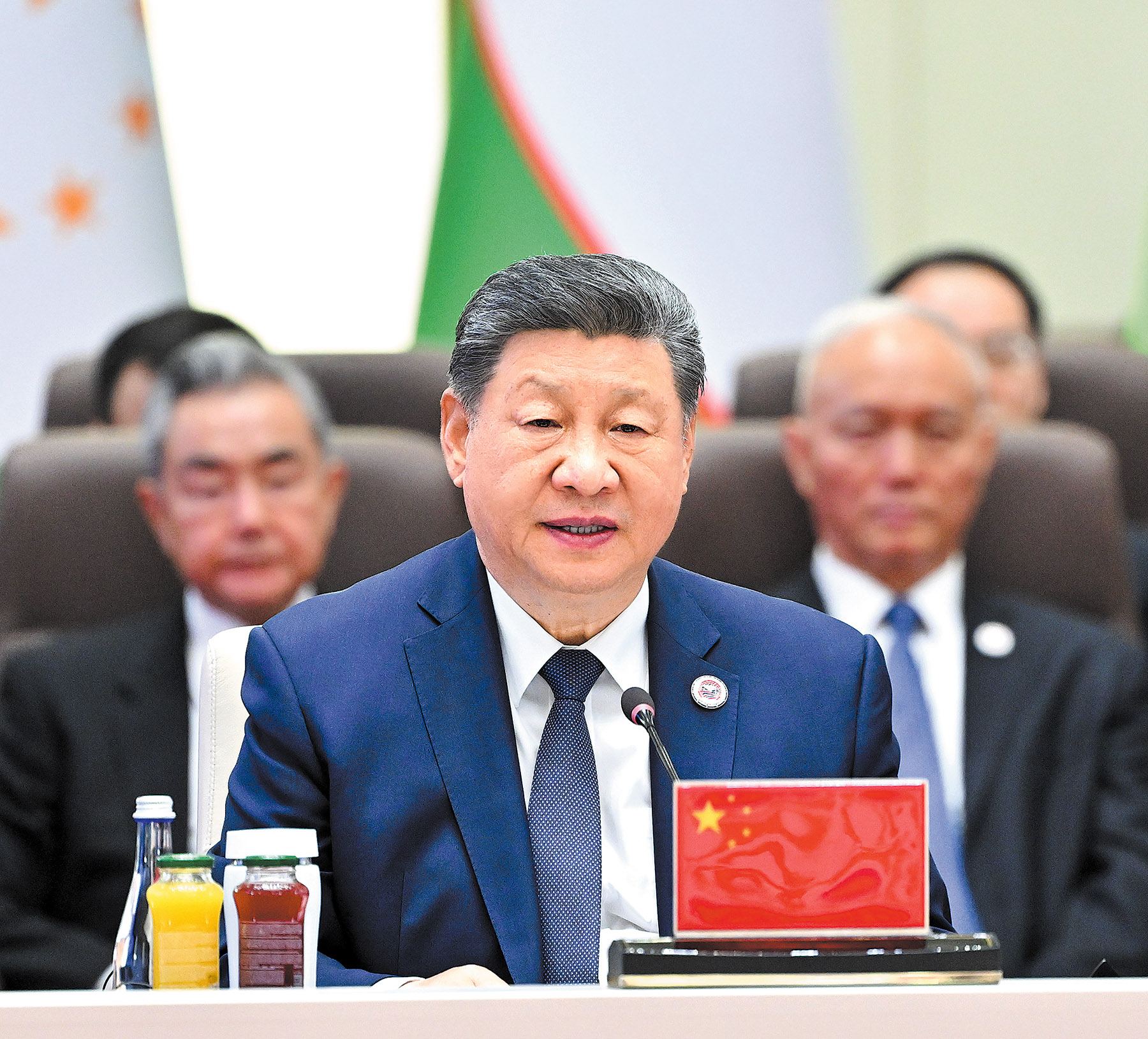
President Xi Jinping returned to Beijing on Sept 3 after attending the Shanghai Cooperation Organization summit in the Kyrgyz capital of Bishkek and concluding state visits to Kyrgyzstan and Egypt.
Officials and experts said the five-day trip, covering more than 20 bilateral and multilateral events across Central Asia and the Middle East, responded to international calls for peace, stability, and development with concrete efforts, offering Chinese solutions and insights to a world of intertwined changes and turbulence.
Speaking at a news briefing in Cairo at the conclusion of the trip, Foreign Minister Wang Yi said that with solidarity and cooperation as its central theme, the trip was significant for building consensus on cooperation and for reforming and improving global governance.
In Bishkek, Xi attended the 26th Meeting of the Council of Heads of State of the SCO as the organization marked its 25th anniversary this year.
At the summit, Xi announced that China would establish a China-SCO port economic cooperation center in Tianjin and a China-SCO basic education cooperation center, and implement 100 technological cooperation projects with other SCO countries over the next three years.
Leaders of the member states signed and issued the Bishkek Declaration, approved the protocol on amendments and additions to the SCO Charter, and adopted 28 outcome documents covering areas such as security, economic and people-to-people cooperation, and organizational development.
The strategic blueprint drawn up at last year’s Tianjin summit is becoming a reality step by step, Wang said, noting that the SCO now has a more optimized structure, more efficient operation and stronger cooperation.
According to Wang, in Kyrgyzstan, the two heads of state reached an important consensus on further deepening the two nations’ comprehensive strategic partnership for a new era and advancing the building of a China-Kyrgyzstan community with a shared future. Bilateral relations are now at their best in history, he said.
Wang said the most important political outcome of the visit was the signing of the treaty on permanent good-neighborliness, friendship, and cooperation. The treaty enshrines the two countries’ commitment to lasting friendship in legal form and opens broader prospects for bilateral relations, he said.
Kyrgyz Foreign Minister Zheenbek Kulubaev told reporters that as a result of the Aug 31 meeting of the heads of state, Kyrgyzstan and China have raised the strategic partnership to a high-quality level of development.
This reflects the high level of political trust and confidence between the two countries and their readiness to deepen cooperation further, he said.
Xi’s trip to Egypt was the first state visit to the country by a Chinese president in a decade and coincided with the 70th anniversary of the establishment of diplomatic relations.
According to Wang, Xi has emphasized that China, whether in the past, at present or in the future, is Egypt’s trustworthy and dependable comprehensive strategic partner.
Wang described Xi’s historic visit to Egypt as both a journey to renew friendship and one to expand cooperation, calling it a milestone that fully demonstrates the strategic and exemplary nature of China-Egypt relations.
Zoon Ahmed Khan, a researcher at the Belt and Road Institute of Tsinghua University, said Xi’s visit reflected an ongoing transformation in which the two ancient civilizations are advancing from mere markets and transit corridors into creators of their own shared agency.
“The true vitality of this partnership lies in its tangible momentum,” she said, pointing to industrial hubs, local-currency financing, space technology and job-creating projects as examples of political trust being translated into productive capacity and practical South-South cooperation.
Ayman Mohseb, a member of Egypt’s House of Representatives, said that closer China-Egypt coordination could help ease regional tensions, promote dialogue and political settlements, and contribute to a more balanced and equitable international order.
During his talks with Egyptian President Abdel Fattah El-Sisi, Xi put forward a four-point proposal to build a new security architecture in the Middle East by upholding a vision of common, comprehensive, cooperative, and sustainable security.
Wang also highlighted the cultural and people-to-people dimensions.
Peng Liyuan, Xi’s wife, took part in cultural activities with Aigul Japarova, the wife of the Kyrgyz president, and Entissar El-Sisi, the wife of the Egyptian president. The activities added a warm cultural dimension and helped strengthen mutual understanding, people-to-people bonds, and cultural exchanges, Wang said.
Elsewhere, officials and experts worldwide lauded Xi’s trip for injecting much-needed certainty and positive momentum into efforts to ease regional tensions and promote global peace and development.
In his speech at the 26th Meeting of the Council of Heads of State of the SCO in Bishkek, Xi put forward a four-point proposal, urging the SCO to shoulder its historical responsibility and steer the course for the future.
Xi called on the SCO to stay committed to putting development first, and open up the prospects for shared prosperity; stay committed to taking security as a key goal and foster an environment of common security; stay committed to a people-centered approach and cement the foundation for everlasting friendship; and stay committed to dialogue and consultation, while striving for more equitable and orderly governance.
Tahir Farooq, president of Daily Ittehad Media Group and the Pakistan Economic Network, described Xi’s remarks as “timely and constructive, particularly in outlining a vision for the future of the Shanghai Cooperation Organization and for broader global cooperation”.
“His four-point proposal rightly places development, security, people-to-people relations and dialogue at the center of sustainable peace and prosperity. President Xi’s message reinforces the importance of multilateralism at a time when the international community is facing increasing uncertainty and geopolitical tensions,” Farooq said.
Karori Singh, former director of the South Asia Studies Centre at the University of Rajasthan in India, noted Xi’s speech underscored four major interconnected points — development, security, a people-centered approach, and the principle of equality in governance through dialogue and consultation. “That is the secret of SCO’s success,” Singh said.
Lawrence Loh, director of the Centre for Governance and Sustainability at the National University of Singapore Business School, said that Xi has laid out a clear and coherent road map for regions and countries around the world to join hands in achieving the common good for all, which will lay the foundation for global unity through peaceful means.
Paul Frimpong, executive director of the Africa-China Centre for Policy & Advisory, a think tank based in Ghana, highlighted Xi’s emphasis on development and the evolving direction of development cooperation.
Asim Iftikhar Ahmad, Pakistan’s permanent representative to the United Nations, praised China’s important role in global governance through the four global initiatives — the Global Development Initiative, the Global Security Initiative, the Global Civilization Initiative, and the Global Governance Initiative.
During his state visit to Egypt, Xi raised a four-point proposal on building a new security architecture in the Middle East, offering a Chinese solution for achieving long-term peace and stability in the region.
Xi put forward the proposal in his talks with Egyptian President El-Sisi, calling for unleashing internal drivers, advancing an integrated approach, cementing the foundation of development, and enhancing international coordination.
Rasha Al Joundy, a senior researcher at the Dubai Public Policy Research Centre in the United Arab Emirates, said Xi’s visit to Egypt came at a critical juncture as escalating tensions between the US and Iran have threatened regional security, with major risks to maritime safety and the global economy.
Against this backdrop, she said, the proposal serves as a credible initiative to safeguard stability and prevent tensions from worsening.
Abdulaziz Alshaabani, a researcher at the Al Riyadh Center for Political and Strategic Studies in Saudi Arabia, said the four-point proposal highlights a fundamental reality: Achieving durable Middle East peace requires not only conflict management, but also the broader building blocks of stability, including development, security, and regional cooperation.
Zhang Minlu in New York and Edith Mutethya in Nairobi contributed to this story.
Contact the writers at mojingxi@chinadaily.com.cn
