

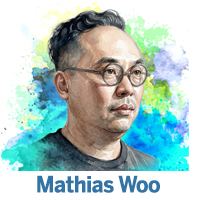
Mathias Woo says the museum does not lack resources or space, but there has been little deep strategic thinking about its own role
An afternoon at the West Kowloon Cultural District ought to be a quiet moment for contemporary art, yet recently it has been stirred into clamor by a mahjong event. The sound traveled through M+’s exhibition halls and struck a sensitive nerve in Hong Kong society. On the surface, public debate concerns whether playing mahjong in a museum is appropriate; at a deeper level, this is merely one concentrated eruption among the many predicaments facing M+ as a cultural institution.
 The paradox is striking. M+, as a publicly funded cultural institution, should be a cultural space open to all residents. Yet it has imperceptibly become a kind of “private club”. Its financial operations resemble a deep pool — outsiders can neither see clearly where its funds flow nor understand the logic behind its acquisitions. The building designed by Swiss architects stands on Hong Kong soil like a stranger, utterly disconnected from the city’s fabric. It replicates the spatial aesthetic logic of London’s Tate Modern, yet is unable to respond to the cultural pulse along Victoria Harbour.
What places M+ in an even more awkward position is the predicament of its core collection. Those Chinese contemporary artworks from some four decades ago, sourced from Swiss collectors, are largely subjective expressions born of specific historical conditions — personal interpretations of social reality by a particular group of artists. These works were once highly sought after in Western markets because they happened to conform to a certain preconceived imagination and expectation of China: a simplified, singular, negative political narrative.
Yet artistic expression is inherently subjective, and whether subjective interpretation can truly bring about rational reflection and promote rational dialog requires great caution. When these works are housed in Hong Kong, a strange dislocation emerges: Rather than offering audiences a systematic perspective for understanding the complex evolution of Chinese society, they reinforce existing political biases.
Hong Kong’s role has never been to serve as a showcase for any particular ideology; the city's distinctiveness lies precisely in its inclusiveness and pluralism. But when art from a single angle becomes an absolute presence, when a specific lens on China becomes a passport to taste and marketability, art loses the enlightenment and openness it should possess. More practically, as the international landscape shifts, global interest in such collections has steadily waned. They can neither form a genuinely influential discourse nor support M+’s ambition to be a heavyweight in Asian visual culture.
This leads to a deeper question: the alienation of Western contemporary art itself. It was once a sharp instrument for social critique and intellectual enlightenment, a bridge for dialogue between ordinary people and elites. Now it has increasingly degenerated into a game of capital. Artworks have become investment products; museums have become display venues for capital, drifting ever further from the general public. The role M+ plays in this process is troubling. Its curatorial team lacks genuine understanding of Hong Kong and Asian culture and language. The fundamental functions of a public art museum — elevating social taste, supporting artists, promoting engagement — all seem to have been cast aside.
Does anyone remember M+'s original positioning? It was meant to be a temple of Asian visual culture, encompassing film, television, popular culture, design, and ink art — four domains bearing Hong Kong’s distinctive character. Asia’s culture is extraordinarily rich and diverse; China’s visual traditions are profoundly deep and vast, from the vital energy of ink painting to the ingenuity of folk crafts, from the narrative aesthetics of cinema to the life wisdom embedded in design. Every thread deserves thorough exploration. Yet today, M+’s exhibition catalog is filled with content calibrated to Western contemporary art tastes, interpreting Asian and Chinese culture from a single angle, lacking the depth of research that Asian visual culture deserves. It has not followed its own cultural threads to unearth the unique values that truly belong to Asia and to Hong Kong; instead, it has become a follower of a monolithic Western curatorial logic.
This loss of direction is particularly evident in specific exhibition choices. Bringing in a Japanese team’s design exhibition may be interesting, for example, but the cost-effectiveness and cultural positioning behind it remain unquestioned. Or take the fashion exhibition of a Beijing designer — one cannot help but ask: why not Vivienne Tam Yin Yok, a Hong Kong designer with genuine international influence in the fashion world? Her work fuses Eastern aesthetics with contemporary design language — precisely the finest footnote to Asian visual culture. By contrast, choosing a designer who has merely staged a fashion show at the Metropolitan Museum of Art in New York raises baffling questions about the underlying cultural logic and criteria. This is not merely a matter of exhibition selection; it is a fundamental question: Was this museum built for Hong Kong, or for somewhere else? If this question remains unanswered, it becomes all too easy to use “internationalization” as a pretext to package projects lacking fiscal efficiency and cultural benefit. Hong Kong’s ethos has always been about being shrewd, principled, and pragmatic. Such practices — pursuing inefficiency in the name of internationalization — betray the very spirit of Hong Kong.
What M+ lacks is not resources, not space, but strategic depth of thinking about its own role. Perhaps what it truly needs is a return — a return to its original promise, to genuinely explore the distinctive character of Asian visual culture rather than producing predetermined, simplified interpretations according to Western tastes. Hong Kong’s visual culture has never lacked vitality. Film, design, ink art, popular culture — these currents carry the unique soul of this city. If M+ could follow this path, cultivate the soil of Asian visual culture, and genuinely engage with the local art ecosystem, it could have become an irreplaceable cultural powerhouse. Regrettably, it seems to have chosen an easier road: replicating Western models, catering to international markets, maintaining distance from Hong Kong’s reality with an ostensibly “elevated” posture.
That mahjong event was, rather than a cultural activity, a metaphor. It revealed M+’s ambivalence toward public and private, localness and internationalism, scholarship and marketability. When the clattering of mahjong tiles echoed through the exhibition halls, it was at once a reverberation of cultural memory and an echo of institutional predicament. The question is not whether mahjong should be played, but whether we still remember for whom this museum was built and for whom it exists. When a cultural institution loses sight of its original purpose, no matter how the mahjong tiles echo, they cannot drown out the hollowness and bewilderment lying beneath.
The author is a member of the Chinese Association of Hong Kong and Macao Studies and artistic director of Zuni Icosahedron.
The views do not necessarily reflect those of China Daily.
