

With its lack of light pollution and vast emptiness, the Gobi Desert proves a perfect spot to watch Perseid meteor shower
Long after sunset, sweltering 40 C heat still hung over the vast, remote Gobi Desert as hot winds swept across the wilderness.
Suddenly and fleetingly, a blazing fireball streaked across the star-studded sky, leaving a long, glowing trail and drawing loud whoops of amazement from stargazers.
Astrophotographers stationed behind their tripods leaned forward to eagerly check their camera screens, hoping to have captured the fleeting moment.
As the Perseid meteor shower peaked on Aug 12 and 13, observers and astrophotographers across China flocked to the Pterosaur-Yardang Dahaidao Scenic Area in Hami, Northwest China's Xinjiang Uygur autonomous region, to witness the celestial event.
READ MORE: Photos on a star trek
"Stargazers are absolutely drawn to this place, and for good reason. Beyond minimal light pollution, the air here is extremely dry with little dust, creating exceptional atmospheric transparency," said veteran astrophotographer Liu Bing from Beijing.
"As a result, stars retain their sharpness in camera shots, and less starlight is scattered away, making it possible to capture stunning pictures," Liu added.
Astrophotographers can pair the varied, wind-eroded Yardang landforms with celestial subjects to create one-of-a-kind images.
Liu and other astrophotographers recently attended the annual Sweet Whispers to the Galaxy Festival in Hami and captured images of the Perseid meteor shower.
The event aimed to reinforce the area's reputation as a premier destination for stargazing. Many of them are from the China StarVision Alliance, a domestic platform for nearly 1,000 Chinese astrophotographers.
Official data showed that Dahaidao registered about 25,000 visitor arrivals and more than 10,000 vehicles in early August. To cater to stargazers' needs, the site imposes strict nighttime lighting restrictions, and all stargazing spots feature 24-hour security patrols, emergency contacts and safety signs.
For astrophotographers, advance preparation is vital, from understanding lunar phases to scouting locations with minimal light pollution.
They check shooting sites in daylight and use apps to monitor weather and cloud cover, keeping close track of shifts in these conditions to the nearest hour. They also use apps to forecast how stars will move across the night sky and assess potential interference from the moon.
"When observing the Perseid meteor shower, we need to locate the constellation Perseus and learn about the radiant point in advance — the spot in the sky from which all meteors seem to originate. As the radiant rises, it shapes the paths of meteor trails across the sky," said Wang Junfeng, a Beijing-based astrophotographer. "We often joke that we all became meteorologists just to take good photos."
One night on the trip was mostly overcast, and the group waited patiently until clear breaks opened up between the clouds. "We could only seize those brief windows to observe the meteors and take photos," Wang said.
Another member of the group, Liu Dapeng, set up three cameras at different locations before dusk, adjusted their shooting parameters and configured them to shoot a frame every few seconds until the predawn twilight.
Liu said that smartphones, when mounted on a tripod, can capture the starry sky. Beginners can invest in cameras and wide-angle lenses based on their budgets, or opt for affordable secondhand gear.
"After putting it into practice, they can think about whether they want to stick with astrophotography. It can be tiring, enduring outdoor hardships such as freezing cold and rain.
ALSO READ: Photographer finds joy in dark nights
"However, through astrophotography, I've made many friends across the country, and we enjoy shooting together. To me, the real reward is the joy of sharing tips and fun stories," Liu Dapeng said.
"Safety is always paramount. It is very easy to get lost in the desert at night, so you should travel with others and take no risks. At night, you need to call out to one another regularly to check that everyone is safe," he added.
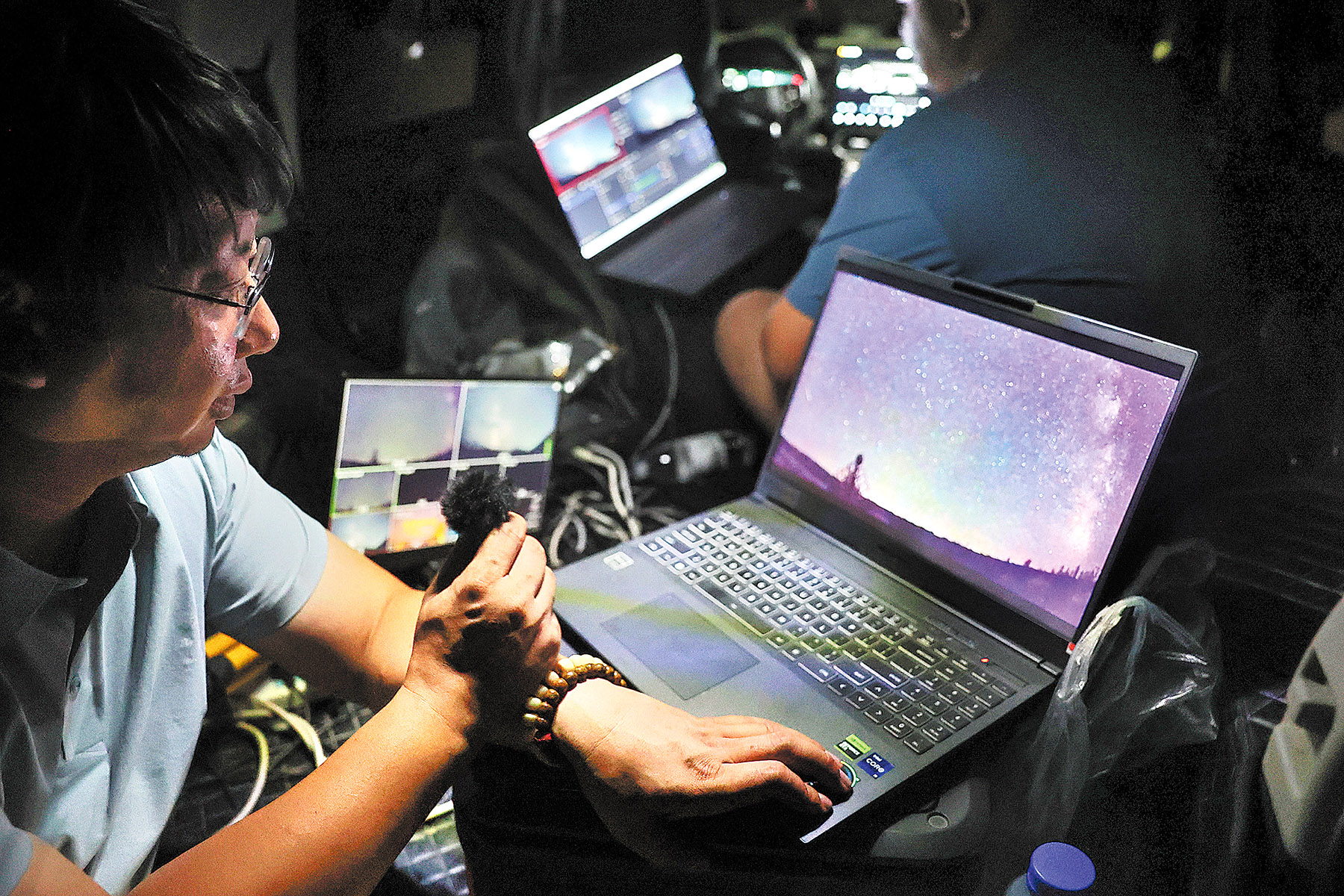
Zhou Bo led a team to livestream the Perseid meteor shower from Dahaidao, Barkol Lake and Yiwu county across Hami. Drawing on his multidisciplinary knowledge, including geology and history, he promoted Hami's natural resources and cultural heritage while hosting the livestream.
Zhou said he believes that the meteors stir curiosity and a thirst for knowledge among his viewers, fostering a desire for travel and inspiring wonder at the boundless cosmos.
Contact the writers at xulin@chinadaily.com.cn
