

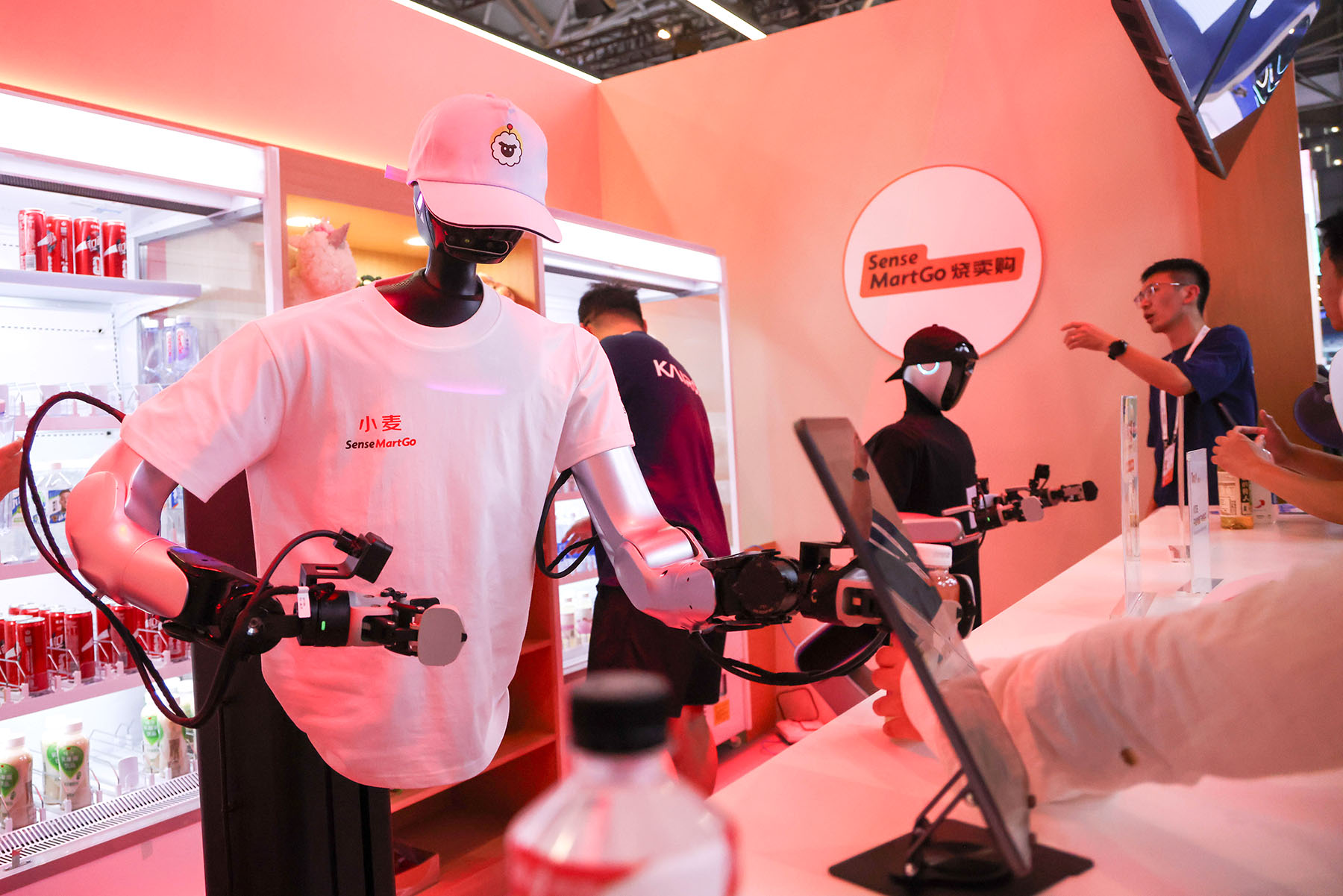
As the artificial intelligence industry rapidly evolves, a new frontier is emerging: the export of AI computing infrastructure. Chinese tech companies, once known primarily for hardware manufacturing and consumer app exports, are now taking their AI models, algorithms and computing infrastructure to overseas markets, corporate executives and experts said.
"China's AI-led expansion overseas is changing. It is moving beyond the export of stand-alone software and applications toward a more sophisticated offering of industry-specific solutions and digital infrastructure," said Jeff Shi, president of SenseTime's Asia-Pacific business, in an exclusive interview with China Daily.
That model draws on nearly the full breadth of China's AI ecosystem — from data centers and token plans to governance frameworks and talent development, Shi said.
READ MORE: Suzhou forging photonics powerhouse amid AI uptrend
SenseTime is at the forefront of this transformation, he said. Since its founding, the company has expanded into more than a dozen overseas markets, serving over 500 enterprise clients globally, with more than 430 in the Asia-Pacific region alone. From intelligent hardware and software licensing to industry solutions and cloud services, the company has built a comprehensive portfolio that spans the entire AI value chain.
The shift from exporting trained AI models to exporting computing infrastructure represents a strategic upgrade driven by fundamental changes in the industry. Shi explained that in the early stages of international expansion, Sense-Time primarily delivered computer vision models trained in China, with computing needs met domestically. But the generative AI era has fundamentally altered the landscape.
"Customers no longer need just a single model — they need an end-to-end solution that integrates computing power, models and applications," Shi said. The surge in overseas demand for AI inference has created an urgent need for local computing infrastructure.
At the same time, the rise of "Chinovation" — a term coined in 2011 to describe Chinese innovation has taken on new meaning. It has changed from representing cost-effective alternatives, to being the flagship of high-tech original innovation.
"Overseas clients now come to China to find Chinese technology, Chinese applications, and Chinese opportunities," Shi noted. This shift reflects China's growing global competitiveness in technology — and explains why the world's best open-source large language models are emerging from China.
According to Shi, more foreign visitors are traveling to China to study AI firsthand. International business visitors to SenseTime's Executive Briefing Center in Shanghai have risen tenfold so far in 2026.
SenseTime's computing power export strategy took a major leap forward in 2025 with the successful deployment of China's first overseas domestic computing cluster in the Middle East. The company established a joint venture called SenseTime MEA with Saudi Arabia's Public Investment Fund, or PIF, and has been deeply engaged in the country's Vision 2030 transformation.
Hong Kong also plays a pivotal role in SenseTime's global computing strategy. In June, SenseTime partnered with Hong Kong Science and Technology Parks Corp to build the city's largest domestically developed AI data center, targeting over 40,000 petaFLOPS of computing capacity by 2030. The first phase, expected to be completed by the end of 2026, will deliver 3,000 petaFLOPS of computing power.
Shi described Hong Kong as an "AI-era entrepot trade center" with three unique advantages: dual-compliance capabilities bridging Chinese and international legal systems; superior international network connectivity; and its strategic location within the Greater Bay Area, backed by the Chinese mainland's vast talent pool.
ALSO READ: Summer of tech debuts heating up
"The project will significantly supplement SenseTime's own computing power supply while serving as a springboard to support the overseas deployment of integrated 'computing+model+application' capabilities," Shi explained.
The senior executive identified three key drivers for SenseTime's future growth: the unprecedented opportunity created by Chinovation; the maturation of the global computer vision market where SenseTime has achieved global leadership; and the trust and reputation built over eight years of overseas operations.
Industry observers are taking note of the broader implications. Li Shan, country head of NCS Greater China, highlighted two key characteristics of Chinovation: practicality and openness. "China can turn lab experiments into real industrial productivity in a very short period of time, and we also have a very fast turnaround time to improve technology," Li said.
Contact the writers at masi@chinadaily.com.cn
