

Holidaying railwayman who lost his life helping others in flood-hit Guangxi mourned by millions online
The high-speed train didn't stop at Meishan East Railway Station on that sweltering July afternoon. It was Dang Xinrui's last ride as a railwayman.
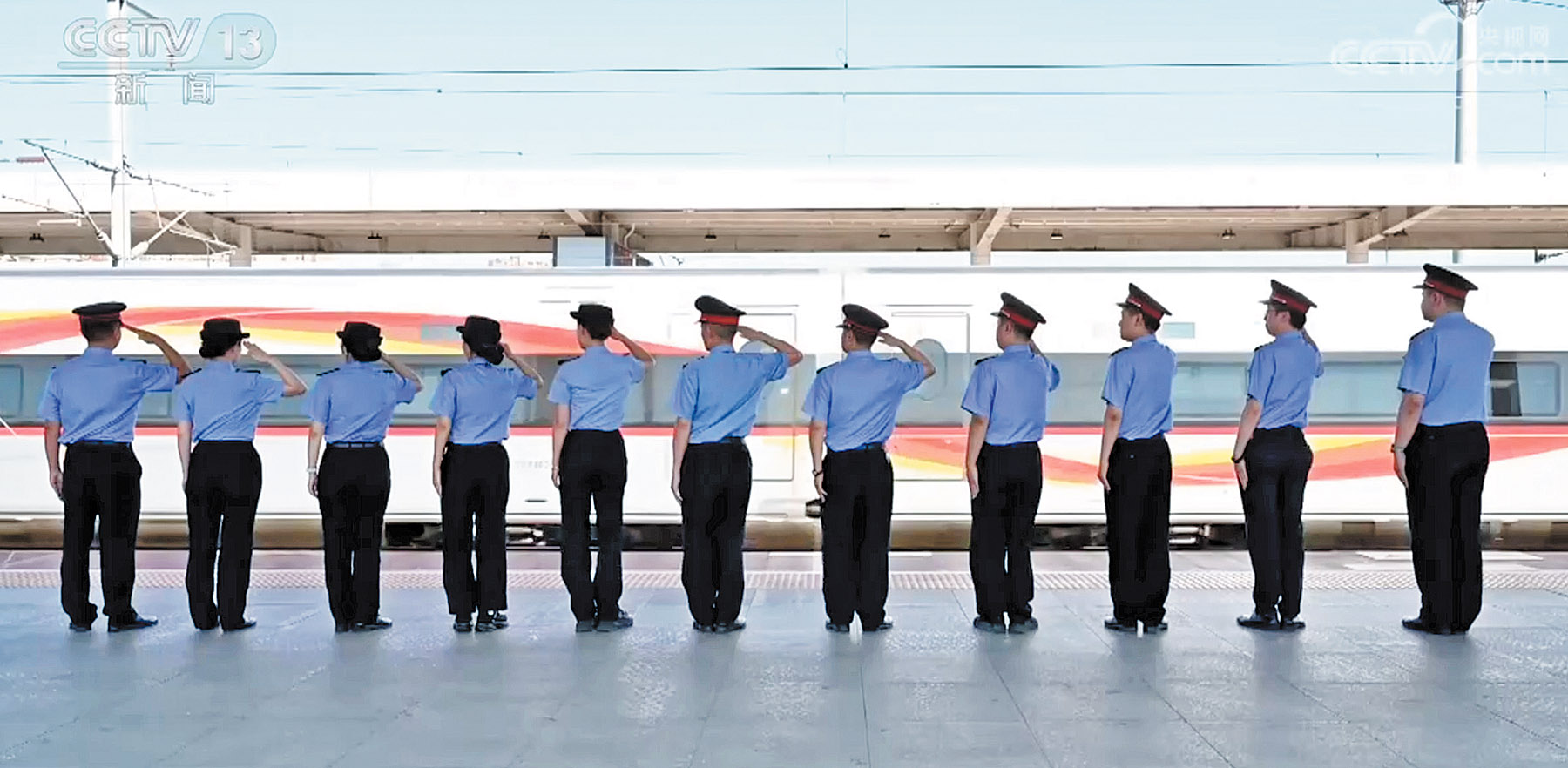
His father Dang Qing accompanied his son's ashes on the train on July 19 as it passed the platform of the station where the 29-year-old had worked.
Some uniformed station staff wept openly as they stood in a line saluting as the train swept by.
Dang Qing said he chose the rail route "so his son could be a railway worker one final time".
While on vacation, Dang Xinrui volunteered to carry supplies on foot to villages cut off by flooding in southern China's Guangxi Zhuang autonomous region. He collapsed and died of heart failure caused by heat and exhaustion on July 14 while returning from a village where he and other volunteers had delivered medicine, vegetables and other supplies.
After his body was cremated, his father took his remains from Guangxi to the family home in Chengdu, Sichuan province.
"I knew he would join the disaster relief, but I never imagined I would lose him," Dang Qing told CCTV.
"What comforts me most is that he spent his final days doing something he truly loved and something meaningful. That makes me proud."
Dang's tale has also touched tens of millions of netizens, with many hailing him as a relatable hero.

Heavy burden
Dang Xinrui started his annual vacation on July 9 in Yunnan province where he intended to go hiking. He sent his friend and former colleague Ma Ziwen daily photos of the scenery.
"I'll take you hiking to watch the sunrise someday. Climbing up and seeing it. It's truly amazing," he told Ma.
He was in Lijiang, Yunnan, on July 11 and exchanged messages with his father that night, not mentioning anything about a change of plans.
The next day, he saw a message in a social media group saying volunteers were urgently needed to carry supplies into the mountains of Zhenlong township in Nanning, Guangxi's capital. He immediately responded to the call.
Many areas in Guangxi had been inundated by heavy rainfall from July 4, due to the impact of Typhoon Maysak, the 10th typhoon of the year.
In Zhenlong, roads had been washed away and villagers were trapped without access to food or drinking water.
"He messaged me saying he wasn't going sightseeing anymore. Instead, he was going to save lives," Ma recalled, adding whenever someone needed help, his friend would always be the first person to step forward.
Dang traveled to Nanning and then headed to Wuli town in Qintang district, Guigang, where there was a relief supply distribution center and a departure point for volunteers entering the mountains.
Zhenlong's Heyuan village, nestled deep in the mountains, was one of the areas hardest hit.
Landslides and road collapses had occurred in multiple locations. Water, electricity, communications and transportation were cut off to some villagers. Supplies could only be transported on foot.
More than 30 young people from across the country gathered at Wuli with a shared purpose.
On July 13, Huang Jinda, a villager from Heyuan, said he just completed a supply delivery the day before when a group of young strangers arrived in the afternoon and asked him to guide them into the mountains. He said he was too exhausted to join.
"Carrying supplies in takes over eight hours, and the return trip takes another four. The weather was sweltering. I was too worn out and needed to rest," he told Guangxi Daily.
After discussions, the group decided to follow two other volunteers who had been into the mountains, using routes recorded on their sports watches.
Worried about their safety, Huang gave them dozens of boxes of herbal remedy and glucose for emergencies.
"These volunteers were complete strangers, yet they worked harder than family. They're all good people! Many had paid 2,000 ($296) to 3,000 yuan out of their own pockets for travel expenses," Huang said.

Fateful day
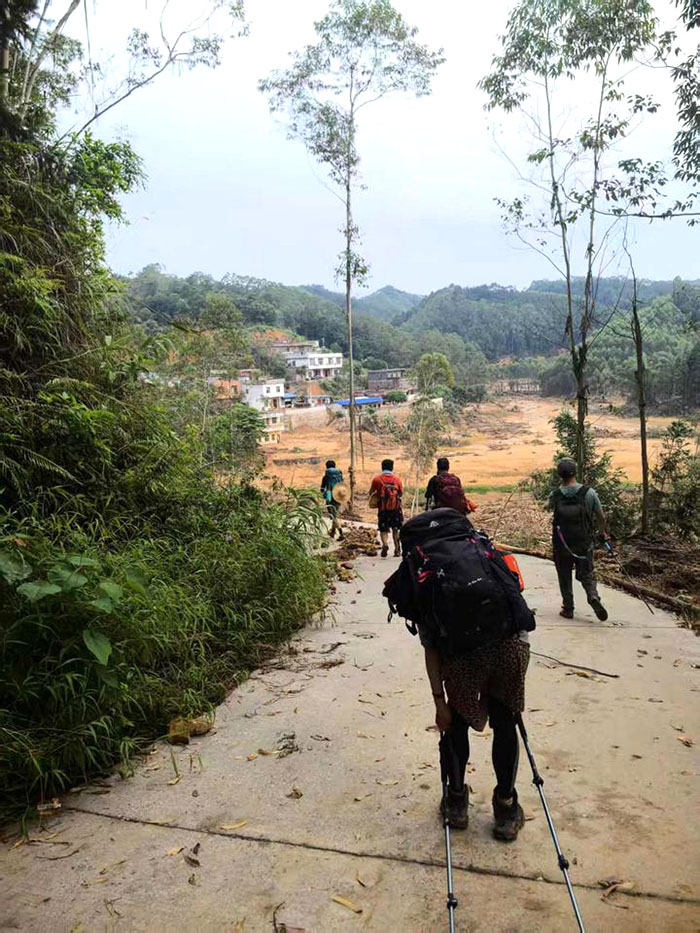
At 5 am on July 14, before dawn had broken, Dang and more than 30 fellow volunteers set out from Wuli to deliver supplies to Heyuan.
A video filmed before their departure shows volunteers loading supplies into Dang's new backpack.
When they thought it was full they said, "We can go now."
Dang adjusted the backpack and motioned for them to add more. After five more cucumbers were packed in, his voice can be heard in the final seconds of the video telling them to add "a little more".
According to Huang, the supplies included cabbage, winter melon, rice, chopsticks, toothbrushes and medicine. Given the humid weather and road conditions, each person carried no more than 15 kilograms.
Guo Xiaolin, captain of the Meishan emergency rescue volunteer association, participated in a nearby relief effort. He told media that the temperature was around 35 C that day. Though there was no direct sunlight, the humid, stuffy air made it hard to breathe. Intermittent rain in the mountains added to the moisture. People were drenched in sweat even standing still.
"The road was badly hit by landslides — muddy and slippery — with many flooded sections where the water reached knee level," Guo said.
Selfies from Dang's phone show him drenched in sweat. Another image shows him and other volunteers lying on the ground resting, with their shoes and legs caked in soil.
The team walked for about six hours, crossing several mountains, before finally reaching the flood-isolated village around noon.
After unloading the supplies and having some porridge prepared by the villagers, the volunteers collapsed on the ground to rest for a while before beginning their return journey. Before leaving, Dang drew a heart in the mud.
It was on the return trek that Dang's condition took a turn for the worse.
According to police reports, when Dang and his companions reached Tangtou village in Sanli town, he suddenly felt dizzy. He rested for a while, but after walking another 300 meters, he fell unconscious. His companions performed CPR while waiting for an ambulance.
Due to severe road damage, the ambulance could not reach him quickly. By the time medical personnel reached him on foot, Dang's pupils were dilated and his heart had stopped.
He could not be revived. The cause of death was listed as heart failure brought on by extreme exhaustion.
Yang Song, a deputy railway station master who accompanied Dang's father to the site, said he learned from fellow volunteers that Dang had felt physically depleted during their trek. His companions urged him to rest, but he insisted on continuing so as not to hold up the group.
Ma said after more than four hours of walking, Dang's body might have already been struggling to cope.
The last message he sent to Ma was: "Someone else is carrying my backpack for me."
Seeing that his friend, who was always the one to help others, now needed assistance himself, Ma asked, "Can't carry it anymore?"
He never received a reply.

A kindhearted kid
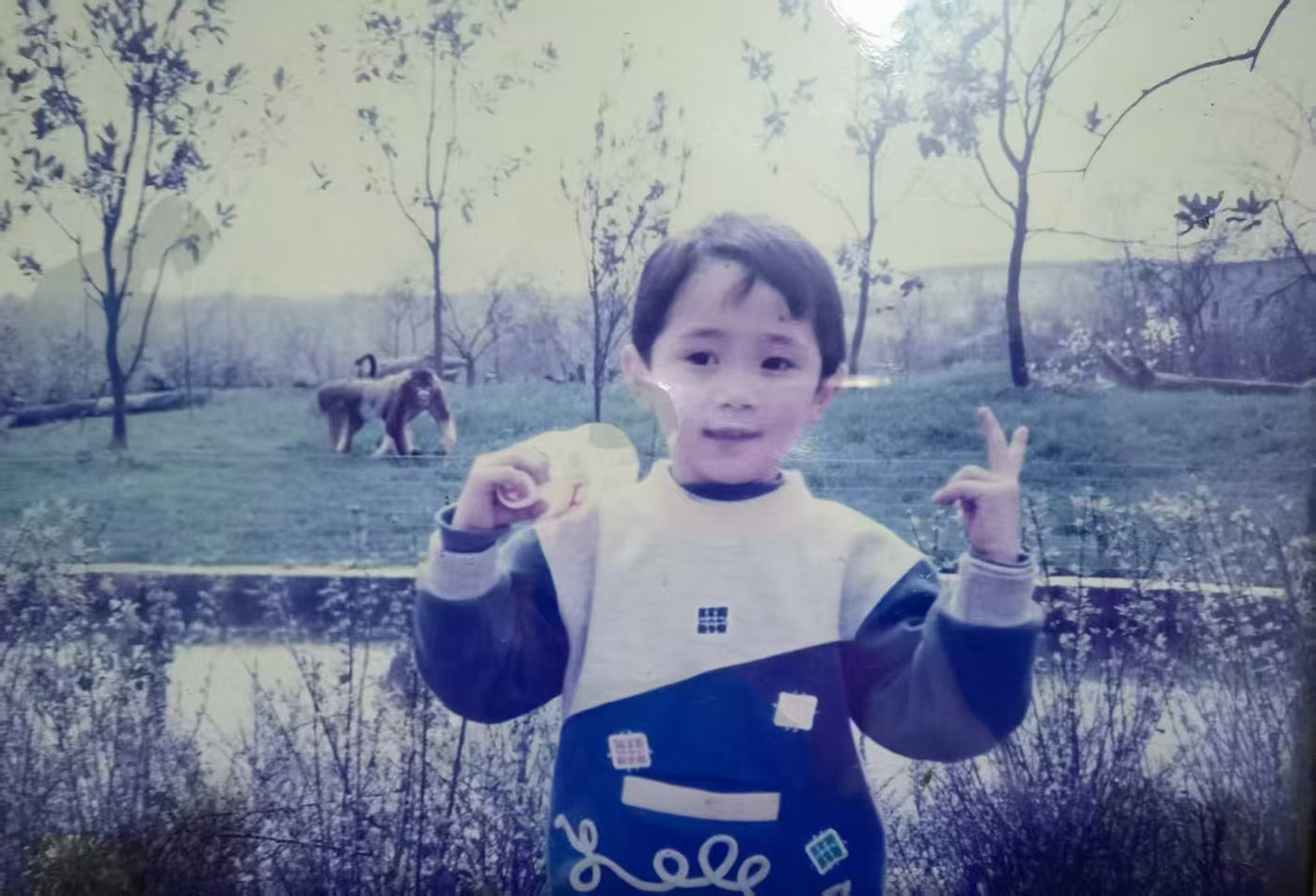
Dang Qing traces his son's empathy back to early childhood.
He remembers the little boy who used to hold his hand while strolling through the market. If they passed an elderly person struggling to walk, the child would go over to help. When buying vegetables, he'd indicate to his father to buy from elderly vendors.
At age 6, Dang chose to buy a turtle over taking a bumper-car ride, saying the old seller by the roadside must be having a hard time.
In his adult life, Dang's compassion extended to animals and public welfare. Only after his death did his family discover from his mobile payment records that he had been spending more than 60 yuan each month on pet insurance for stray cats, along with recurring automatic donations to clean-water charities.
Late on the night of July 14 while at home in Chengdu, Dang Qing received a call from an unfamiliar Guangxi number. The caller said they were from the local police station and told him Dang Xinrui was unreachable, asking the father to come to Guangxi.
With a sense of foreboding, he immediately bought a ticket.
He arrived on July 16. At the funeral home, he saw his son, still wearing the same clothes from the mountain trek, with his pants and shoes caked in mud.
Dang Qing broke down. "Seeing all that mud, I knew just how hard his journey had been," he said.
He had seen news reports about the severe flooding in Guangxi, but it had never crossed his mind that his son would be involved.
If Dang had told him he was going to Guangxi for disaster relief work when they spoke the night before, he would have tried to stop him. Those days marked the peak of the disaster.
After the tragedy, Dang Qing admitted he initially felt a pang of resentment toward his son.
"Resentment that he was too foolish," he explained, falling silent for a long moment.
"But a relative consoled me: 'Your child did something he was passionate about, something good.' Those words helped me shift my perspective," he said quietly, adding with conviction that he is proud of his son.
Local authorities offered to arrange flights back to Chengdu for Dang Qing. He declined.
Instead, he chose to take the high-speed train from Nanning — deliberately selecting the G3438 train that passes through Meishan East Railway Station.
Multiple honors
At the station, part of the Chengdu section of China Railway Chengdu Bureau Group, Dang was known as the "comprehensive controller", the nerve center of the operation.
His job was to receive and verify dispatch orders and oversee high-speed train scheduling instructions. Over eight years, he handled more than 10,000 dispatch orders. Not a single one was incorrect. He received multiple honors from the railway bureau for his dedication.
"He always said dispatching isn't like passenger services, where you can apologize for a mistake. A wrong dispatch order puts trains and people in danger," recalled his friend Ma.
His colleagues said that beneath his burly 1.85-meter frame lay a gentle heart.
Once, when he found a passenger's backpack on the platform containing nearly 5,000 yuan in cash, he contacted the owner to return it.
"He was someone who could always empathize with others," said colleague Yang Fang. "When I learned he cut his vacation short to join the relief effort, I wasn't surprised. That was simply who he was."
On July 26, authorities from Hengzhou in Guangxi officially issued a certificate of heroic conduct for Dang.
The certificate reads: "Comrade Dang Xinrui actively engaged in flood-fighting and disaster-relief efforts, carrying supplies on foot to affected residents, and ultimately sacrificed his precious life in the process."
Ma, who worked alongside Dang for six years until he was transferred to another railway station two years ago, still struggles to accept the loss.
"In my eyes, he has always been towering — not just in stature, but in spirit," Ma said.
The two young men had three other close friends. The five had made a pact: once they all started families, they would travel together with their loved ones.
Before Dang left for his trip, they had planned to meet up after his vacation. That promise was never kept.
But the image endures of a tall young man with a ready smile, adjusting his backpack on a muddy mountain road, motioning for "a little more", before heading into the floodwaters to help people he had never met.
Zhao Junfeng in Chengdu contributed to this story.
Contact the writers at pengchao@chinadaily.com.cn
