

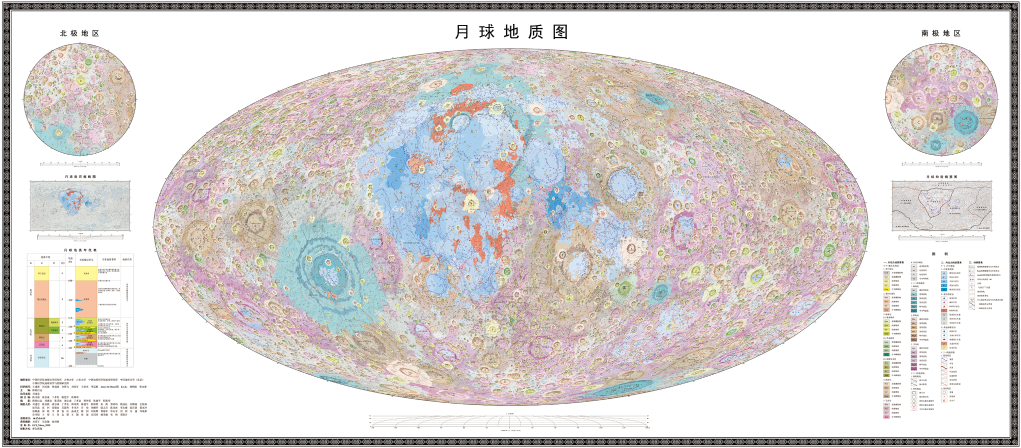
China has completed a 1:5,000,000-scale geological map of the whole Moon, plotting over 13,000 impact craters and 81 impact basins and classifying 14 types of geological structures and 17 types of rocks to provide systematic baseline data for lunar science research and future exploration missions.
The map, drawing on data from the Chang'e lunar exploration program, was compiled by the Institute of Geology of the Chinese Academy of Geological Sciences. The main sheet measures about 280 centimeters long and 120 cm high, supplemented by specific geological maps of the north and south polar regions.
The project refined the lunar geologic timescale by revising the starting age of the Aitkenian period — anchored to the formation of the South Pole-Aitken Basin, the Moon's largest known impact structure — to 4.33 billion years ago, while the Nectarian period starts at 4.17 billion and the Imbrian period at 3.92 billion. It also made the first subdivision of late-stage lunar stratigraphy at a global scale.
ALSO READ: Chinese scientists create new detailed map of moon rocks
The lunar materials inventory was also updated by adopting higher-resolution maps of key mineral distribution on the lunar surface and improving rock classification standards. This was made possible by the lunar samples returned by the Chang'e 4 and Chang'e 6 missions. Using these materials, scientists identified a new rock type — gabbronorite — in the South Pole-Aitken Basin, giving a direct look at material from the Moon's deep interior.
Additionally, a differentiated minimum mapping scale was developed and tailored to different geological feature categories, ensuring the large-format map remains readable while preserving scientifically significant details.
Yang Zhiming, the director of the institute, told Xinhua News Agency that the new map will provide crucial scientific support for China's future lunar research station construction, landing site selection, and deep space exploration, thereby making a new Chinese contribution to exploring the evolution of the solar system.
