

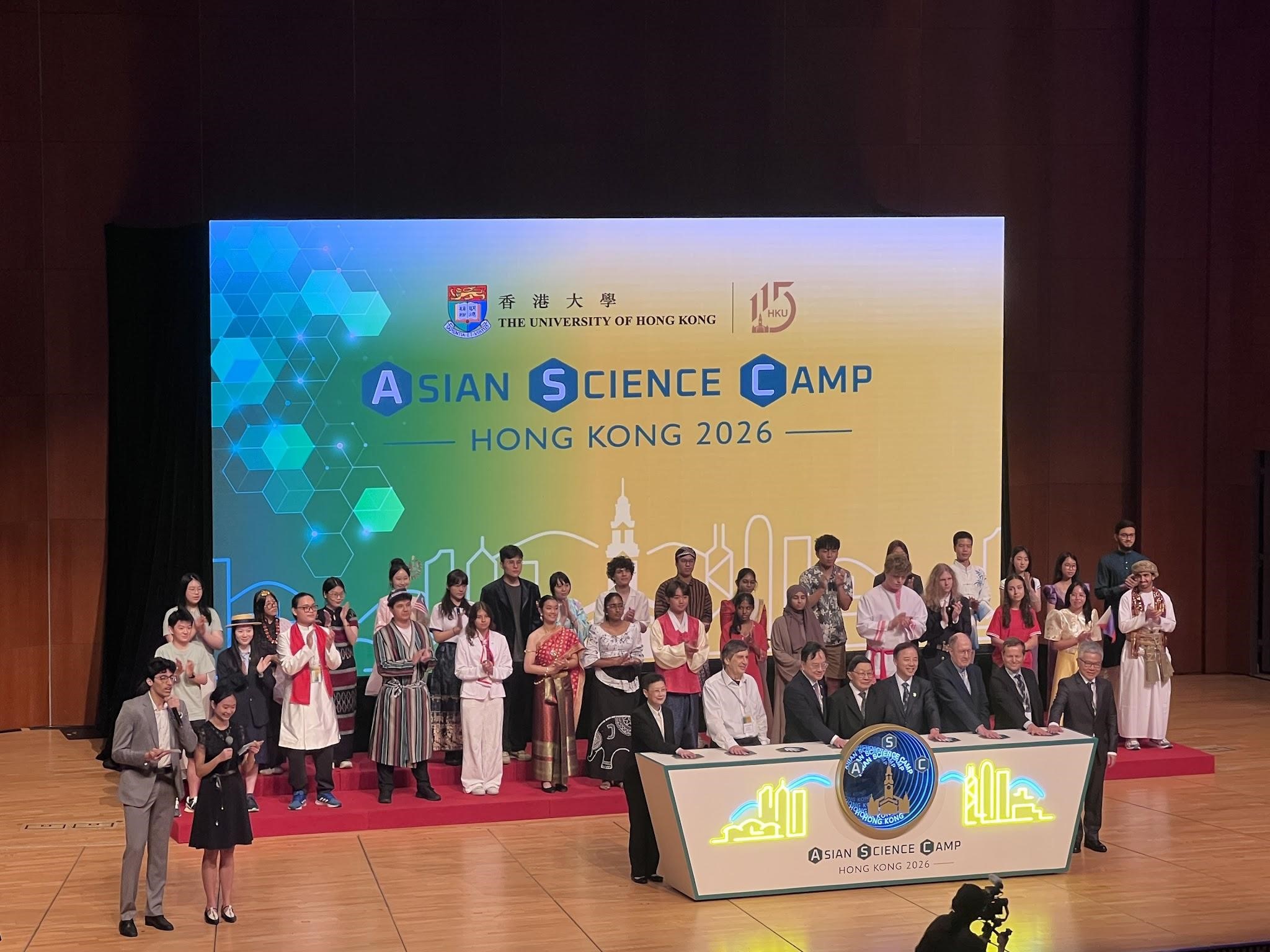
The Asian Science Camp 2026, featuring numerous Nobel laureates, opened at the University of Hong Kong on Monday, marking the first time the prestigious annual forum for young scientists has been held in the Hong Kong Special Administrative Region.
The weeklong event, which runs through Saturday, gathers more than 300 pre-collegiate and university students from nearly 30 countries and regions for plenary lectures, hands-on workshops, and direct engagement with top researchers — opportunities that young attendees described as “hard to believe”.
In his opening address, HKU President Zhang Xiang said science has no borders. He said he hopes students will not only learn from the lectures but also challenge themselves and build friendships.
Citing climate change and geopolitical tensions facing the current generation, Zhang highlighted the need for multidisciplinary solutions, adding that Hong Kong, as an international hub of culture, economics and technology, is determined to pursue collective efforts and welcome global collaboration.
He referred to the rapid pace of change in the world, urging students to treat the information from their lecturers as a starting, and not an endpoint. “If our Nobel laureates tell you, ‘this is the way we did it 20 years ago’, challenge that,” he said.
ALSO READ: Historic double for HK: HKU, CUHK in QS world top 20 for 1st time
A renowned materials physicist, Zhang also called on students to adopt a “look beyond science” attitude, encouraging young prodigies to embrace the humanities and arts.
“Looking beyond science and humanity is very critical,” he said.“Work across boundaries. Bring down the silos. That’s what we need for tomorrow’s science.”
Jay Siegel, vice-president of HKU and a chemistry professor, said the camp is an incredibly important event as it “brings young scientists together, gives them a chance to get to know each other, and builds bonds that will ultimately last a lifetime”.
For the young participants, the camp has already made a lasting impression. Thai students Natnicha Puttarangsee, 19, and Rachaya Dachathornvorapol, 18, found it“pretty exciting and interesting”.
Puttarangsee, a chemistry major, said she was drawn to “the way each scientist thinks about their work and how that leads to something that could change the world”.
Saudi Arabian high school students Faisal Alrubaian and Tameem Khan, both 17, echoed the enthusiasm. Khan said the camp is “super organized” with “a very enthusiastic community”, while Alrubaian added that the experience is about more than just science: “You get to meet people from other cultures, other cities — you can see different mindsets.”
The Asian Science Camp was co-founded by Nobel laureates Yuan Tseh Lee (Chemistry, 1986) and Masatoshi Koshiba (Physics, 2002) and modeled after Lindau Nobel Laureate Meetings.
READ MORE: 'Atomic architect' shares journey from curiosity to Nobel Prize at HKU
This year’s program features lectures and dialogues with Nobel laureates, including Aaron Ciechanover (Chemistry, 2004), Andre Geim (Physics, 2010), Ferenc Krausz (Physics, 2023), and Gregory Paul Winter (Chemistry, 2018). Plenary speakers also include recipients of the Feldberg Prize and the Fields Medal, as well as leading Hong Kong scientists — biologist Dennis Lo Yuk-ming and chemist Vivian Yam Wing-wah.
The young students are inspired by the Nobel laureates they have met. “It’s hard to believe that you’re talking to people who have discovered a one-of-a-kind thing that contributes to the world,” Khan said.
Dachathornvorapol, majoring in medicine, called meeting Nobel laureates “a great opportunity” to “see how they think and develop amazing ideas”.
Siegel also called the event the“seeds of the trees” that will one day form part of Hong Kong’s international talent and higher education hubs — a vision that aligns with the HKSAR government’s goal of transforming the city into a global magnet for both.
Since its first edition in 2007, the forum has been held 16 times, including the 2019 edition in Shantou, Guangdong, the only occasion held on the Chinese mainland.
Contact the writer at stacyshi@chinadailyhk.com
