

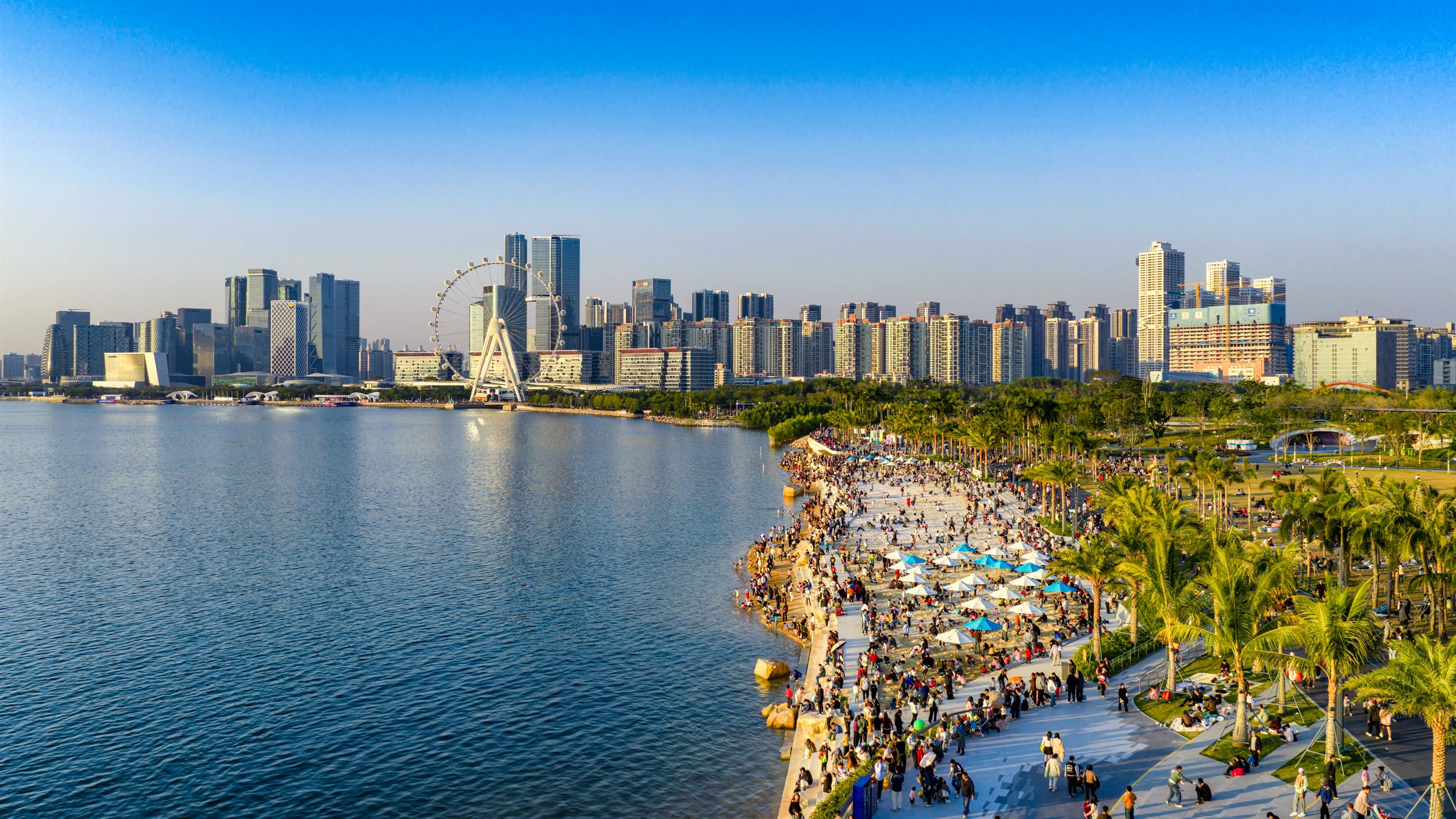
As Shenzhen’s commercial property market undergoes structural adjustment, an increasing number of Grade A office buildings are being partially converted into hotels – a notable trend in the city’s efforts to optimize stock amid high vacancy rates.
Several projects have transformed floors of office space into mid-tier business hotels, including brands such as Atour and Jinjiang, in the first half of 2026. This shift has reduced the leasable office area and helped accelerate destocking, according to international real estate services providers.
“The trend is driven by several factors,” said Carlby Xie, head of southern China research at Savills.
“The vacancy rate for Shenzhen’s Grade A offices remains high and there’s a need for property owners to improve asset efficiency,” he said.
Although Savills’ data shows that the average vacancy rate for top-tier offices in the city fell to 29.3 percent as of the end of second quarter – the first time in nearly two years that the figure dropped below 30 percent – it still represents a high level.
ALSO READ: Central’s Grade-A office rentals see 15-year high in HK market surge
Average rents declined to 130.6 yuan ($19.26) per square meter per month, prompting some property owners to explore alternative uses to make better use of existing space.
Xie also attributed the trend to a rising demand for business accommodation. Shenzhen’s expanding high-tech sectors, including the artificial intelligence, semiconductor and advanced manufacturing industries, have attracted more corporate activities and business travelers. “The growth of these industries has increased demand for mid-range business hotels and provided support for office-to-hotel conversions,” he said.
Policy support, meanwhile, has also played a role in the transformation. Shenzhen introduced the Implementation Measures for Functional Conversion of Existing Non-residential Buildings policy, which took effect on March 26, aimed at revitalizing underutilized space and promoting high-quality urban development.
The policy, which covers various existing non-residential properties, including commercial buildings, offices, hotels, factories and research space, introduces positive-list management and a five-year transition period without additional land premium payments.
The change in property functions in Shenzhen is not limited to office buildings. Joseph Zhong, head of retail consulting at CBRE China, pointed out that the city is also seeing accelerated development in two other types of property transformation – the upgrading of commercial projects and the conversion of industrial to commercial projects.
“These transformations provide new possibilities for existing buildings and help improve the utilization of urban resources,” Zhong said.
READ MORE: HK seen poised to boost SMEs’ digital and intelligent shift
As the development of Shenzhen’s high-tech sectors gains momentum, demand for office space from tech firms continues to increase. According to CBRE data, technology consumer goods companies and technology, media and telecommunications (TMT) enterprises accounted for 39.5 percent of office leasing demand in Shenzhen in the first half of 2026, surpassing finance and professional services for the first time.
Emerging industries are also creating demand for specialized space. With the rapid growth of embodied intelligence and robotics companies, demand for research and testing facilities has increased. However, some older industrial buildings cannot meet high-tech companies’ requirements for advanced infrastructure and customized environments.
“Robotics companies need more suitable space for research, development and testing, while traditional industrial buildings often face limitations in supporting these new requirements,” Ryan Chen, head of industrial leasing at CBRE Shenzhen, said.
Chen Yanshan contributed to this story.
