

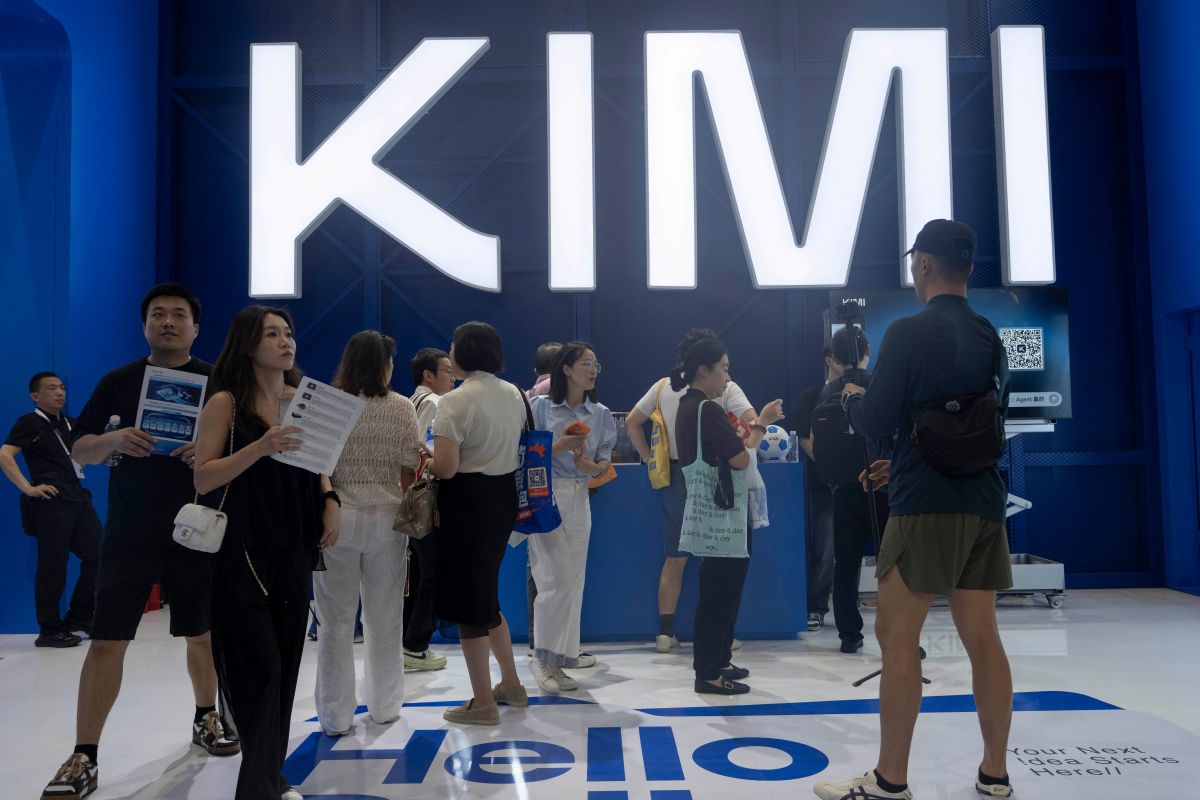
Chinese artificial intelligence startup Moonshot AI's Kimi K3 has put China's foundation-model sector on a faster path to technological and commercial maturity, while leading a new wave of competition in the global AI market, industry experts said.
Released on Friday, Kimi K3 is a 2.8-trillion-parameter model with native vision and a 1-million-token context window, which is designed for frontier intelligence in long-horizon coding, knowledge work and reasoning, rather than simple question answering. Moonshot calls it the world's first open model in the 3-trillion-parameter class and plans to release the full weights by July 27.
Parameter count broadly reflects a model's scale and complexity, while the context window determines how much information it can process in a single session.
Industry benchmark tables have placed K3 among the world's strongest systems. Independent evaluator Artificial Analysis gave K3 an Intelligence Index score of 57, placing it third globally, only behind Anthropic's Claude Fable 5 and OpenAI's GPT-5.6 Sol.
The technological advance has been accompanied by faster commercialization. According to domestic media reports on Monday, Moonshot has distributed a shareholder resolution seeking approval for a Hong Kong listing and could complete an initial public offering within six months.
The news comes as its annual recurring revenue reached $300 million in June, up from $200 million in April, and increased severalfold following the launch of its K3 model, according to the company.
Guo Tao, a member of the Chinese Association for Artificial Intelligence and a senior expert in AI, said a listing by Moonshot would set a clear capital market financing template for China's large-model industry.
He added that a successful Moonshot offering could encourage more Chinese developers to pursue listings and may be followed by increased mergers, acquisitions and strategic investment activity over the next one to two years.
"Global capital will also reassess the growth potential of Chinese AI companies," Guo said, adding that investors would place greater value on developers able to demonstrate stable revenue, paid user conversion and deployment across real-economy scenarios.
K3's pricing further points to a shift in industry economics. Its application programming interface charges 100 yuan ($14.7) per million output tokens, significantly higher than 6 yuan charged by its domestic counterparts DeepSeek V4-Pro and Xiaomi's MiMo-V2.5-Pro, 28 yuan by Z.ai's GLM-5.2 and 36 yuan by Alibaba's Qwen3.7-Max.
"K3's pricing breaks the domestic AI industry's long-running low-price competition and moves it toward a model in which capability determines price," Guo said.
He noted that such sustainable pricing could improve revenue quality, finance computing infrastructure and model upgrades, and gradually narrow the valuation discount between Chinese and US model companies.
Even so, K3 is still priced below leading flagship systems in the United States. It is roughly half the price of GPT-5.6 Sol and about one-third the price of Claude Fable 5.
Kevin Kelly, founding executive editor of the US tech magazine Wired, told China Daily that token costs start to matter as businesses and individuals spend more on AI services.
By offering capable open-source models at competitive prices, Chinese developers could lower the cost of using AI and win wider adoption, Kelly said.
The growing technological sophistication and commercial maturity of Chinese LLMs are also challenging assumptions abroad about a persistent US lead.
Ion Stoica, a computer science professor at the University of California, Berkeley, told Bloomberg that after K3's release, the estimated lag between Chinese open models and the global state of the art may have narrowed from six to nine months to two or three months.
Gavin Baker, managing partner and chief investment officer of Atreides Management, wrote in a post that K3 may be an important "inflection point for AI". Although it may have a potentially negative impact on Anthropic and OpenAI, it is "net positive for essentially every other company in the world", Baker wrote.
Strong demand after K3's release has also provided an early test of that commercial appeal. Moonshot announced on Sunday that since requests had far exceeded forecasts over the previous 48 hours, it had to temporarily pause new consumer subscriptions to prioritize existing members, whose services remained unaffected.
The company said it is adding capacity and would reopen subscriptions in batches. It also plans to separate its main Kimi membership from a Kimi Code plan, tailoring services more closely to general and coding users.
Ma Si contributed to this story.
Contact the writer at lijiaying@chinadaily.com.cn
